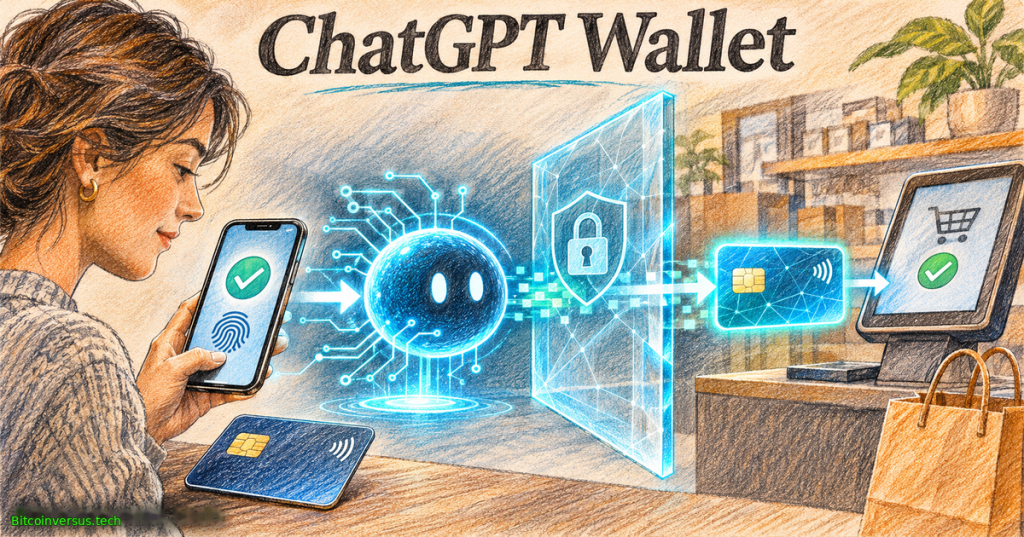
OpenAI launched ChatGPT Wallet on November 13, 2026, allowing its dots AI agents to complete purchases using an eligible saved credit card after a user reviews and approves each transaction. The product combines payment-network tokens with biometric confirmation, keeping the actual card number away from the agent and merchant, according to OpenAI’s launch announcement. Initial access is limited to eligible U.S. ChatGPT Pro users aged 18 or older with supported U.S.-issued cards. The launch moves agentic shopping toward payment, but does not guarantee that retailers will accept an automated checkout.
OpenAI, “The dots demo, take two,” October 1, 2026. An official presentation of the underlying AI-agent system, released before Wallet; not a demonstration of Wallet checkout. Watch directly on YouTube.
How authorization and payment tokens work
An eligible user enrolls a credit card through a secure form, rather than typing card information into chat. When a dot reaches checkout, Wallet displays the merchant, items, total and selected card. Approval requires biometric verification, such as Face ID or Touch ID. A participating payment network then supplies substitute card credentials for the approved transaction. The merchant processes the payment request without receiving the actual card details; the card issuer still determines whether to authorize the charge. Approval is not an order confirmation.
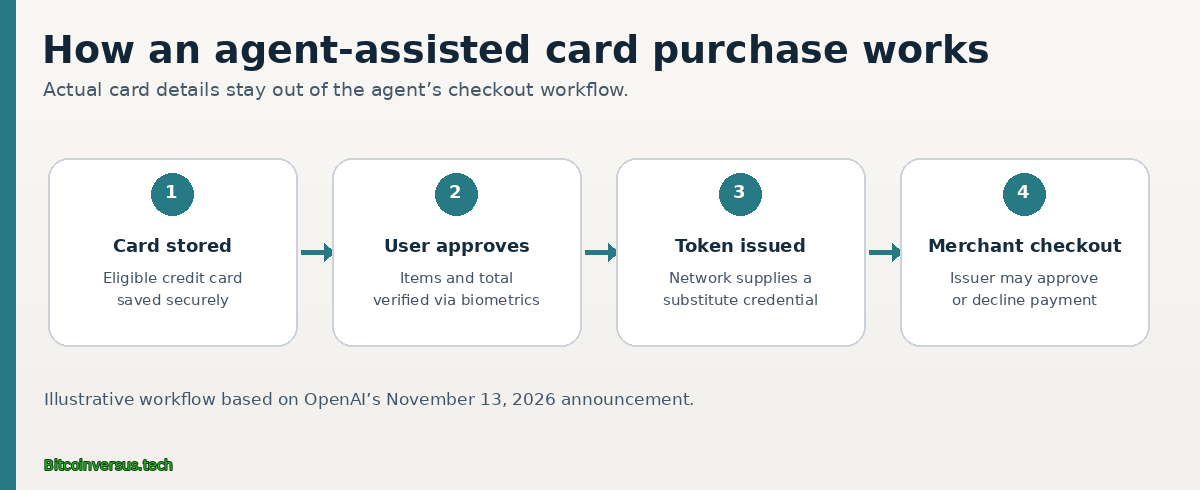
OpenAI says eligible rewards and dispute protections remain attached to the original card. The wallet is not a bank account, stored balance or guarantee against merchant fraud. Under the published Wallet terms, the retailer remains the seller and controls pricing, inventory, fulfillment, returns and refunds. Users should verify the final merchant confirmation before attempting payment again after an unclear result.
Merchant access and fraud screening pose separate barriers
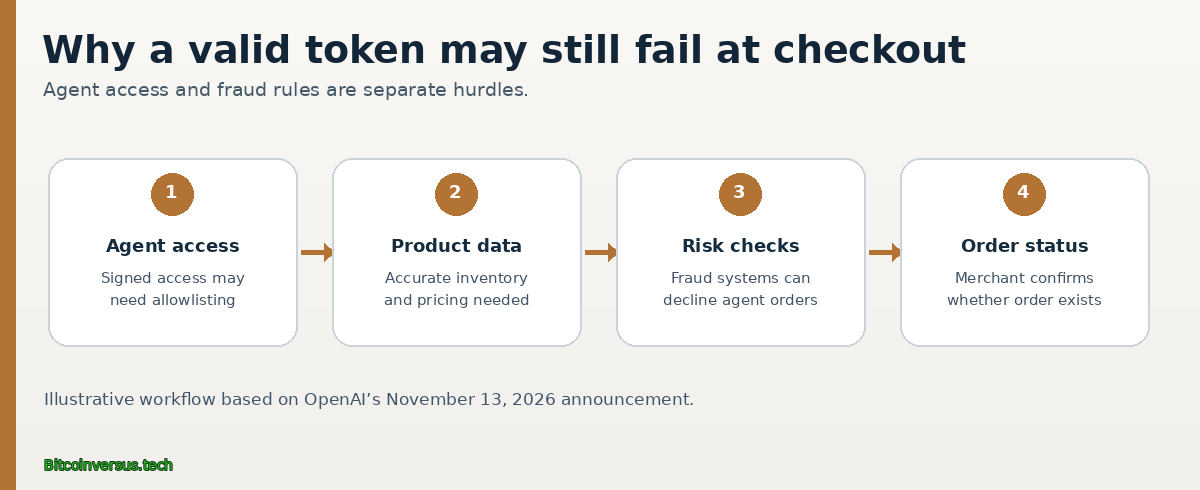
A payment token can work through familiar checkout forms, but an agent may encounter two obstacles. First, anti-bot controls or content-delivery networks can prevent the agent’s browser from reaching a website. OpenAI recommends signed-agent identification through Web Bot Auth. Second, fraud-screening tools may flag legitimate automated purchases as suspicious, causing a declined or canceled order. OpenAI names payment providers, including Stripe, Adyen and Checkout.com, alongside several fraud-prevention firms, as partners working on compatibility. Partnership does not establish universal acceptance.
AI-assisted shopping already has competing approaches. BitcoinVersus.Tech previously covered Newegg’s checkout inside Google Gemini. Wallet instead emphasizes existing card networks and explicit user approval, rather than a single merchant-specific shopping experience. Yet tokenization alone does not settle shipping addresses, taxes, recurring-payment disclosures or retailer restrictions. Elsewhere, OpenAI’s oil-industry forecasting agents illustrate different agent responsibilities without direct card authorization.
Rollout remains narrow, with critical metrics undisclosed
According to OpenAI’s support documentation, Wallet is rolling out gradually through dots and does not support debit cards or user-supplied virtual cards at launch. It cannot be used in ordinary ChatGPT conversations, Work or standalone Codex threads. OpenAI has not published comparable figures for active Wallet customers, completed purchases, fraud rates, payment declines or merchant checkout success. Independent end-to-end measurements were not available at announcement.
OpenAI describes broader autonomous purchasing under preapproved spending limits, categories or time windows as a future capability, not a generally available launch feature. Developer plugins for ChatGPT may give agents more structured access to inventory and carts. Apple’s reported Siri-agent plans indicate competing interest in automation, but do not establish any compatibility with Wallet.
The verified advance is a user-approved purchase mechanism using payment credentials substituted by card networks. Scaling beyond a restricted rollout will depend on merchant participation, fraud controls, consumer trust and reliable records for orders, refunds and disputes.
Reporting sources: OpenAI product announcement, November 13, 2026; OpenAI Wallet purchase guidance; Wallet terms, effective November 12; Reuters launch coverage, November 13. Company statements about product function and partnerships have not been independently verified through live purchases.
Editor’s Note: Reporting distinguishes the released Wallet approval and tokenization workflow from future plans for preauthorized agent spending. The illustrated featured cover and two workflow diagrams are editorial concepts, not real OpenAI screens, payment logs or merchant checkout tests. The embedded October 1 OpenAI video describes dots, not Wallet. Checkout reliability, mobile layout and video playback have not been independently measured at publication.

BitcoinVersus.Tech is volunteer-run. To support independent research, scan the original QR code from another screen with a compatible Bitcoin wallet. On a phone displaying the QR, use a wallet image-import feature if available. Verify the recipient address 3C9o19EH5HSiwEPyCTmEKzxhNCbo2X6TTb and the optional 5,000-satoshi amount before sending; Bitcoin payments are generally irreversible.
We volunteer daily to ensure information on BitcoinVersus.Tech is Verifiably True. Reporting is educational and informational, not individualized technical, financial or investment advice.


Leave a Reply