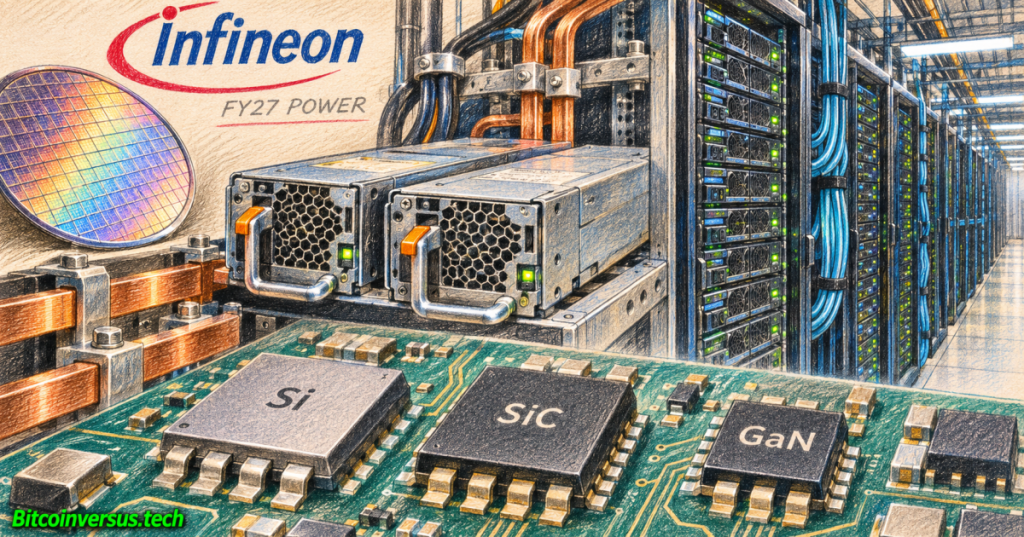
German chipmaker Infineon Technologies expects revenue from data-center power supplies to approach €4 billion in fiscal 2027, up from approximately €2.2 billion reported for fiscal 2026. The outlook, published November 10, points to rapid growth in power-semiconductor content as AI computing systems demand denser, more sophisticated electrical infrastructure.
Infineon reported €16.353 billion in group revenue for the fiscal year ended September 30, 2026, a 12% annual increase. Fourth-quarter revenue reached €4.706 billion, with a 23.8% segment-result margin. Management forecasts approximately €20 billion in fiscal 2027 group revenue, more than 20% growth. The future amounts remain company guidance rather than realized sales.
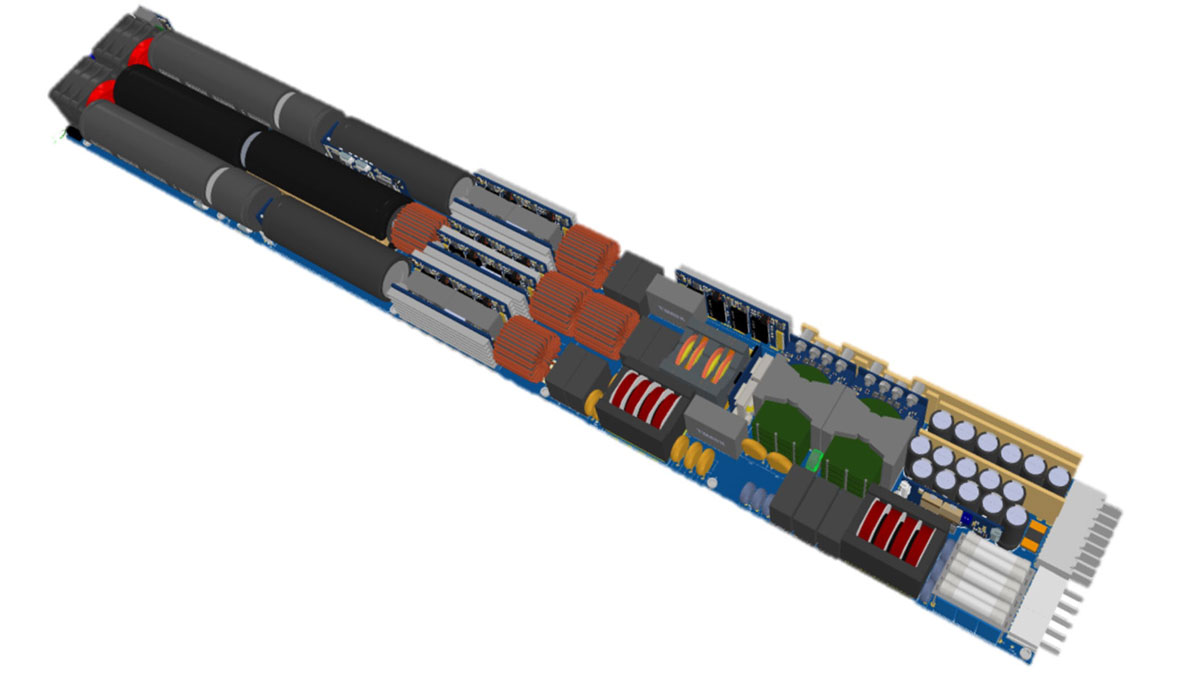
Infineon Technologies explains an 8 kW high-efficiency server power-supply reference design. Official manufacturer video, June 2025; engineering background, not footage of the November 2026 earnings announcement.
Reported revenue versus the new forecast
Infineon’s November investor presentation separates fiscal 2026 data-center revenue into €1.7 billion from AI infrastructure and €0.5 billion from traditional data centers. Combined, the two businesses generated €2.2 billion, or approximately 13.5% of the company’s annual revenue. The close-to-€4-billion forecast for fiscal 2027 also includes traditional data-center power sales.
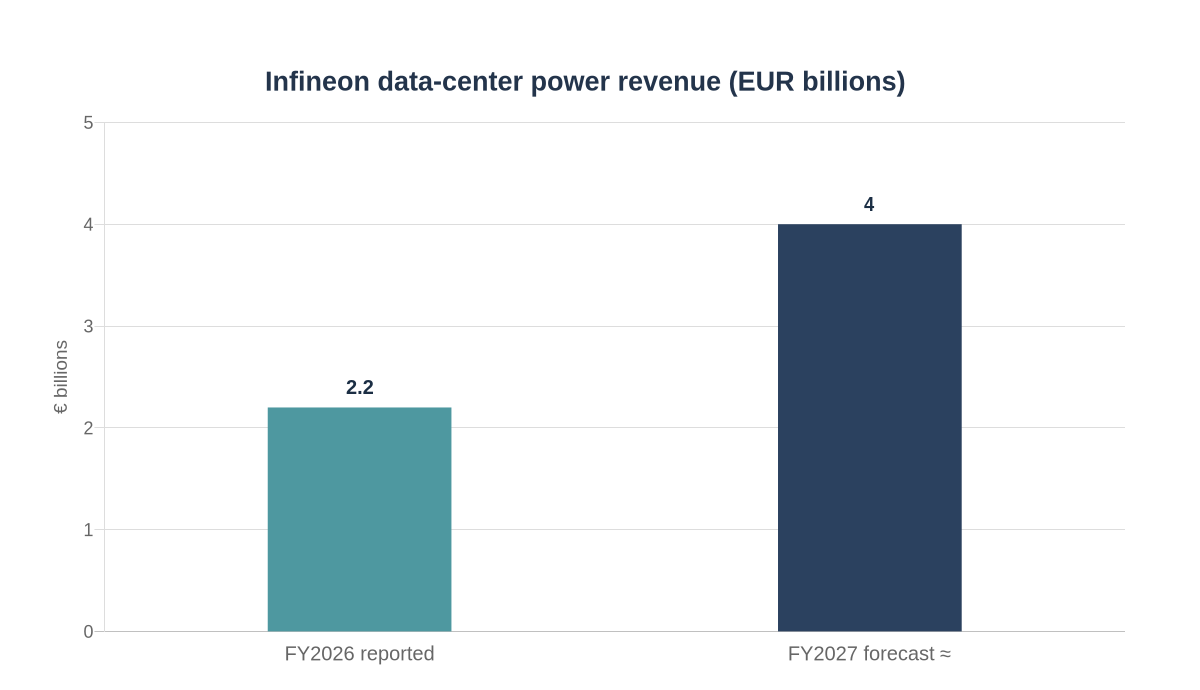
If sales reached exactly €4 billion, growth from the 2026 baseline would equal 81.8%, calculated as (€4.0 billion ÷ €2.2 billion − 1) × 100. Because Infineon said close to €4 billion, the percentage is an illustrative benchmark, not precise corporate guidance. The business would represent roughly one-fifth of forecast group revenue at those rounded values.
Why power chips are becoming a larger AI expense
Graphics accelerators perform computation, but switching transistors, rectifiers, voltage regulators and control electronics determine how electricity reaches processors. Infineon sells silicon, silicon-carbide (SiC) and gallium-nitride (GaN) components across stages ranging from incoming AC conversion to processor-level regulation. The company estimates average AI power-semiconductor content near $175 per kilowatt, with applications ranging roughly $100–$250 per kilowatt. The figure describes its semiconductor content opportunity, not utility electricity prices or installed server cost.
Electrical distribution at 800 volts DC can carry equivalent power at lower current than low-voltage DC distribution, potentially reducing resistive loss and copper requirements. Engineering trade-offs include insulation, arc management, fault interruption and converter efficiency. BitcoinVersus.Tech previously examined Infineon’s 800 V power collaboration with SOLUM and a 27 kW server PSU design. Neither example establishes industry-wide deployment of 800 V architectures.
Infineon’s 300 mm silicon-carbide wafer work and planned gallium-nitride manufacturing expansion are relevant supply-side developments. Capacity still requires fabrication, packaging, qualification and customer adoption before increasing delivered chip volumes.
Official Infineon COMPUTEX 2026 keynote, published July 7, covering semiconductor materials, data-center power paths and emerging high-voltage architecture. Corporate presentation predating fiscal 2026 earnings; technical commentary and product plans are not independent performance validation.
Manufacturing constraints remain material
Management describes fiscal 2027 data-center growth as supply-limited, making ramp-up at its Dresden Smart Power Fab and external manufacturing partners important execution tests. Infineon projects €3.0 billion–€3.5 billion in total annual investment, while the group targets an overall segment-result margin in the mid-20% range, up from 19.7% in fiscal 2026.
Earlier Vertiv–Infineon supply arrangements demonstrate customer demand for specialized power devices. However, agreement announcements, capacity reservations and development samples should not be added to recognized revenue. Data-center construction delays, customer spending changes, manufacturing yield, pricing and foreign-exchange movements could all affect the outlook.
The new forecast suggests that AI infrastructure investment increasingly benefits suppliers beyond GPU manufacturers. Infineon’s opportunity rests on converting growing electrical power requirements into qualified semiconductor shipments. Its fiscal 2027 forecast will ultimately be judged against revenue actually recognized, hardware delivered and margins earned.
Primary sources and calculations: Infineon Q4 and FY2026 results, November 10; FY2026 investor presentation, slide 37; analyst-call introductory statement; 18 kW and 30 kW PSU reference-design announcement, June 2; Reuters earnings coverage, November 10. Calculation: €2.2bn ÷ €16.353bn = 13.45%; €4.0bn ÷ €20bn = 20.0%; (€4.0bn − €2.2bn) ÷ €2.2bn = 81.82%, using rounded outlook values.
Editor’s Note: Reported fiscal 2026 sales and management’s fiscal 2027 projections are different evidence classes. The close-to-€4-billion forecast includes both AI and traditional data-center power business. The chart shows a rounded illustrative endpoint, not a promised sales total. Manufacturer video demonstrations and an 18 kW reference-design rendering document power-electronics technology, not November earnings or confirmed customer installations. Original colored-pencil cover art is conceptual and depicts no identified Infineon facility. The cover measures 1200 × 630 pixels. Embedded video playback and mobile presentation still require independent live-device testing.

BitcoinVersus.Tech is volunteer-run and publishes independent educational technology reporting. An optional 5,000-satoshi donation supports research. Scan the QR from a second screen using a compatible Bitcoin wallet; on mobile, save the QR image and scan it with a compatible wallet. Independently verify the address 3C9o19EH5HSiwEPyCTmEKzxhNCbo2X6TTb and the amount before sending. Bitcoin payments are generally irreversible.
We volunteer daily to ensure information on the BitcoinVersus.Tech platform is Verifiably True. Coverage is for educational and informational purposes and is not financial or investment advice.


Leave a Reply