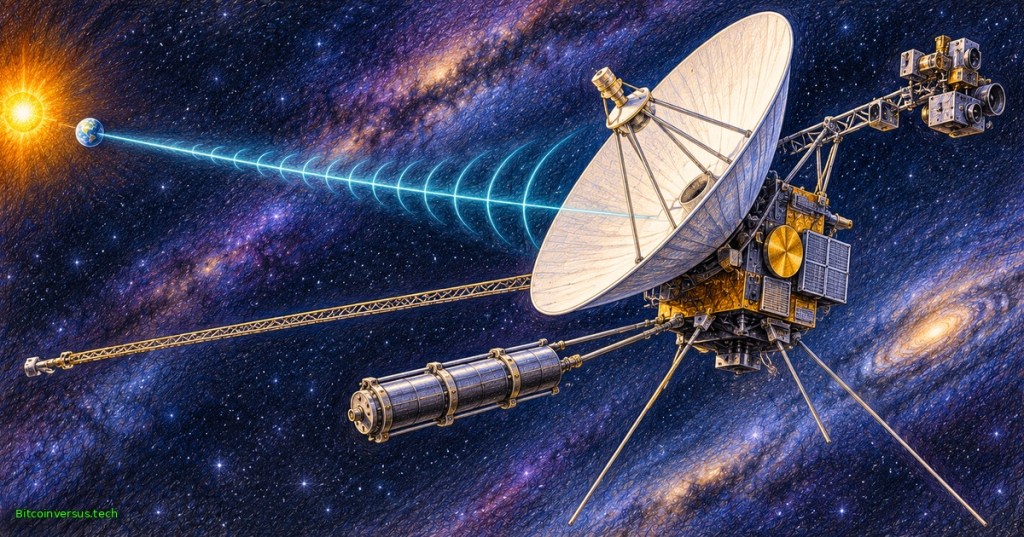
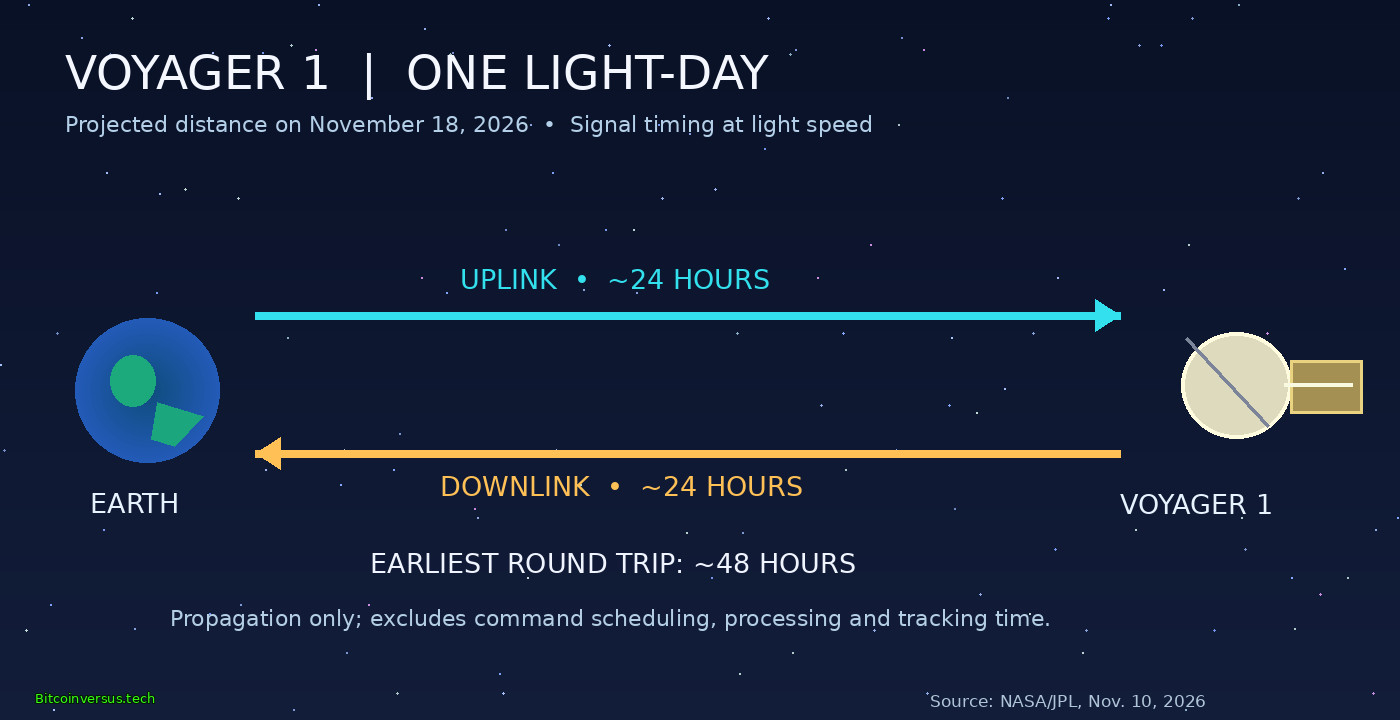
NASA expects Voyager 1 to reach a distance of one light-day from Earth on November 18, 2026, a separation of approximately 16.094 billion miles (25.902 billion kilometers). At that range, a command sent at light speed needs about 24 hours to arrive, and the first possible radio reply needs another 24 hours to return. The milestone is scheduled for 2:16 a.m. Pacific, according to NASA’s mission tracker. As of November 14, the milestone remains ahead.
NASA Jet Propulsion Laboratory, “Fixing Voyager: How NASA Restored Communications with Voyager 1,” November 21, 2024. Official archival discussion of the spacecraft’s engineering and communication challenges; not footage of the upcoming November 2026 milestone. Watch on YouTube.
A light-day measures distance, not spacecraft speed
The definition is straightforward: light travels 299,792.458 kilometers per second in a vacuum. Multiplying by 86,400 seconds per day yields 25,902,068,371 kilometers, or about 25.902 billion kilometers. Radio signals move at approximately the same speed through space. Nothing physically changes aboard Voyager when its Earth-distance crosses the one-light-day threshold; the figure describes communication delay, not a new propulsion capability.
Voyager 1 launched September 5, 1977, and crossed the heliopause into interstellar space in 2012. The twin probes are among the earliest examples of durable electronics flown beyond Earth. Even with advanced ground antennas, commands cannot bypass the speed-of-light limit.
October communication loss highlights the difficulty
A NASA/JPL update issued October 29 disclosed that Voyager 1’s signal disappeared during scheduled tracking on October 18 and 19 and returned on October 20. Engineers determined that one thruster group had switched off and backups had activated; the cause remained under investigation. The team also reported a September power-saving swap involving three spacecraft devices and three lower-power replacements. Radioisotope power generation diminishes by roughly 4 watts annually, constraining the remaining scientific experiments.
NASA’s Deep Space Network relies on large radio dishes distributed around Earth. Unlike electronically steered phased-array antennas, the network’s enormous dishes are mechanically pointed at distant targets. Its operations also differ from near-Earth relay services, including the Viasat satellite-relay demonstration, because Voyager commands cross billions of kilometers before reaching their target. A temporary missing signal cannot be diagnosed instantly when a test command itself takes a day to arrive.
NASA Jet Propulsion Laboratory, “Voyagers’ Mission to the Outer Solar System” (1977 archival film, released November 21, 2024). Includes early Deep Space Network antennas, mission control and historical spacecraft visuals; not current spacecraft footage. Watch on YouTube.
Two instruments remain active
NASA’s latest instrument-status table lists Voyager 1’s magnetometer and plasma wave subsystem as operational. Other instruments have been disabled because of power limits, wear or completed planetary objectives. The broader engineering challenge is to sustain scientific measurements without regular hands-on repair. Newer exploratory spacecraft such as NASA’s ESCAPADE Mars probes likewise depend on distant navigation and ground communication, though their trajectories and light-time delays differ.
The one-light-day event is a predicted position, not a completed maneuver or proof of spacecraft health. NASA has scheduled public activities November 17 and a mission discussion November 19. The enduring achievement is a 1970s spacecraft still sending select interstellar measurements as engineers work within steadily shrinking power margins and unavoidable radio delays.
Primary sources and calculations: NASA November 10 advisory, updated November 13; NASA/JPL Voyager mission tracker; NASA/JPL October 29 engineering update; NASA Voyager mission history. 299,792.458 km/s × 86,400 s = 25,902,068,371 km. One-way and round-trip delays are propagation estimates, not guaranteed command turnaround times.
Editor’s Note: Reporting uses dated NASA primary sources and original distance arithmetic. The November 18 milestone is prospective as of publication. Featured artwork and the in-story timing diagram are conceptual illustrations, not spacecraft photographs or measured telemetry. Both YouTube videos are verified NASA/JPL archival presentations. Playback and mobile rendering require separate testing; no spacecraft signal or communications equipment was tested by the publication.

BitcoinVersus.Tech is volunteer-run. To support independent research, scan the original QR code from another screen with a compatible Bitcoin wallet. On a phone displaying the QR, use a wallet image-import feature if available. Verify the recipient address 3C9o19EH5HSiwEPyCTmEKzxhNCbo2X6TTb and the optional 5,000-satoshi amount before sending; Bitcoin payments are generally irreversible.
We volunteer daily to ensure information on BitcoinVersus.Tech is Verifiably True. Reporting is educational and informational, not individualized technical, financial or investment advice.


Leave a Reply