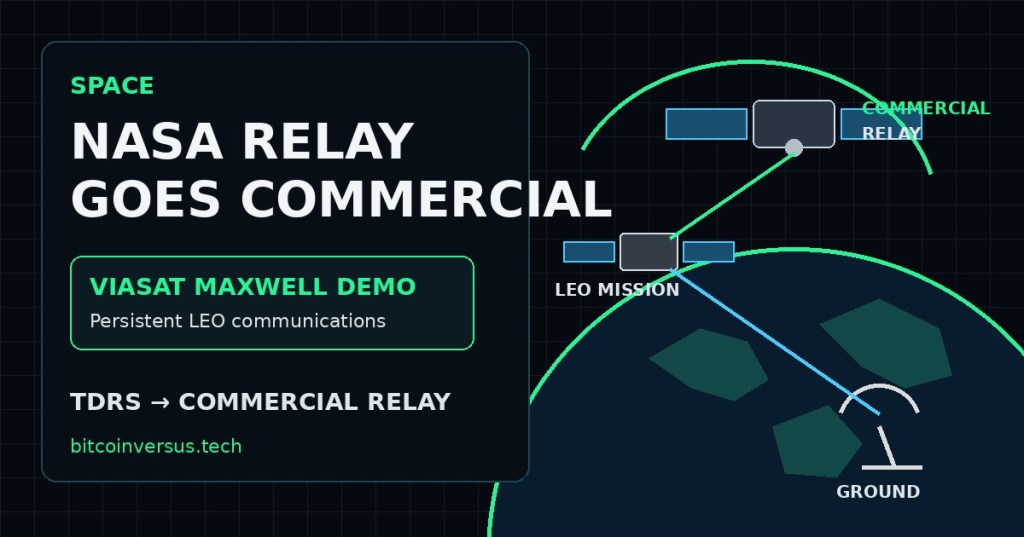
NASA’s next generation of near-Earth communications may look less like a government-owned relay network and more like a commercial service that spacecraft can roam onto when they need bandwidth. Viasat is preparing to test exactly that idea with its Maxwell demonstration satellite.
According to Aerospace America’s October 5 report, Maxwell has been integrated for SpaceX’s upcoming Bandwagon-5 mission. The spacecraft was built and will be operated by Rocket Lab, while Viasat will use it to demonstrate an end-to-end commercial relay service intended to show how future low-Earth-orbit missions could communicate without depending on NASA’s aging Tracking and Data Relay Satellite network.
TDRS has been NASA’s orbital data backbone since 1983
The Tracking and Data Relay Satellite system changed how NASA talked to spacecraft by placing communications relays in geosynchronous orbit. Instead of waiting for a low-Earth-orbit spacecraft to pass over a ground station, a mission could send data upward to a relay satellite and then back down to mission control.
That architecture helped make near-continuous communications practical for missions including the International Space Station, Hubble and Earth-observation spacecraft. But NASA stopped assigning new missions to TDRS in 2024 and is now shifting toward commercial relay services rather than building a replacement fleet itself.
Maxwell is testing the “spacecraft roaming” model
The Maxwell demonstration is designed around a different operating model: spacecraft buy relay connectivity as a service. Viasat says the goal is to move away from rigid communication windows and toward persistent connectivity, reducing the short dropouts that can occur when a spacecraft transitions between relay coverage zones.
NASA’s Communications Services Project has awarded $278.5 million across six U.S. companies to develop and demonstrate commercial relay capabilities. Viasat received $53.3 million, while other participants include SpaceX, Amazon’s Kuiper, SES Space & Defense and Telesat.
This is closely related to the wider shift toward distributed low-Earth-orbit communications infrastructure. BitcoinVersus.Tech recently covered Nokia and ICEYE’s sovereign LEO satellite network plans, where the value comes from treating space communications as a scalable network rather than a small number of isolated spacecraft.
Commercial relay could become another layer of space infrastructure
The most important part of Maxwell is not the satellite itself. It is the service model behind it. If NASA science missions can purchase relay bandwidth from multiple commercial providers, future spacecraft could gain more redundancy and more flexible routing while NASA spends less capital building dedicated relay satellites.
That also creates a new infrastructure market around high-rate space networking. We have already seen the hardware side of that transition in Filtronic’s $68.1 million SpaceX order for Starlink GaN E-band amplifiers, where radio-frequency components become critical pieces of a global satellite data network.
NASA wants commercial services in place for the 2030s
NASA’s target is broader than one Viasat spacecraft. The agency is building a market in which multiple commercial providers can offer relay, telemetry, tracking and high-rate data services to government and private missions. NASA has said future science missions beginning around 2031 are expected to rely on commercial satellite relay services instead of new TDRS assignments.
The result could resemble terrestrial telecom more than traditional mission operations. A spacecraft would still need compatible terminals and careful flight-certified networking, but the network itself would become an external service that can evolve independently of the mission using it.
That same commercial logic is showing up in other satellite markets. BitcoinVersus.Tech previously covered a $50 million satellite-network preorder in the Philippines, another example of orbital connectivity moving from specialized government infrastructure toward contracted network capacity.
The transition risk is continuity
The hard part will be changing networks without breaking missions that were designed around TDRS. Some spacecraft already in orbit cannot simply swap communications hardware, so NASA must maintain legacy compatibility while validating commercial alternatives. That makes the next few years less of a clean replacement and more of a migration period.
If Maxwell works as intended, the demonstration will help answer a basic question for the post-TDRS era: can NASA buy reliable, persistent orbital communications the same way organizations on Earth buy network services? The answer will shape how science missions, commercial spacecraft and eventually lunar systems are connected in the 2030s.
BitcoinVersus.Tech
Advertisement
Editor’s Note
We volunteer daily to ensure the credibility of the information on this platform is Verifiably True. If you would like to support to help further secure the integrity of our research initiatives, please donate here: 3C9o19EH5HSiwEPyCTmEKzxhNCbo2X6TTb
BitcoinVersus.tech is not a financial advisor. This media platform reports on financial subjects purely for informational purposes.


Leave a Reply