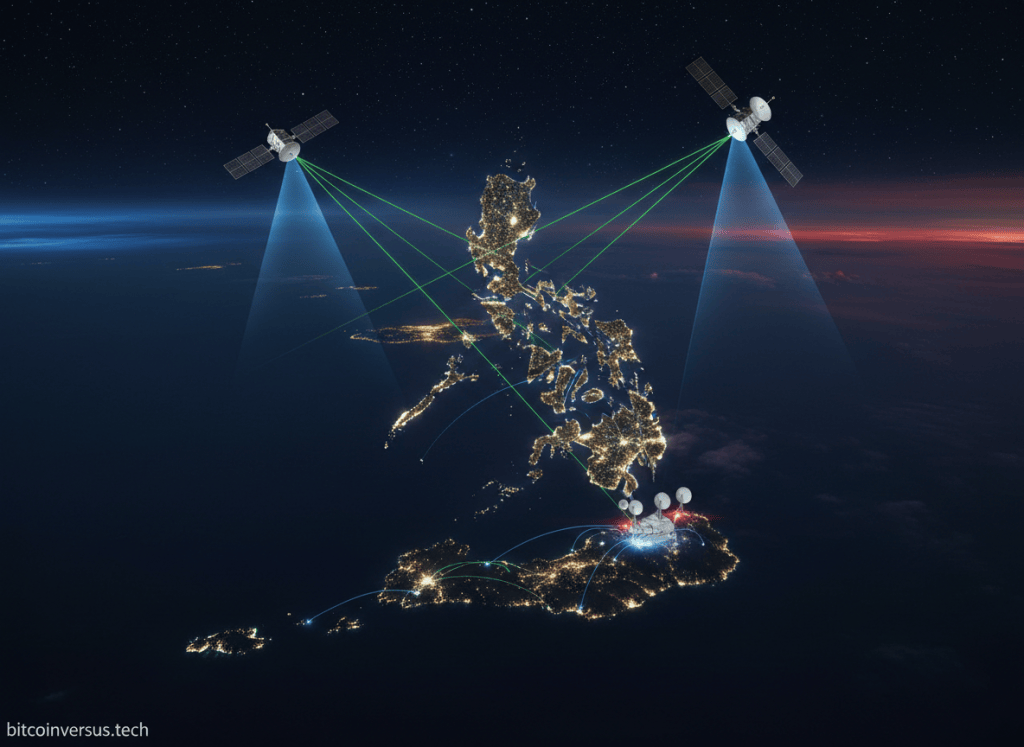
Space Network has signed a binding Philippine satellite-connectivity pre-order worth about ₿599 ($50 million), giving its planned Freeport low-Earth-orbit network a second major commercial commitment before full service begins.
Using an October 1 reference of 1 BTC (about $83,448), the Philippine agreement is worth roughly ₿599 ($50 million). Spacecoin disclosed the deal in a September 29 post, saying HQ Company International Holdings will use Freeport capacity to build satellite communications services across the Philippines.
The agreement pushes Space Network’s disclosed commercial pre-orders to about ₿1,798 ($150 million), including an earlier Vietnam commitment. That does not mean the full amount has been recognized as revenue: Freeport is still a planned network buildout and commercial services are targeted for later deployment.
The Philippines deal is really a network-infrastructure contract
Space Network describes its platform as a decentralized low-Earth-orbit connectivity layer designed to extend secure data links into underserved regions. Under the Philippine agreement, Space Network says it will provide network access, technical hardware, proprietary software and ongoing engineering support.
HQ Company is expected to handle the local commercial side: customer acquisition, spectrum authorizations, sales and regional service execution. That split matters because the satellite operator does not have to build every national retail operation itself.
SpaceNews independently reported that the binding pre-order comes from a Philippine renewable-infrastructure developer seeking capacity from Space Network’s planned independently owned broadband-satellite network.
Freeport is being built as shared satellite infrastructure
Space Network’s model differs from a vertically integrated constellation in one important way: the company says independently owned satellites and ground stations will eventually be able to join the network and carry traffic for one another.
The company says Freeport currently operates four low-Earth-orbit satellites and is targeting a constellation of roughly 230 spacecraft by 2029. Optical inter-satellite links are intended to move traffic across orbit, while Ka-band connections bring data down to customers and ground infrastructure.
That is a different architecture from simply selling access to one operator’s closed constellation. The network is designed more like shared communications infrastructure in orbit, with local telecom providers buying capacity and building their own services on top.
BitcoinVersus.tech recently covered Starlink V3 deployment hardware, where the competing model is tightly integrated: one company controls spacecraft, launches, network software and end-user service.
Software determines how independently owned nodes cooperate
Space Network says every Freeport node will run the same software stack. SOLAR handles routing, LUMEN records delivered traffic for settlement, PHOTON handles private payments using zero-knowledge cryptography, and SPONTE is intended to let spacecraft from different manufacturers join the network.
The technical goal is to let separate operators relay one another’s data without relying on a single centralized owner for every satellite, ground station and billing relationship.
That model will still have to prove interoperability in practice. Spacecraft from different owners must maintain compatible communications, routing, security and operations standards while meeting national spectrum and telecom rules on the ground.
The hardware challenge starts before commercial service
A pre-order does not eliminate the physical deployment risk. Hundreds of satellites have to be manufactured, launched, commissioned and maintained. Ground terminals and network infrastructure must also reach enough locations to make local services useful.
BitcoinVersus.tech’s coverage of Rocket Lab’s StriX satellite launch program illustrates the operational side of constellation building: deployment cadence, repeat launches and satellite production capacity can become just as important as the network software.
Space Network’s ₿599 ($50 million) Philippine commitment therefore functions as a commercial signal before the full infrastructure exists. The value is meaningful because a local operator is reserving future network capacity, but the long-term outcome depends on whether Freeport reaches its targeted scale.
Why an archipelago is a natural test market
The Philippines is geographically difficult for terrestrial communications because communities are spread across thousands of islands. Fiber, towers and microwave backhaul remain essential, but satellite links can extend coverage to places where terrestrial construction is expensive or slow.
Freeport is targeting that gap as complementary infrastructure rather than as a complete replacement for terrestrial networks. Satellite backhaul can connect remote facilities or communities to a local operator that still manages customer relationships, service plans and national regulatory obligations.
Satellite broadband competition is broadening
The satellite-connectivity market is no longer only about launch capability. Companies increasingly compete on terminals, routing software, optical crosslinks, spectrum access, constellation economics and how much control local operators retain.
BitcoinVersus.tech previously examined the growing field of companies challenging SpaceX across launch and space infrastructure. Space Network adds another variation: an attempt to make orbital connectivity itself more open to independent infrastructure owners and national service providers.
The next milestone is deployment, not another pre-order
Space Network now has about ₿1,798 ($150 million) in disclosed commercial pre-orders, but the important next test is whether those commitments turn into functioning regional networks as the constellation expands.
The Philippine agreement provides a concrete market and a local operating partner. The harder engineering work remains ahead: scale the constellation, make optical and Ka-band links reliable, integrate independently owned infrastructure, and deliver enough capacity that local operators can build services customers will actually use.
BitcoinVersus.Tech
Advertisement
BitcoinVersus.Tech Editor’s Note:
We volunteer daily to ensure the credibility of the information on this platform is Verifiably True. If you would like to support to help further secure the integrity of our research initiatives, please donate here: 3C9o19EH5HSiwEPyCTmEKzxhNCbo2X6TTb
BitcoinVersus.tech is not a financial advisor. This media platform reports on financial subjects purely for informational purposes.


Leave a Reply