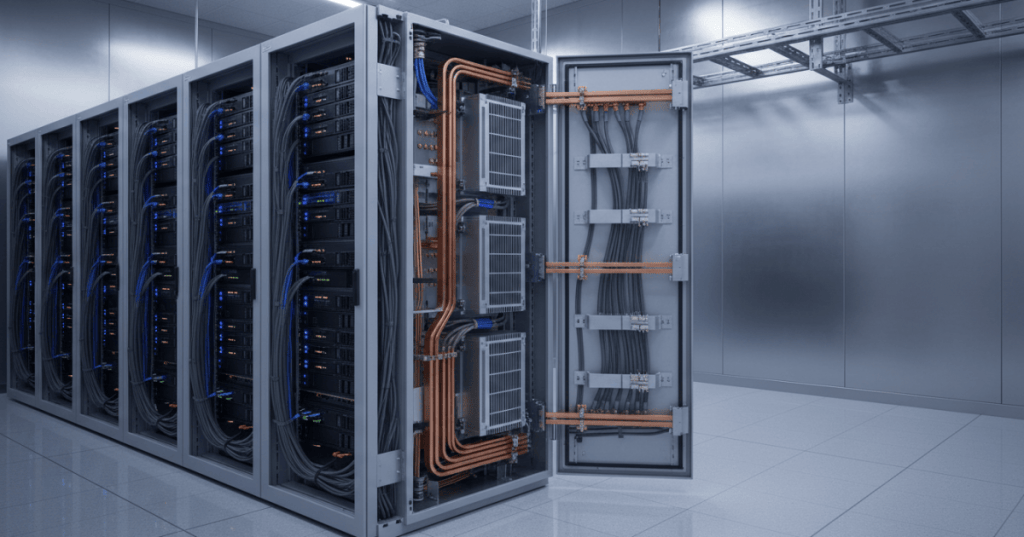
Infineon Technologies and South Korea’s SOLUM signed an agreement on November 5, 2026 to advance high-voltage direct-current power systems for artificial intelligence data centers. The memorandum of understanding covers intermediate bus converters, battery backup units and power supply units. SOLUM also disclosed development of a 26-kilowatt converter for an 800-volt DC rack architecture, with mass production targeted for 2027.
The announcement comes as higher-density AI accelerators increase electrical distribution and backup requirements. Conventional server rooms perform multiple power-conversion steps between utility service and chip-level voltage rails. Higher-voltage DC distribution can reduce current for a given power transfer, potentially lowering conductor losses and simplifying portions of the conversion chain, although efficiency depends on the full architecture.
Infineon Technologies explains its earlier 8 kW AI-server power-supply reference design. The 2025 video provides technical background, not a demonstration of SOLUM’s new 26 kW converter. Credit: Infineon Technologies / YouTube.
What the 800-Volt Collaboration Actually Covers
Under the agreement, Infineon will contribute semiconductor expertise, reference designs and early-stage engineering support. SOLUM will apply its server-power manufacturing experience to commercial development. Infineon identifies silicon, silicon carbide and gallium nitride as available device technologies, but has not announced a complete, commercially installed rack system from the partnership.
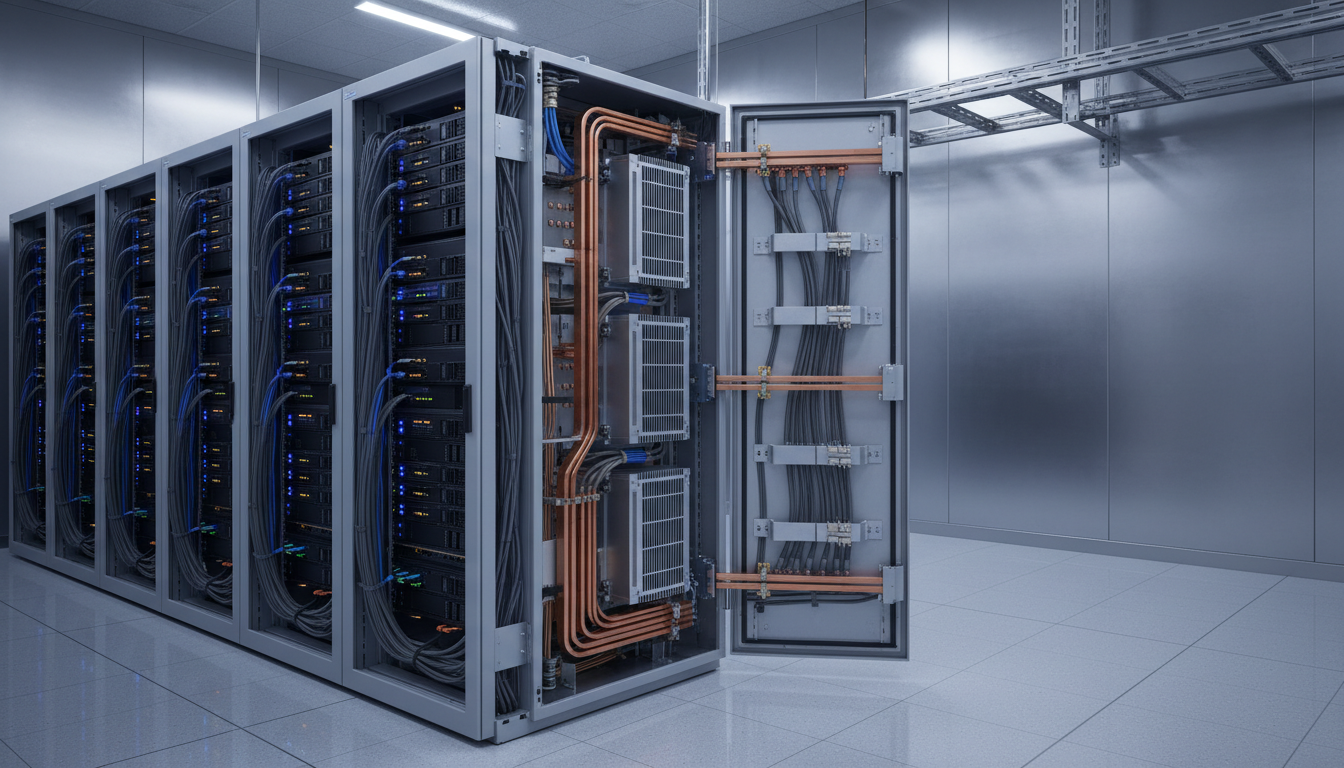
SOLUM says its 26 kW-class battery-backup DC/DC converter uses Infineon CoolSiC MOSFETs, EiceDRIVER gate drivers and PSOC digital power controllers. A peak conversion efficiency above 98.5% is a development target. It is not a verified production measurement, and it does not describe whole-facility energy efficiency.
For scale, a 26 kW output at 98.5% efficiency would imply roughly 396 watts of conversion heat at full load, calculated as 26,000 × (1/0.985 − 1). At 97% efficiency, the same calculation would imply about 804 watts. Both values are illustrative calculations using assumed efficiencies, not measured losses for SOLUM’s prototype.
Power Architecture Matters Beyond a Single Converter
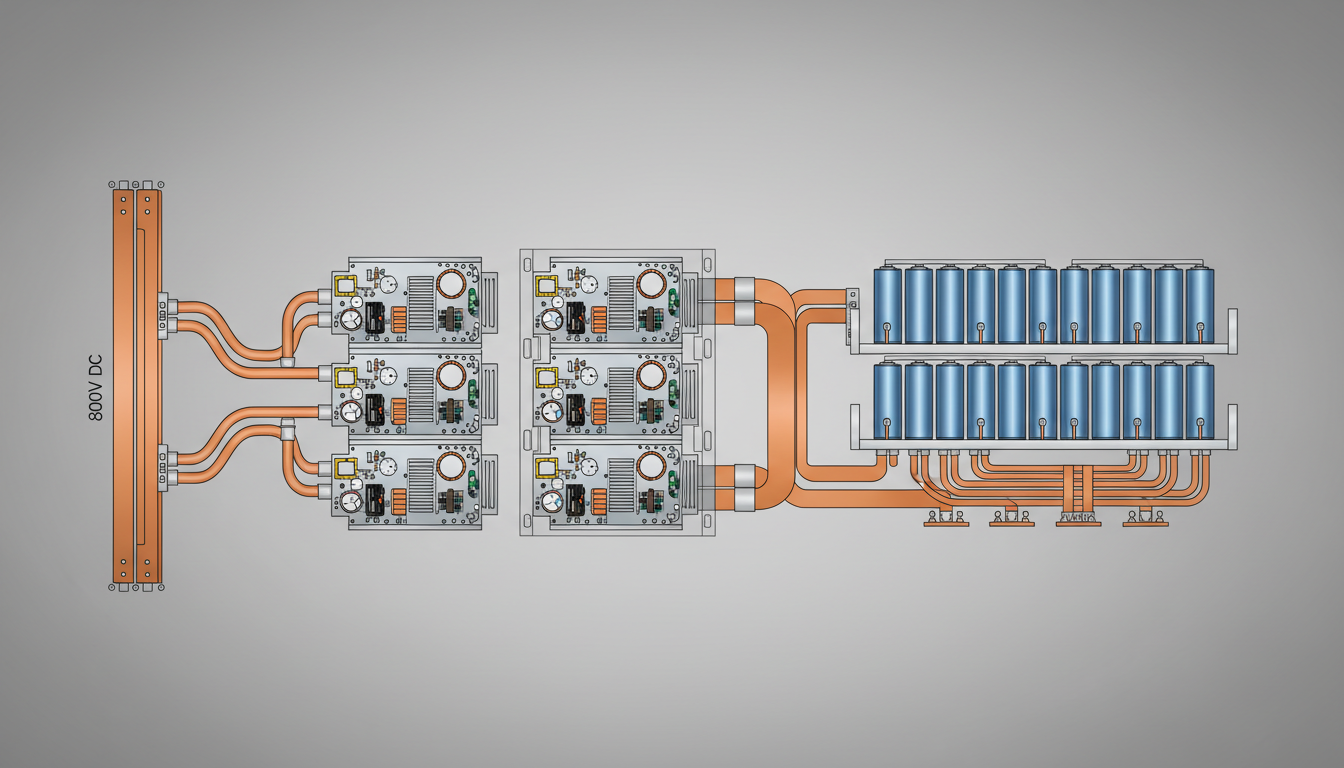
Power conversion is only one constraint. Rack-scale DC systems also need isolation, fault protection, reliable switching, thermal management, maintainability and safe service procedures. Higher voltage reduces current for equal power, yet increases the importance of insulation coordination and controlled fault interruption. Costs and reliability must be validated over operating lifetimes.
The agreement extends a broader transition already visible in Enphase’s 800 V conversion testing, Vantage’s solid-state transformer procurement plans, and Infineon’s earlier 27 kW server power supply. A separate Vertiv–Infineon supply agreement also illustrates demand for power semiconductor components.
SOLUM also showed an Open Rack v3-compatible 33 kW power shelf and other power products during the companies’ collaboration event in Yongin. Neither partner disclosed a final selling price, customer installation schedule or externally certified efficiency result for the new converter. The next substantive milestones are design qualification, independently reproducible performance figures and evidence of production shipments in 2027.
Primary Reporting
Infineon’s November 5 announcement and SOLUM’s November 5 technical release underpin the agreement, product scope, development targets and timeline.
We volunteer daily to ensure the information on this platform is Verifiably True. If you would like to support the research, please scan QR code.

Scan the original QR code using another device to support independent research.
Editor’s Note. Claims about the 26 kW converter, target efficiency and planned 2027 production are attributed to SOLUM’s announcement dated November 5, 2026. Engineering calculations are illustrative and are not independent product test results. Images are editorial concepts, and the embedded Infineon video documents earlier hardware rather than the newly announced converter.


Leave a Reply