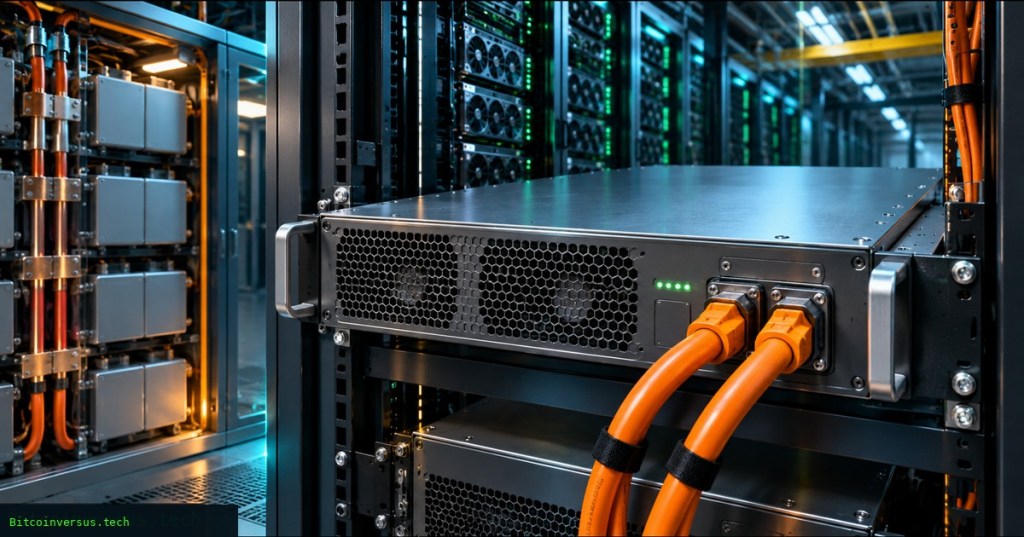
GPU clusters can change their electrical demand faster than conventional utility infrastructure can follow. On November 11, 2026, Colorado-based Ampt announced a rack-mountable battery converter rated for 80 kilowatts at 800 volts DC, claiming a response time below one millisecond. The aim is to buffer short AI workload spikes with batteries rather than forcing operators to reserve grid capacity for every instantaneous peak. The converter remains in partner pilots, with general availability targeted for the third quarter of 2027.
A battery between the grid and GPU
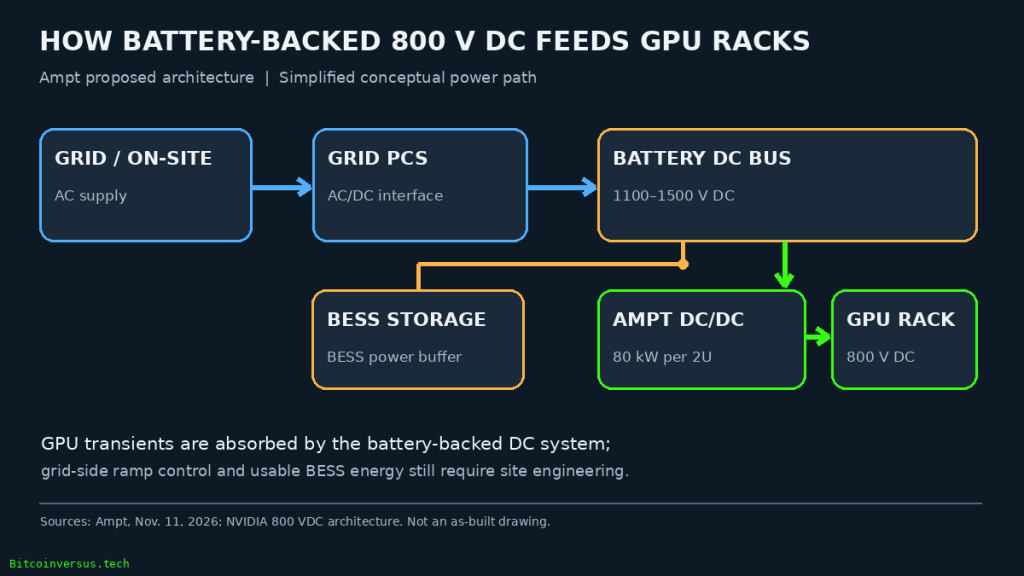
Ampt’s architecture puts storage, utility supply and optional on-site generation on a shared 1,100–1,500 V DC bus. Its new converter regulates the GPU-side output to 800 V DC while battery state of charge changes the upstream bus voltage. The company quotes 99.2% peak conversion efficiency, not a verified whole-facility efficiency figure or a guarantee at every operating load. An independently requested datasheet and measured transient waveforms were not publicly available with the announcement.
Unlike a conventional backup UPS that mainly waits for a grid interruption, the proposed storage system would continuously absorb or supply short-term power differences. NVIDIA separately describes AI rack draw swinging from roughly 30% idle to full demand within milliseconds. Earlier BitcoinVersus.Tech reporting compares three approaches to 800 V DC AI racks; Ampt targets the buffering and conversion layer, not the GPU or its cooling system.
80 kW units add up quickly
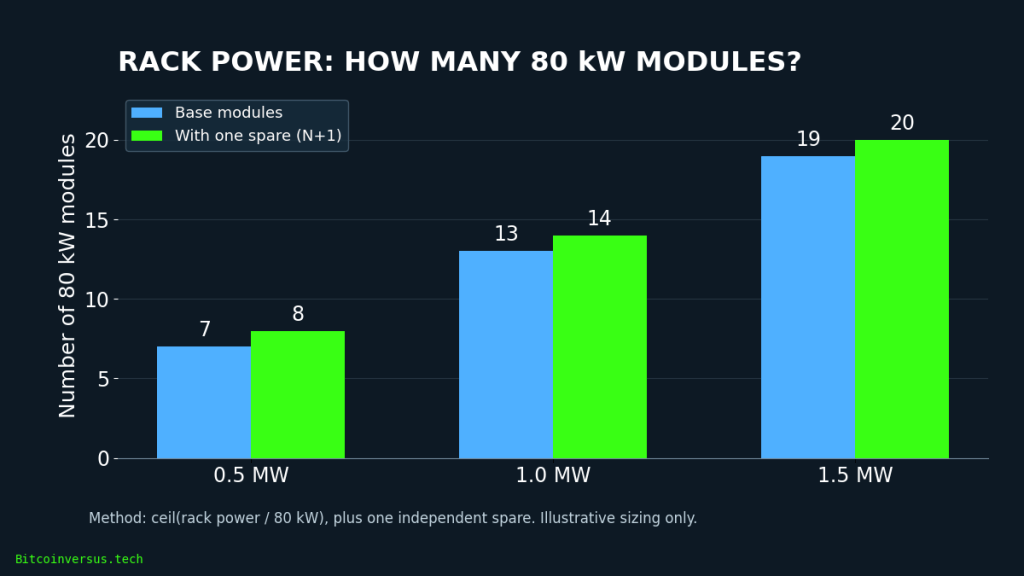
Each 2U unit supplies 100 amperes at 800 V, consistent with P = V × I. A hypothetical 1 MW rack therefore needs at least 13 units: 1,000 ÷ 80 = 12.5, rounded up. Adding one independent spare for N+1 capacity yields 14 units, or 1.12 MW of nameplate output. At 1.5 MW, the arithmetic becomes 19 active units plus one spare. Actual design must accommodate thermal derating, failure domains, busbar limits and load-sharing stability.
Related 26 kW battery-backup work and Envision’s deployed 800 V DC power system address adjacent parts of the high-density power chain. Neither independently validates Ampt’s converter performance.
Fast power is different from stored energy
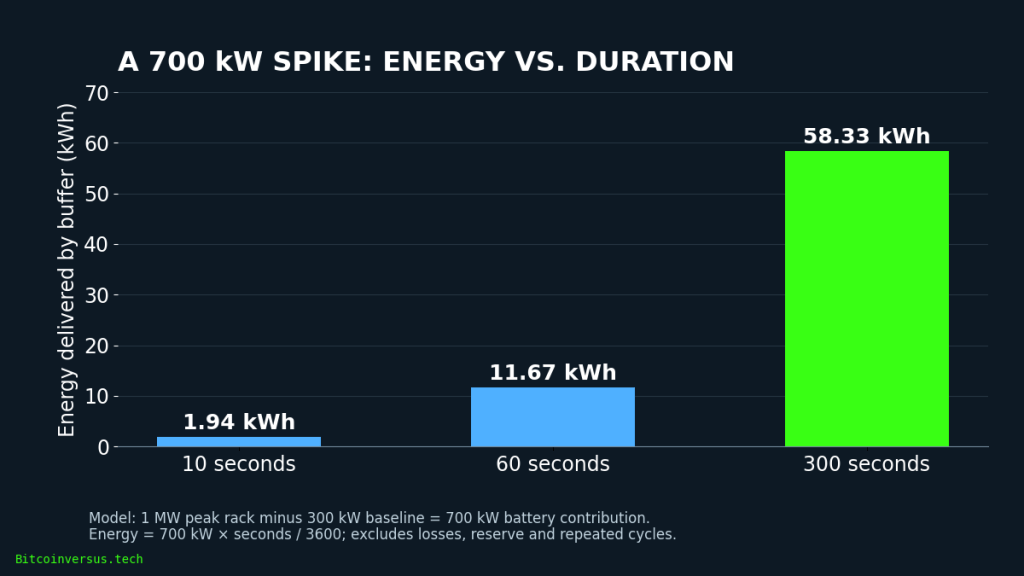
Suppose a 1 MW peak rack normally draws 300 kW and suddenly demands its full rating. If utility input stays at 300 kW, storage must briefly supply 700 kW, before losses. Ten seconds requires 700 × 10 ÷ 3,600 = 1.94 kWh; one minute requires 11.67 kWh; five minutes requires 58.33 kWh. Those figures are illustrative, not Ampt endurance measurements. Battery capacity, discharge rates, temperature, recharge scheduling and repeated peaks determine whether the arrangement is practical.
A sub-millisecond converter response also cannot guarantee grid stability by itself. Fault protection, arc interruption, insulation, energy-storage safety and electrical coordination remain essential. BitcoinVersus.Tech previously examined grid-fault ride-through safeguards and a separate 13.8 kV AC-to-800 V DC laboratory converter.
Pilot-stage hardware faces its real test
Ampt says the units support parallel operation, N+1 redundancy, built-in web controls and Modbus TCP telemetry. However, independent full-load efficiency curves, multi-rack transient recordings, customer availability results and lifetime economics were not released with the announcement. Claims of using more compute on an unchanged grid connection also depend on battery recharging, site protection and utility interconnection approval. The immediate development is pilot-stage hardware proposed for managing GPU power swings—not evidence that data-center grid demand or construction costs have already fallen.
Reporting and technical sources: Ampt announcement, November 11, 2026; Ampt product specifications; Ampt DC power-path documentation; NVIDIA engineering analysis of GPU load swings; Texas Instruments technical white paper on fast-transient power supplies, March 2026. Published specifications attributed to Ampt are not independent verification.
BitcoinVersus.Tech Editor’s Note: We volunteer daily to ensure the credibility of the information on this platform is Verifiably True. If you would like to support to help further secure the integrity of our research initiatives, please donate using the QR code provided.

Optional donation: 5,000 satoshis (0.00005 BTC). On mobile, open the QR code on another screen to scan with a Bitcoin wallet, or use a wallet’s saved-image QR scanner. Verify the payment destination and amount before sending.
BitcoinVersus.Tech is maintained by volunteers. BitcoinVersus.Tech is not a financial advisor. Reporting on technology and financial subjects is informational, not investment advice.


Leave a Reply