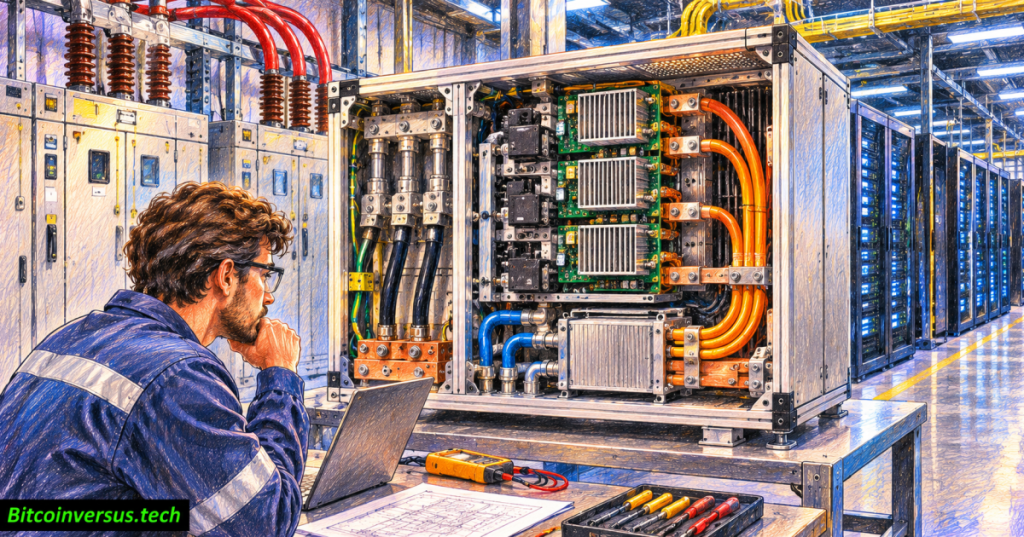
SolidUltra, a French startup founded in June 2026, announced €3 million in financing on November 9 to develop modular solid-state transformers for 800-volt DC artificial-intelligence data centers. Backed by power-electronics manufacturer Watt & Well, the company proposes converting medium-voltage grid electricity to an 800 VDC distribution bus using silicon-carbide converter cells. Its first commercial deployments are targeted for 2028; no completed customer installation or independently verified efficiency test accompanied the announcement.
Texas Instruments, “Solid State Transformers (SST): Replacing traditional transformers for AI data centers,” September 3, 2026. Official manufacturer overview of related medium-voltage power-conversion engineering, not a demonstration of SolidUltra hardware. Credit: Texas Instruments / YouTube.
Why 800 volts matters for megawatt racks
Traditional facilities often combine a 50- or 60-hertz transformer, power conditioning, rectifiers and lower-voltage distribution. Reaching higher server power density through 800 VDC can reduce current at a given delivered power compared with a lower-voltage bus. For example, an idealized 1 MW load draws 1,250 A at 800 V, versus approximately 18,519 A at 54 V, before conversion losses. Cable sizing, protection and safety requirements still depend on the entire electrical design.
The comparison follows BitcoinVersus.Tech’s 54 V versus 800 V engineering analysis. Higher bus voltage can ease conductor-current constraints but increases the importance of insulation coordination, arc suppression and qualified DC fault protection. A 100 kW cell does not eliminate those obligations.
Solid-state transformers use controlled semiconductor stages
SolidUltra’s published product description outlines 100 kW building blocks arranged in series on the medium-voltage input and in parallel on the DC output. The company emphasizes silicon-carbide switches, modular redundancy and field-replaceable equipment. Although it calls the assembly a single grid-to-DC conversion stage, practical solid-state transformers still require controlled switching, magnetic isolation where specified, regulation and protection; the phrase should not be read as a passive transformer with no internal conversion stages.
Previous Enphase laboratory testing at 13.8 kV and Envision’s operating 800 VDC campus represent different points in the industry’s development cycle. Neither validates SolidUltra’s proposed product specification.
Efficiency and footprint are unverified targets
The startup targets 98.5% conversion efficiency, a footprint four times smaller than conventional alternatives and roughly 30% lower total ownership cost. Its website compares above-98% conversion against approximately 92% for a transformer-plus-rectifier architecture. Those figures are vendor projections, not independent measurements using the same input voltage, output power, cooling boundary and reliability test conditions.
Using the company’s own 92% and 98.5% assumptions, supplying 1 MW of DC output implies about 87 kW versus 15 kW of conversion losses, respectively—a modeled difference of roughly 72 kW. The calculation illustrates potential energy savings; it does not establish actual performance for a commercial unit. Thermal management and partial-load behavior can significantly change results.
Infineon Technologies, “The shift to DC grids and solid-state infrastructure in AI data centers,” June 3, 2026. The company’s engineers discuss power distribution, semiconductors, grid stability and solid-state transformers around 19:43. Background technology analysis, not SolidUltra validation. Credit: Infineon / YouTube.
Funding now; commercialization expected in 2028
SolidUltra says Watt & Well’s backing will finance engineering, industrialization and early customer discussions. Its roadmap describes modules spanning approximately 300 kW to 10 MW or more, maintenance swaps targeted below 15 minutes and five-nines availability. By 2032 it aims to deliver 10,000 modular systems representing roughly 1 GW; those figures remain plans rather than shipment data.
Competition is already developing. Vantage’s agreement for Heron transformer capacity addresses another supplier, while Ampt’s 80 kW battery converter tackles rapid load variation at a different point in the power chain. Engineers still need data on switching losses, electromagnetic interference, galvanic isolation, fault handling, serviceability, certification and sustained availability.
The confirmed development is €3 million in funding for a product still under development. Commercial adoption will depend on independently demonstrated efficiency, safe medium-voltage operation, manufacturing repeatability and signed customer installations—not its 2028 and 2032 ambitions alone.
Primary sources: Watt & Well and SolidUltra announcement, November 9, 2026; original distributed press release; product and development status; Texas Instruments’ solid-state-transformer engineering paper, revised November 2026; independent industry coverage. Company targets are not presented as certified results.
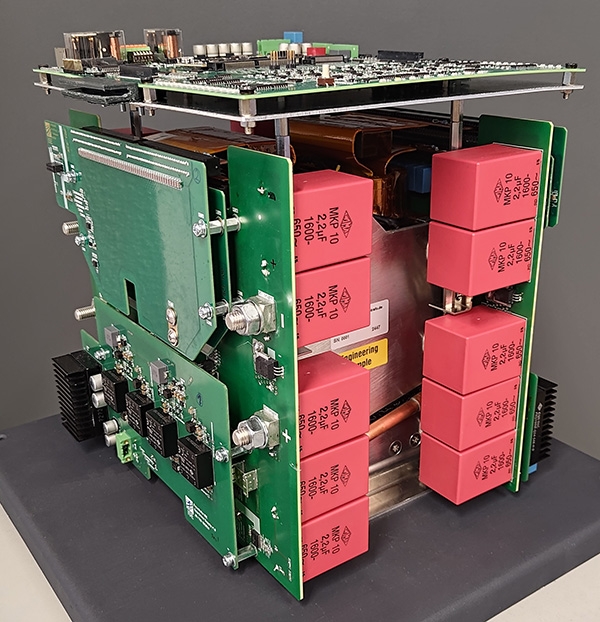
Editor’s Note: The €3 million financing, 2028 launch target and 2032 scale ambition were verified against SolidUltra and Watt & Well’s dated announcement. Efficiency, footprint, maintenance and cost figures are attributed company claims; the 1 MW loss calculation is explicitly hypothetical. The original colored-pencil 1200 × 630 cover illustrates a generic electrical-conversion laboratory rather than a deployed SolidUltra unit and includes the neon-green Bitcoinversus.tech bottom-left watermark. The Fraunhofer ISE photograph and Texas Instruments/Infineon videos illustrate related engineering, not SolidUltra’s hardware or performance. WordPress iframe generation and successful end-user video playback are separate checks.

BitcoinVersus.Tech is volunteer-run and publishes independent technical journalism. Optional support of 5,000 satoshis funds further research. Scan the original QR on a second screen using a compatible Bitcoin wallet; on the same phone, use a wallet that supports importing a saved QR image. Verify recipient 3C9o19EH5HSiwEPyCTmEKzxhNCbo2X6TTb and 5,000 satoshis before sending. Bitcoin transactions are generally irreversible.
We volunteer daily to ensure the information on BitcoinVersus.Tech is Verifiably True. Reporting is informational and educational, not certified electrical engineering guidance, a warranty of future power-conversion performance, financial advice or investment advice.


Leave a Reply