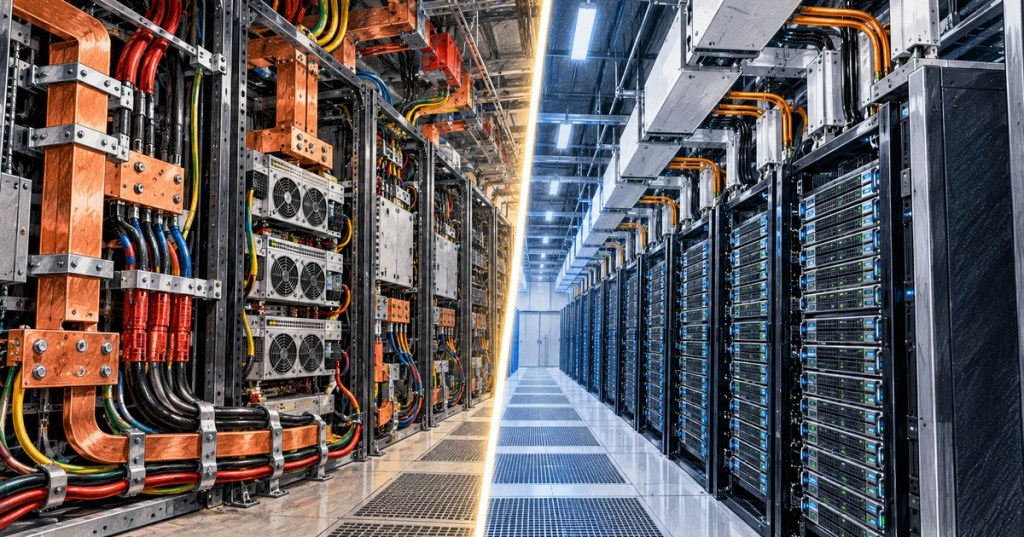
AI servers are forcing data centers to rethink something that used to sit quietly in the background: the voltage inside the rack power system.
For years, high-performance servers have commonly used roughly 48–54 VDC distribution inside the rack. That works well at conventional rack power levels. The problem appears when a rack climbs into the hundreds of kilowatts—and eventually toward 1 megawatt.
The Difference Is Current
The basic physics is simple: power = voltage × current. If the required power stays the same, raising voltage lowers current.
| Rack power | Current at 54V | Current at 800V |
|---|---|---|
| 100 kW | ≈ 1,852 A | 125 A |
| 400 kW | ≈ 7,407 A | 500 A |
| 1 MW | ≈ 18,519 A | 1,250 A |
At 1 MW, the 800V system carries about 14.8 times less current than a 54V system delivering the same power. That matters because very high current demands enormous copper conductors, larger connectors, more busbar area and more physical space. It also raises resistive heating pressure.
NVIDIA’s 800 VDC architecture says legacy 54V distribution becomes a bottleneck as AI racks scale. NVIDIA has estimated that extending 54V architecture to a 1 MW rack could require up to 200 kilograms of copper busbar and enough power shelves to consume most of the rack volume.
54V Still Has Advantages
That does not make 54V obsolete. It is mature, familiar to technicians, supported by a huge installed ecosystem and easier to integrate into conventional server racks. At moderate power densities, there may be little reason to replace a proven architecture.
The 800V transition becomes compelling when current and rack-space requirements begin overwhelming the low-voltage system. Instead of filling racks with power shelves and massive copper bars, conversion can move outside the compute rack into a sidecar, row power system or eventually a centralized facility-level DC architecture.
800V Has New Engineering Problems
Higher voltage is not free. Protection, grounding, connectors, service procedures and arc-flash analysis become more demanding. Schneider Electric’s 800V safety work notes that standards and calculation methods are still catching up to converter-limited DC fault behavior.
Another important point: the GPUs themselves do not run directly at 800V. The higher voltage is used to move power efficiently through the facility and toward the rack. DC-DC conversion still steps that voltage down near the compute hardware.
Which One Wins?
| Category | 54V | 800V |
|---|---|---|
| Maturity | Excellent | Emerging |
| Technician familiarity | High | Lower today |
| Current at extreme rack power | Very high | Much lower |
| Copper and cable pressure | High at megawatt scale | Lower |
| Best fit | Conventional and moderate-density racks | 400 kW to 1 MW-class AI racks |
| Safety/standards maturity | Established | Still evolving |
BitcoinVersus.Tech has already tracked working 800V data-center hardware, the Open Compute Project’s view that AI racks are moving beyond 1 MW, and a 1 MW 800V power rack design.
Bottom line: 54V is not disappearing tomorrow. But the math gets ugly as rack power rises. Once AI systems move toward several hundred kilowatts per rack, higher-voltage DC becomes less about novelty and more about making the physical infrastructure possible.
BitcoinVersus.Tech Editor’s Note:
We volunteer daily to ensure the credibility of the information on this platform is Verifiably True. If you would like to support to help further secure the integrity of our research initiatives, please donate using the QR code provided

For best QR-code scanning results, please scan this donation code from a desktop or larger screen. Mobile screens may prevent camera recognition.
BitcoinVersus.tech is not a financial advisor. This media platform reports on financial subjects purely for informational purposes.


Leave a Reply