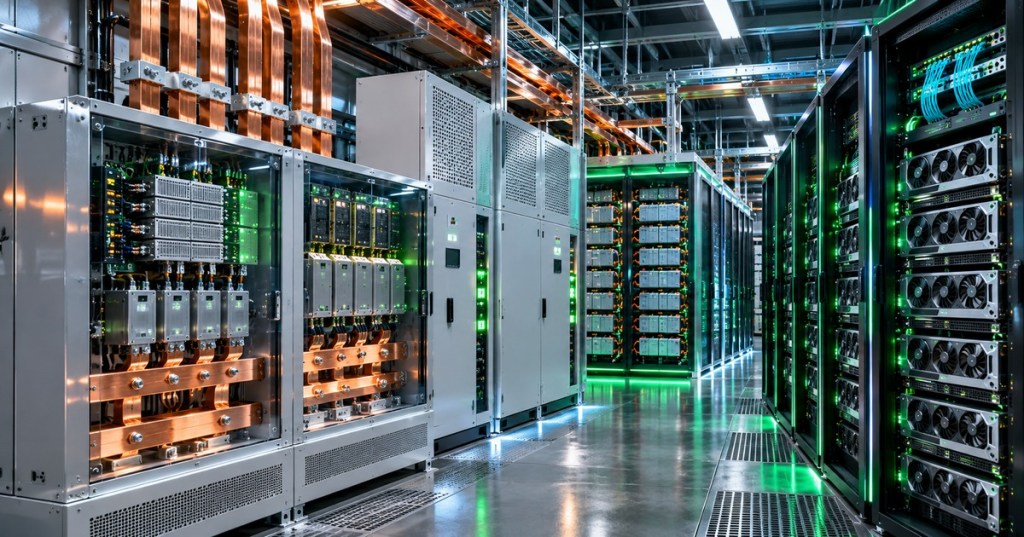
Envision announced November 2, 2026 that an integrated 800-volt direct-current power system is running live computing workloads at its Galaxy AI data-center campus in Ulanqab, Inner Mongolia, China. The company calls the installation the world’s first commercial deployment of an integrated 800 V DC system in a large-scale AI facility. Independent reporting confirms the announcement, but the installation’s operating megawatts and end-to-end efficiency have not been disclosed.
The development differs from equipment launches and laboratory trials. Envision says the operating power chain combines solid-state transformers, battery energy storage, rack-side voltage conversion and coordinated controls. The campus began operations in August, while the latest announcement specifically addresses the electrical system serving workloads.
The power chain
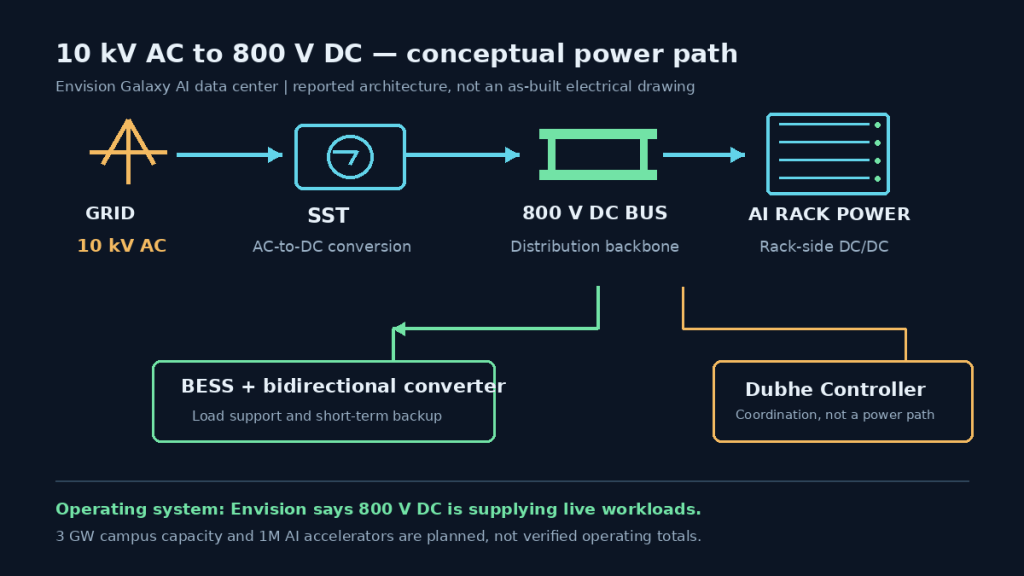
Envision’s design converts an incoming 10-kilovolt alternating-current supply directly to an 800 V DC distribution bus. Its Dubhe Controller, supported by a proprietary energy model, coordinates transformers and batteries as GPU demand changes. Battery storage is intended to absorb short load spikes and provide temporary backup. Downstream DC conversion then supplies the lower voltages computing equipment needs.
A conventional data center can pass electricity through multiple conversions between a grid feed, uninterruptible power system and server power supply. Eliminating stages could reduce heat losses, copper demand and floor space. However, Envision has not released a measured facility-wide efficiency improvement or a comparable cost-per-megawatt analysis. Data Center Dynamics reports that the size of the live 800 V installation remains unknown.
Operating power versus expansion plans
Galaxy has a planned campus capacity of 3 gigawatts, designed eventually to support as many as one million AI accelerators. Neither figure measures current power consumption or the number of GPUs already operating. Envision’s goal for more than 80% directly connected renewable electricity is likewise a future power-supply target, not a disclosed metered share for each operating hour.
The announcement follows a series of distinct developments covered by BitcoinVersus.Tech: Enphase’s laboratory conversion test, ABB’s high-voltage DC power launch, Rittal and Bosch’s rack-power collaboration and a technical comparison of 54 V versus 800 V rack distribution. A commercial power-system deployment is an additional milestone, not proof that all 800 V architectures perform identically.
What remains to be proven
At fixed electrical power, higher voltage reduces current, which can ease conductor requirements. But practical energy savings also depend on power electronics, protection systems, wiring and operating load. Engineers will want independently reported conversion measurements, battery response data, fault-protection performance and evidence of service reliability before treating the design as a general standard.
Envision’s Mission Gobi initiative targets 5 GW of renewable-oriented AI-data-center capacity in desert regions worldwide by 2030. That program and Galaxy’s 3 GW design are projections, not current operational totals. The November deployment supplies a noteworthy commercial reference as AI operators reconsider grid-to-rack power delivery.
Editor’s Note: Envision’s November 2 release is the primary source. Independent reporting by Bloomberg and Data Center Dynamics supplies context. The first-commercial claim is attributed to Envision, and installed megawatts and measured savings remain undisclosed. The featured artwork is a conceptual editorial illustration, not a site photograph.

We volunteer daily to ensure the information on this platform is Verifiably True. If you would like to support the research, please scan the QR code.


Leave a Reply