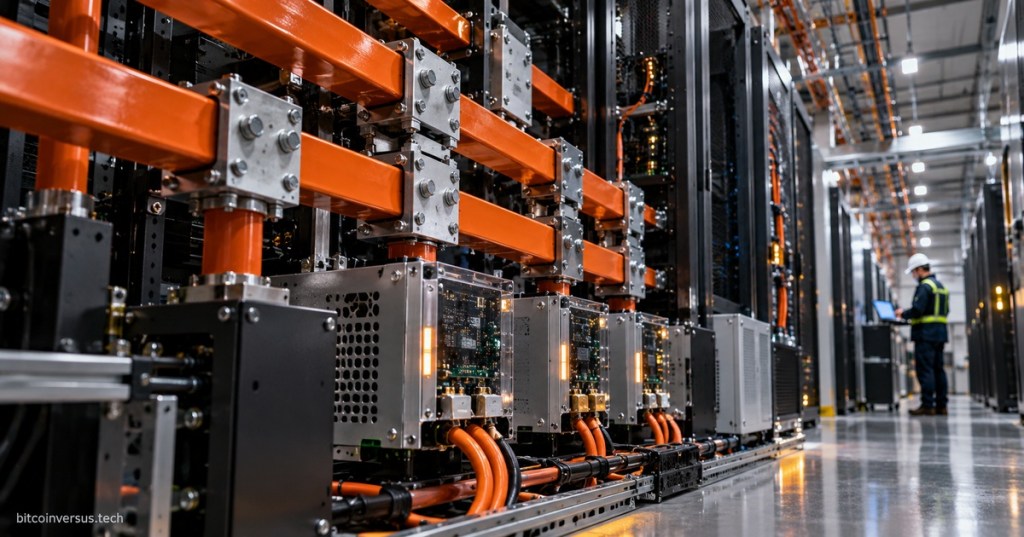
Vertiv used the 2026 OCP Global Summit to introduce an open DC Fault Manager reference architecture for 800 VDC AI data centers. The idea is to separate the millisecond-level job of interrupting a fault from the slower system-level work of deciding what happened, whether the affected section is safe, and when power can be restored.
On its OCP 2026 program page, Vertiv says the design combines localized solid-state circuit breaker action with centralized post-fault analysis, safety interlocks, telemetry correlation and busway re-energization sequencing. The proposed standardization areas include fault-state messages, digital handshakes, breaker behavior classes, sampling expectations and reset sequences.
Vertiv explains why AI rack power is moving toward 800 VDC as rack density climbs.
The protection problem matters because direct current is harder to interrupt cleanly than conventional AC, especially as rack power moves toward hundreds of kilowatts and eventually megawatt-class systems. The Register has documented the industry-wide move toward 800 VDC as vendors try to reduce conversion stages and current levels in dense AI racks.
Data-center operators are already debating how 800 VDC sidecars fit with UPS, protection and distribution architectures.
The proposal builds on a fast-moving 800 VDC ecosystem. BitcoinVersus.Tech has already tracked the 54V-to-800V transition, xFusion’s 800V rack infrastructure, and Delta’s 800 VDC and 3 MW cooling push.
The key caveat: this is a reference architecture and standardization proposal, not a finalized OCP standard. The signal is still important—fault coordination is becoming a first-class design problem as AI power systems move from tens of kilowatts toward megawatt racks.
BitcoinVersus.Tech Editor’s Note:
We volunteer daily to ensure the credibility of the information on this platform is Verifiably True. If you would like to support to help further secure the integrity of our research initiatives, please donate using the QR code provided

For best QR-code scanning results, please scan this donation code from a desktop or larger screen. Mobile screens may prevent camera recognition.


Leave a Reply