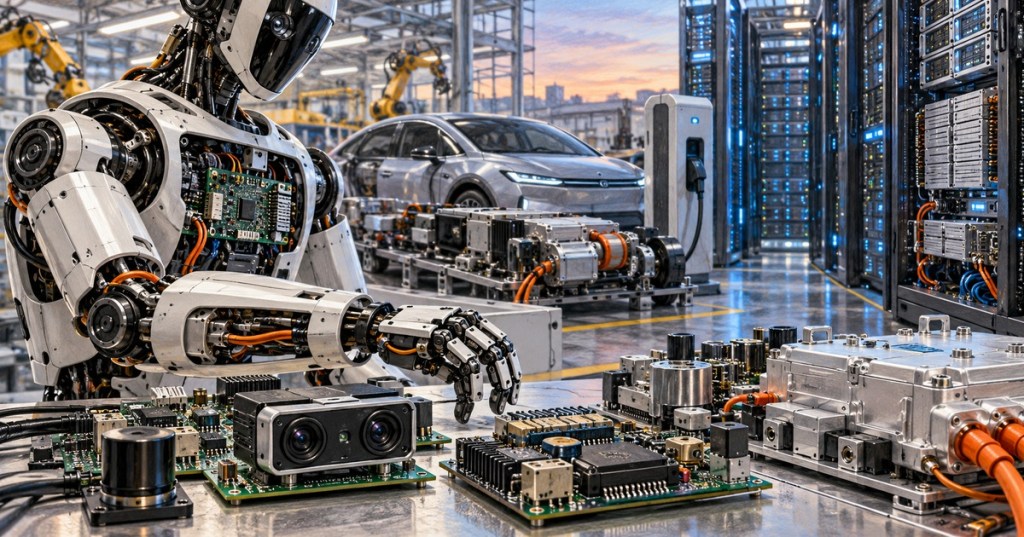
Infineon is making Physical AI one of the centerpieces of its electronica 2026 showcase, spanning robots, intelligent edge devices, software-defined vehicles and the power infrastructure required to run AI data centers. The company said on October 14 that its November 10–13 exhibition in Munich will focus on the semiconductor building blocks that let machines sense their environment, process information locally, communicate securely and turn computation into physical action.
The announcement matters because Physical AI is not one chip category. A useful autonomous machine needs sensors, processors, motor control, connectivity, power conversion, memory, safety systems and security working together. Infineon’s position is that semiconductors across that whole chain are becoming more important as AI leaves the cloud and enters robots, vehicles, factories and edge devices.
That direction fits the broader industry shift BitcoinVersus.Tech has tracked in chip platforms designed specifically for Physical AI. In a physical system, latency, electrical efficiency, safety and deterministic control matter differently than they do in a chatbot running in a remote data center.
Robots need much more than an AI accelerator
Infineon calls robotics the most complex form of Physical AI. A robot must first perceive its environment, then estimate what is happening, decide what to do and finally execute movement through motors and actuators. That loop may repeat hundreds or thousands of times per second depending on the subsystem.
At electronica 2026, Infineon plans to show a live shop-floor robotics use case plus system-level demonstrations for sensing, actuation and motor control. One demonstration is designed around a dexterous robotic hand. Infineon’s event preview says a smart actuator will use gallium nitride power devices in motor control and drive seven degrees of freedom, while sensing systems provide the environmental perception and grasp feedback required for the hand to interact with objects.
Infineon’s official COMPUTEX 2026 keynote connects AI infrastructure to Physical AI and discusses humanoid robotics, motor control, microcontrollers, connectivity and security.
The important point is that the AI model is only one layer. A robot that can identify an object but cannot move a joint precisely, manage battery power efficiently or stop safely when something goes wrong is not a useful production machine. That is why power semiconductors, real-time microcontrollers and safety/security hardware remain central even as AI accelerators receive most of the attention.
Edge AI moves decisions closer to the machine
Infineon’s second Physical AI theme is edge intelligence. Instead of sending every sensor reading to a cloud service and waiting for a response, edge systems process more information locally. This can reduce communication latency, cut bandwidth demand and allow some functions to continue when a network connection is unavailable.
That local processing is especially important in industrial automation, security devices, home appliances and robotics. A motor-control loop cannot wait for an unpredictable round trip to a remote data center. Safety-critical decisions also need defined timing and predictable behavior. In practice, Physical AI often becomes a layered system: a larger AI model may handle perception or planning while local controllers execute tightly timed control functions.
Security is part of that design rather than an optional add-on. Infineon says its electronica demonstrations will also emphasize hardware-level functional safety and cybersecurity. As machines become more autonomous and connected, compromising the processor or communications path can have consequences beyond stolen data; it can change how a physical device moves or behaves.
Software-defined vehicles are another Physical AI platform
Infineon is also using electronica 2026 to preview its next automotive microcontroller platform based on the open RISC-V instruction-set architecture. The company says the future platform is aimed at software-defined vehicles and other Physical AI systems that need scalability, connectivity, safety and security.
The connection between robotics and modern vehicles is becoming tighter. Both combine sensors, high-speed compute, real-time control, networking, power electronics and increasingly complex software. A vehicle may use AI for perception and driver assistance while conventional real-time controllers continue to manage braking, steering, traction, power conversion and other time-sensitive systems.
Infineon explains the power challenge created by AI infrastructure and the role of higher-efficiency semiconductor power conversion in supporting increasingly dense compute systems.
AI data centers turn power electronics into a performance constraint
The other half of Infineon’s electronica story is the infrastructure required to run AI at scale. More compute means more electrical load, and every conversion stage between the utility grid and the processor creates some loss. The engineering goal is therefore not only to deliver more power but to reduce losses while maintaining protection, reliability and manageable thermal conditions.
Infineon says it will demonstrate technology across the entire power chain, from renewable generation and the electrical grid down to the processor core inside an AI server. That includes silicon, silicon carbide and gallium nitride devices, each used where its electrical characteristics make sense for different voltage, frequency and efficiency requirements.
BitcoinVersus.Tech has already covered Infineon’s 27 kW three-phase AI-rack power supply and the wider transition from 54 V distribution toward 800 V architectures. Those changes are happening because rack power is moving into ranges where traditional low-voltage distribution becomes increasingly difficult to scale without enormous current, conductor size and conversion losses.
Infineon’s own financial disclosures show why the company is emphasizing this market. Earlier in 2026, CEO Jochen Hanebeck said revenue from AI data-center power solutions had risen above €700 million, with the company expecting around €1.5 billion in the current fiscal year and roughly €2.5 billion in fiscal 2027. Those are company forecasts rather than guaranteed outcomes, but they illustrate how quickly AI power infrastructure is becoming a major semiconductor market in its own right.
Infineon’s COMPUTEX 2025 presentation explains the grid-to-processor power chain, including collaboration around next-generation AI data-center power architectures.
Why GaN and SiC keep appearing in AI power systems
Gallium nitride and silicon carbide are wide-bandgap semiconductor materials that can switch efficiently at operating conditions where conventional silicon may become less attractive. That does not mean either material replaces silicon everywhere. Instead, engineers choose among silicon, SiC and GaN based on voltage, switching frequency, thermal conditions, cost and the specific power-conversion stage.
In robotics, GaN can help shrink motor-drive and power-conversion hardware where size and weight matter. In data centers, wide-bandgap devices can improve power density and efficiency in parts of the AC-to-DC and DC-to-DC conversion chain. Small percentage-point efficiency improvements become financially and thermally significant when multiplied across megawatts of continuously operating infrastructure.
This is also why Physical AI and AI infrastructure belong in the same announcement. The compute model might be trained in a large data center, then deployed inside a robot or vehicle. Both ends of that chain consume power electronics, sensors, processors, connectivity and security devices, just at very different scales.
What is confirmed and what still needs proof
The confirmed part of Infineon’s October 14 announcement is the electronica 2026 product and technology program: Physical AI demonstrations, a live robotics use case, dexterous-hand technology, edge intelligence, a future RISC-V automotive microcontroller platform and power solutions extending from the grid into AI servers. The trade show itself runs November 10–13 in Munich, where more detailed hardware demonstrations are expected.
What the announcement does not yet provide is a universal performance number for Physical AI. There is no single benchmark showing that Infineon’s collection of sensors, motor-control devices, power semiconductors and controllers makes every robot a fixed percentage faster or more efficient. The value has to be measured at the subsystem level: motor efficiency, response latency, sensing accuracy, power-conversion losses, thermal performance, safety behavior and total system cost.
The same caution applies to data centers. Higher-voltage distribution and wide-bandgap semiconductors can reduce losses and improve power density, but real deployments must also satisfy protection, serviceability, fault isolation, cooling and safety requirements. The best technical comparison will come from measured system efficiency across complete power chains rather than isolated peak device specifications.
The larger shift
Infineon’s electronica preview is ultimately evidence of a larger transition: AI hardware is spreading outward from GPUs and CPUs into every supporting layer that lets computation interact with the physical world. Sensors create the input. Microcontrollers and processors interpret it. Secure connectivity moves data between systems. Power devices convert electricity. Motor-control hardware turns electrical energy into motion. Safety systems define what the machine is allowed to do.
That makes Physical AI less a single product category than a systems-engineering problem. The companies that matter may not only be the firms building the largest models. They may also be the semiconductor suppliers that make perception, control, power, security and motion reliable enough for AI to leave the screen and operate real machinery.
BitcoinVersus.Tech Editor’s Note:
We volunteer daily to ensure the credibility of the information on this platform is Verifiably True. If you would like to support to help further secure the integrity of our research initiatives, please donate using the QR code provided

For best QR-code scanning results, please scan this donation code from a desktop or larger screen. Mobile screens may prevent camera recognition.


Leave a Reply