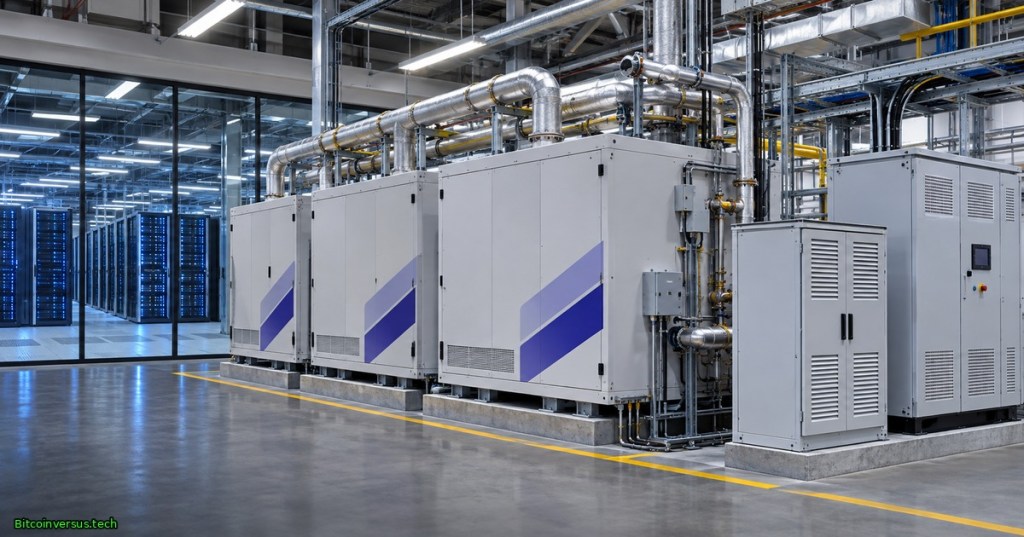
FuelCell Energy said on November 10, 2026, that it will develop a Connecticut power testbed under StabilityMax, a three-year collaboration led by the U.S. Department of Energy’s National Laboratory of the Rockies (NLR) with Argonne National Laboratory. The planned facility will evaluate whether fuel cells, batteries, controls and power electronics can jointly serve the volatile electrical demand of artificial-intelligence data centers. The announcement describes a research program, not a completed installation or newly energized data-center capacity.
National Laboratory of the Rockies: February 2026 video explaining fast-changing data-center loads and ARIES experiments. Background research, not StabilityMax footage.
Three partners with different engineering responsibilities
NLR will construct representative AI-computing load profiles and simulation models. FuelCell Energy will provide its carbonate fuel-cell technology and develop the test facility. Argonne will analyze costs and life-cycle effects, adding economic scrutiny to electrical performance. The company has not published a verified commissioning date, complete budget or measured StabilityMax response-time result.
The problem is seconds, not only megawatt-hours
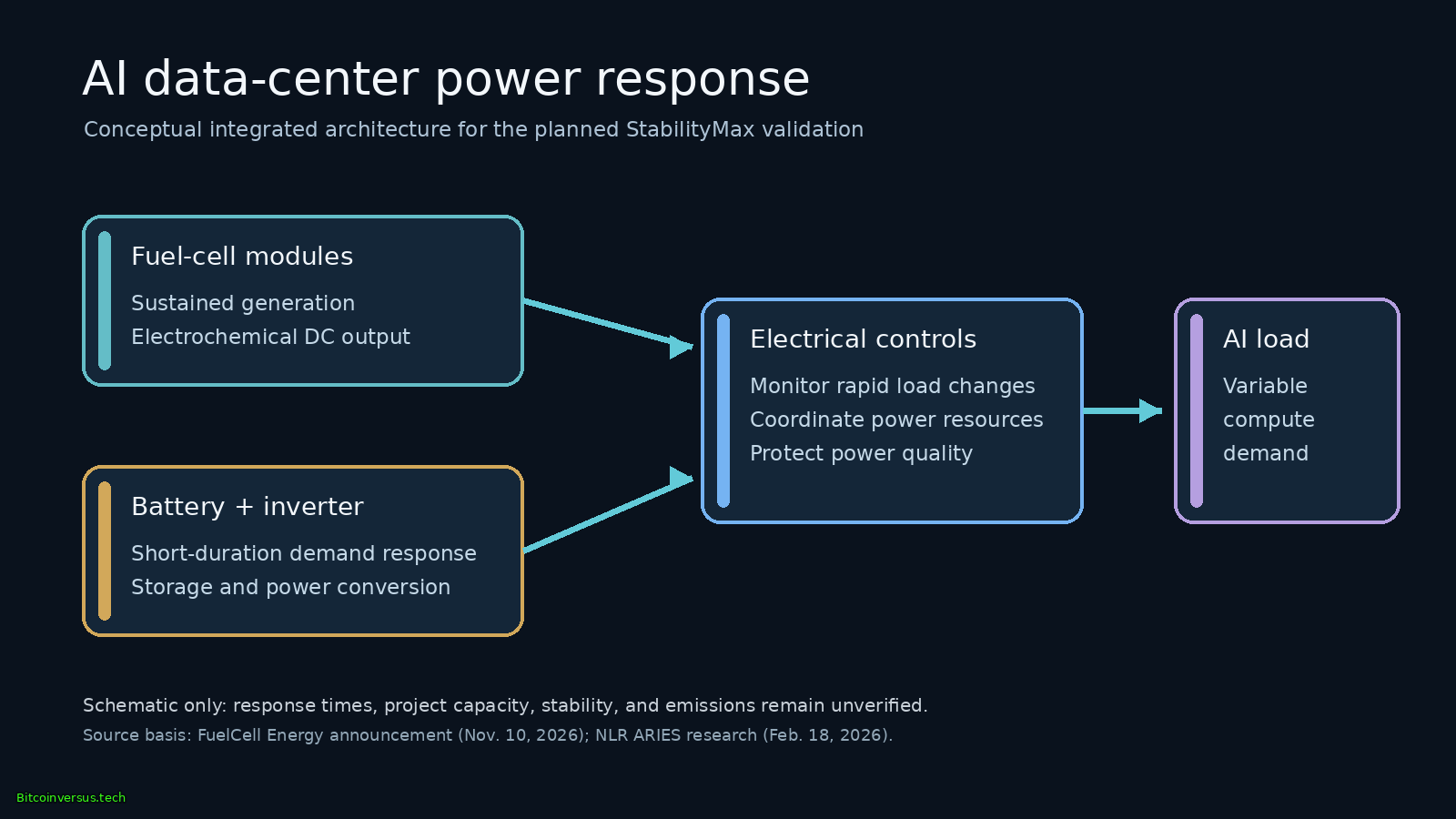
Data-center electricity consumption has two distinct engineering dimensions: energy consumed over hours and instantaneous power demanded within seconds. NLR’s February 18 ARIES research modeled rapid computing-load changes using measurements from an operating U.S. data-services provider. Its simulated system paired steady generation with faster-acting storage and fuel cells. Such load swings can strain conventional turbines and the wider power system.
The proposed architecture assigns complementary jobs to each component. A fuel cell converts the chemical energy of supplied fuel into direct-current electricity through electrochemical reactions. Power electronics and inverters condition electricity for distribution. Batteries and control logic can absorb or supply short bursts of power, while the fuel-cell plant supports sustained generation. Ampt’s separate 80 kW converter announcement illustrates how manufacturers are moving transient buffering nearer to accelerator racks.
What a carbonate fuel cell can and cannot prove
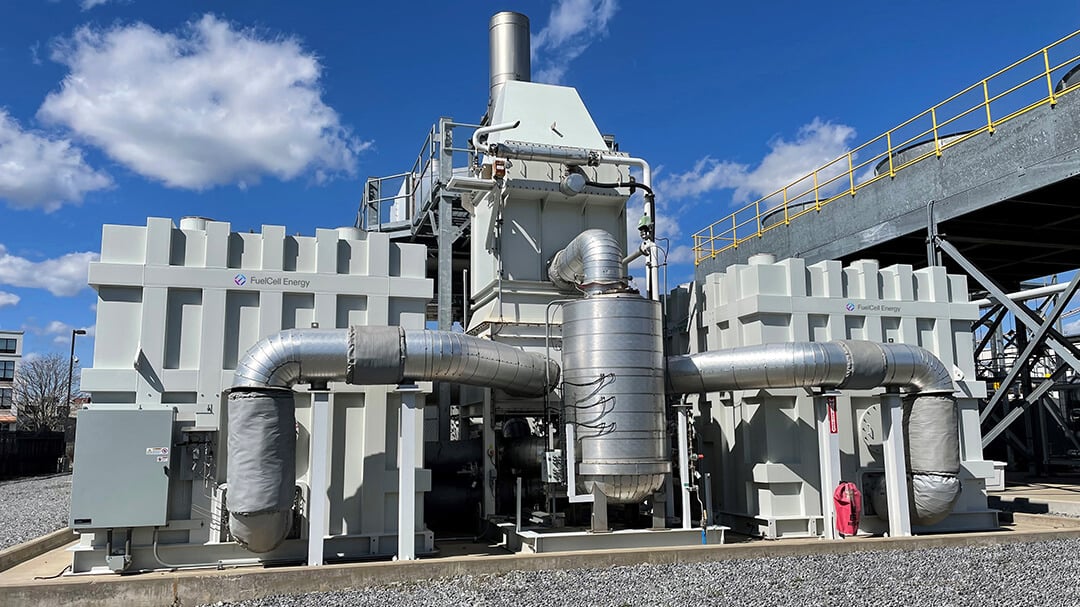
FuelCell Energy’s established carbonate modules are commercially available in 1.25 MW building blocks, according to the manufacturer’s technical explanation. Yet the company’s standard module rating says nothing about the power capacity of the unbuilt StabilityMax testbed. The new project must demonstrate stability, ramp behavior, protective coordination, temperature-related power derating and recovery from realistic demand swings before claims about facility-scale performance can be validated.
On-site generation may reduce dependence on delayed utility interconnections, but fuel supply, redundancy, maintenance, installation cost and interconnection protections remain major constraints. Carbonate fuel cells can operate without flame combustion, although natural-gas reforming and associated upstream operations still produce greenhouse-gas emissions. Lower local air pollution must not be confused with zero lifecycle emissions. Similar deployment questions matter for AEP’s proposed fuel-cell power project serving Google.
Costs, emissions and environmental trade-offs
Cooling and water use also affect an installation’s environmental balance. Heat recovery could improve useful-energy efficiency when a genuine thermal customer exists, while site climate and cooling methods change overall resource demand. Separate research reported by BitcoinVersus.Tech found one quarter of mapped data centers in water-stressed regions, a regional exposure metric rather than a measurement of any planned Connecticut facility.
StabilityMax should therefore be evaluated on published load traces, fuel consumption, electrical response, emissions, reliability and cost—not its partnership roster alone. In its November 10 announcement, FuelCell Energy described objectives and participants, not successful system qualification. Independent replication or detailed laboratory results would be needed to move the story from research intent to demonstrated capability.
Sources: FuelCell Energy, Nov. 10, 2026; NLR ARIES, Feb. 18, 2026; Fuel-cell technical primer; U.S. DOE stationary fuel-cell program; Zacks, Nov. 11, 2026.
Editor’s Note: StabilityMax is a planned validation project, not an operational power plant. The 1.25 MW figure refers to an existing product, not a disclosed testbed capacity. Original imagery is conceptual; the manufacturer photograph shows unrelated, existing equipment. NLR hosts the official educational YouTube video, but direct playback and mobile rendering were not independently tested. No verified testbed performance results are available.

BitcoinVersus.Tech is volunteer-run. Optional donations support independent reporting. To contribute 5,000 satoshis, scan the original QR with a Bitcoin wallet; on mobile, save the image and scan it through your wallet. Independently confirm recipient 3C9o19EH5HSiwEPyCTmEKzxhNCbo2X6TTb and the amount. Bitcoin transfers are generally irreversible.
We volunteer daily to ensure information on the BitcoinVersus.Tech platform is Verifiably True. Coverage is for educational and informational purposes and does not constitute financial or investment advice.


Leave a Reply