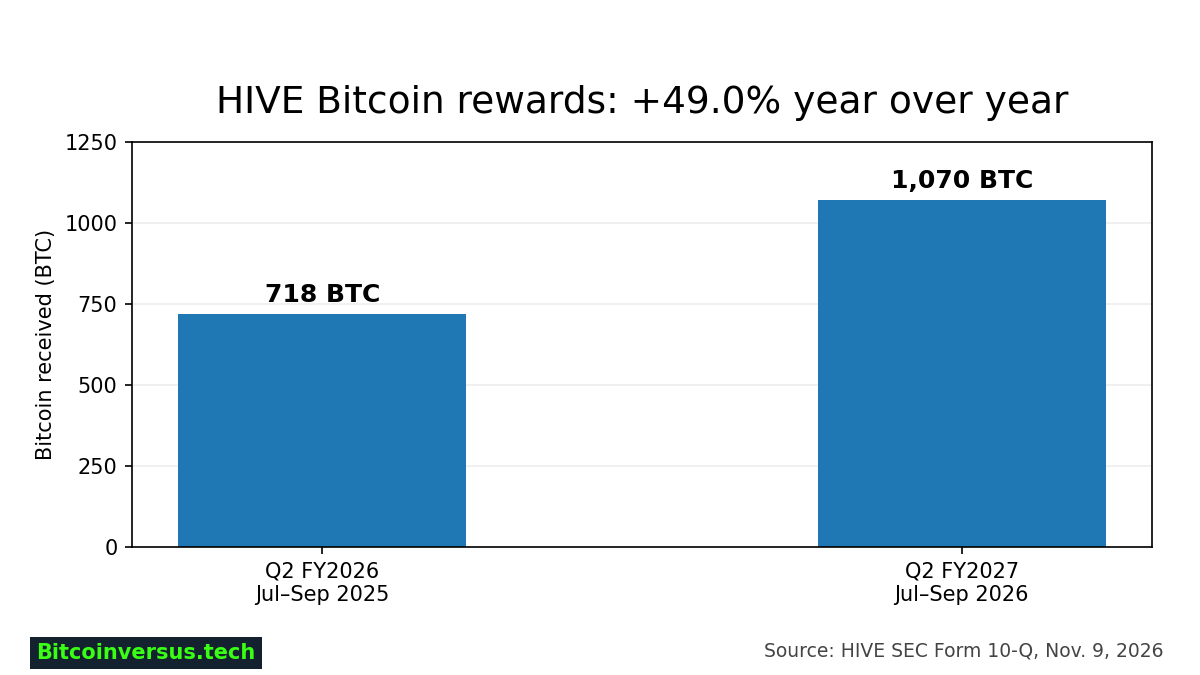
HIVE Digital Technologies mined 1,070 Bitcoin in Q3 2026, up 49% from 718 Bitcoin in Q3 2025. But mining revenue fell to $76.0 million from $82.1 million, and the company wrote down the value of its mining equipment by $31.2 million. The equipment charge was non-cash. HIVE disclosed the figures in a November 9 filing with the U.S. Securities and Exchange Commission.
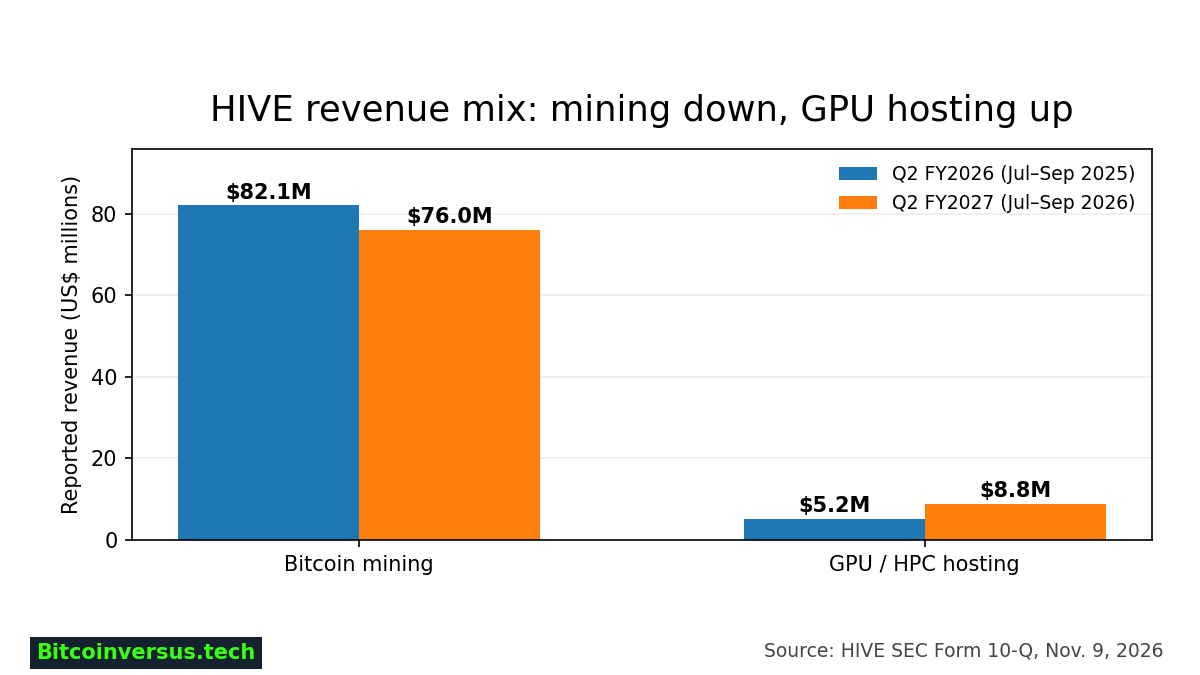
HIVE’s Q3 results also show revenue from AI and high-performance computing hosting rising 70.7% to $8.8 million. Its two businesses make money in different ways: Bitcoin mining machines compete to earn Bitcoin, while GPU servers provide computing power to paying customers.
Archival HIVE-hosted media: CEO Aydin Kilic discusses the convergence of blockchain and artificial intelligence at Paris Blockchain Week in April 2025. HIVE’s official media page identifies the video; it does not depict or verify the November 2026 financial results. Credit: HIVE Digital Technologies/YouTube.
More mining output, less mining revenue
The production increase was (1,070 − 718) ÷ 718 = 49.0%. Revenue moved the opposite way: ($76.038 million ÷ $82.073 million − 1) × 100 = −7.4%. The quarterly filing attributes the gap chiefly to lower average Bitcoin prices, partly offset by higher rewards associated with HIVE’s global hashrate and changes in mining difficulty. A count of Bitcoin received is not a profit measure.
Higher output can coincide with lower earnings when network competition, power charges, Bitcoin prices and hardware replacement costs shift. BitcoinVersus.Tech’s hashprice analysis explains why revenue per unit of computing power can narrow independently of fleet growth. The company reported total revenue of $84.9 million, down 2.7% from a year earlier.
Why accountants reduced ASIC equipment value
HIVE assessed its ASIC fleet for recoverability as lower expected mining cash flows and market resale values weakened the economic case for holding older equipment. Under U.S. accounting rules, the company concluded that expected undiscounted cash flows were insufficient to support the asset group’s carrying amount and recognized a $31.2 million impairment. A write-down reduces book value; it does not mean an additional $31.2 million in cash was paid during the quarter.
The company also recognized about $54.9 million of depreciation and reported a $78.7 million net loss. Depreciation and impairment are separate accounting charges and should not be confused with current-period electricity expenses. As BitcoinVersus.Tech’s ASIC-versus-facility efficiency explainer notes, chip specifications do not by themselves establish delivered electricity cost or site-level return.
GPU hosting grew, but mining remains dominant
BUZZ HPC hosting revenue increased from approximately $5.2 million to $8.8 million, supported by NVIDIA B200 GPU capacity deployed at HIVE’s Manitoba operation. HPC represented about 10.4% of the $84.9 million quarter, calculated from the reported segment and consolidated figures. The company cited contracted AI infrastructure opportunities, but forward-looking annualized contract values are not the same as revenue already recognized.
The expansion echoes a broader power-infrastructure shift documented in BitcoinVersus.Tech’s TeraWulf AI-leasing report. Yet it is premature to assume every Bitcoin mine can become an AI data center: GPU hosting needs different networking, redundancy, cooling, customer contracts and capital expenditure. The site’s Core Scientific margin analysis illustrates similar pressure from power and accounting costs.
What to watch next
The most informative follow-up measures will be HIVE’s realized mining margin, ASIC write-downs, deployed GPU revenue, electricity consumption and the cost of converting mining power infrastructure into higher-availability facilities. Greater Bitcoin production is real, but the quarter’s loss and impairment show that computing output alone cannot settle a data center’s investment economics.
Sources and calculations
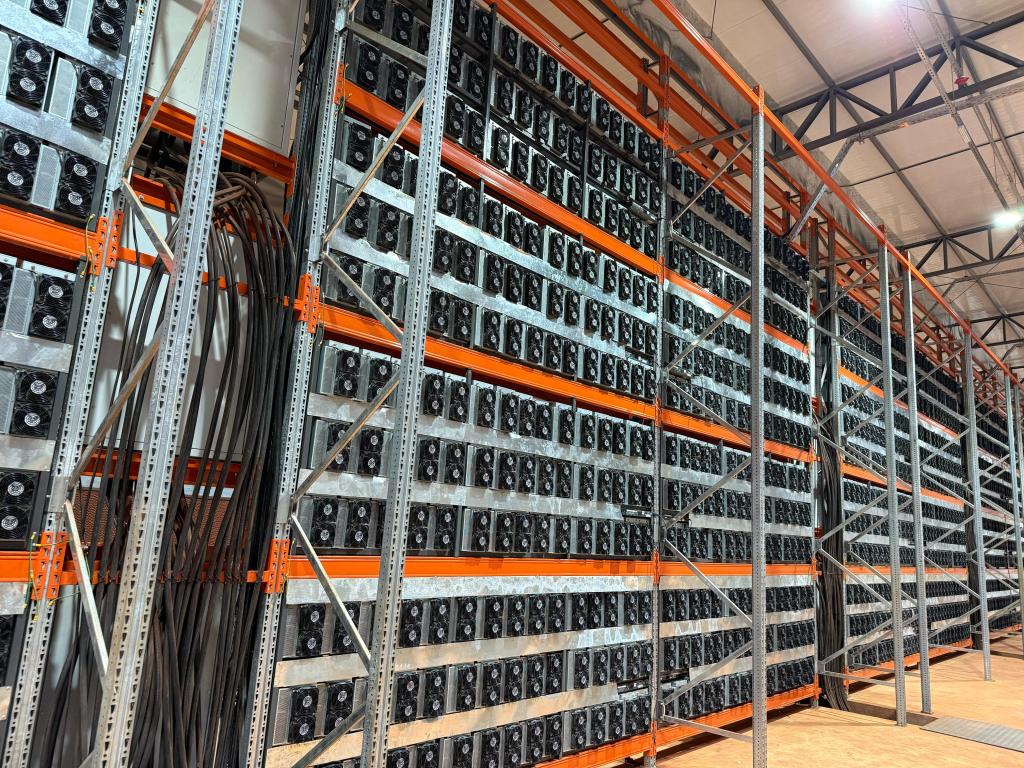
Primary documents: HIVE Form 10-Q, filed November 9, 2026; HIVE earnings release filed with the SEC; HIVE’s official April 2025 Yguazú equipment photograph. Calculations use quarterly, not annual, periods: (1,070−718)/718 = 49.0%; (76.038/82.073−1) = −7.4%; 8.844/84.882 = 10.4%. Figures are rounded.
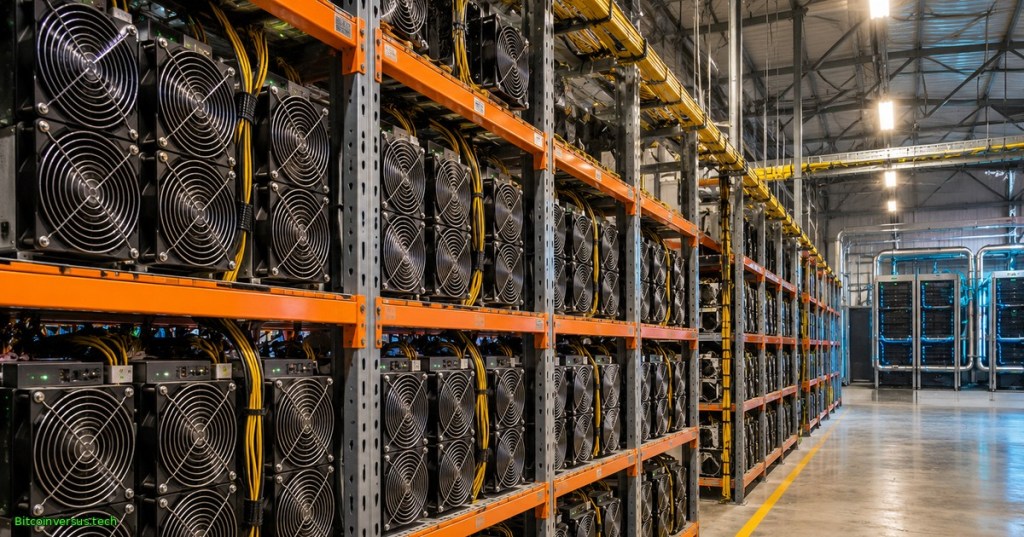
Editor’s Note: HIVE’s November 9 filing reports a fiscal quarter ended September 30, 2026. Bitcoin production, segment revenue, depreciation and impairment have distinct accounting definitions. The $31.2 million equipment impairment is non-cash, while its estimated recoverable value depends on management assumptions. Archived company imagery is labeled by original date. The branded featured cover is conceptual art, not a photograph of HIVE’s operating fleet, and does not reappear within the article. The archival YouTube panel provides industry background, not earnings evidence; playback and mobile-browser rendering need independent verification.
Support BitcoinVersus.Tech
An optional 5,000-satoshi donation supports independent, volunteer-led research. Scan the original BitcoinVersus.Tech QR with a compatible Bitcoin wallet. On mobile, view the QR on a second screen or use your wallet’s saved-image scanner if supported. Independently verify the destination address, network and amount before authorizing a Bitcoin transfer.

We volunteer daily to ensure the information on the BitcoinVersus.Tech platform is Verifiably True. Reporting is educational and informational, does not constitute investment or financial advice, and is not a recommendation to buy or sell securities or Bitcoin.


Leave a Reply