
Luxor’s Bitcoin mining derivatives market priced November 2026 through March 2027 hashrate contracts between $32.38 and $33.50 per petahash per second per day in its November 2 snapshot. The near-flat pricing followed a difficult October, when spot hashprice fell 17.9%, according to the firm’s November 5 market review. The quotes are market indications—not promised returns or a forecast guaranteed to materialize.
Hashprice estimates the gross daily Bitcoin reward earned by a unit of mining computing power, before electricity, equipment depreciation, pool charges and hosting fees. One petahash per second (PH/s) equals 1,000 terahashes per second. BitcoinVersus.Tech previously explained why hashrate and hashprice measure different things.
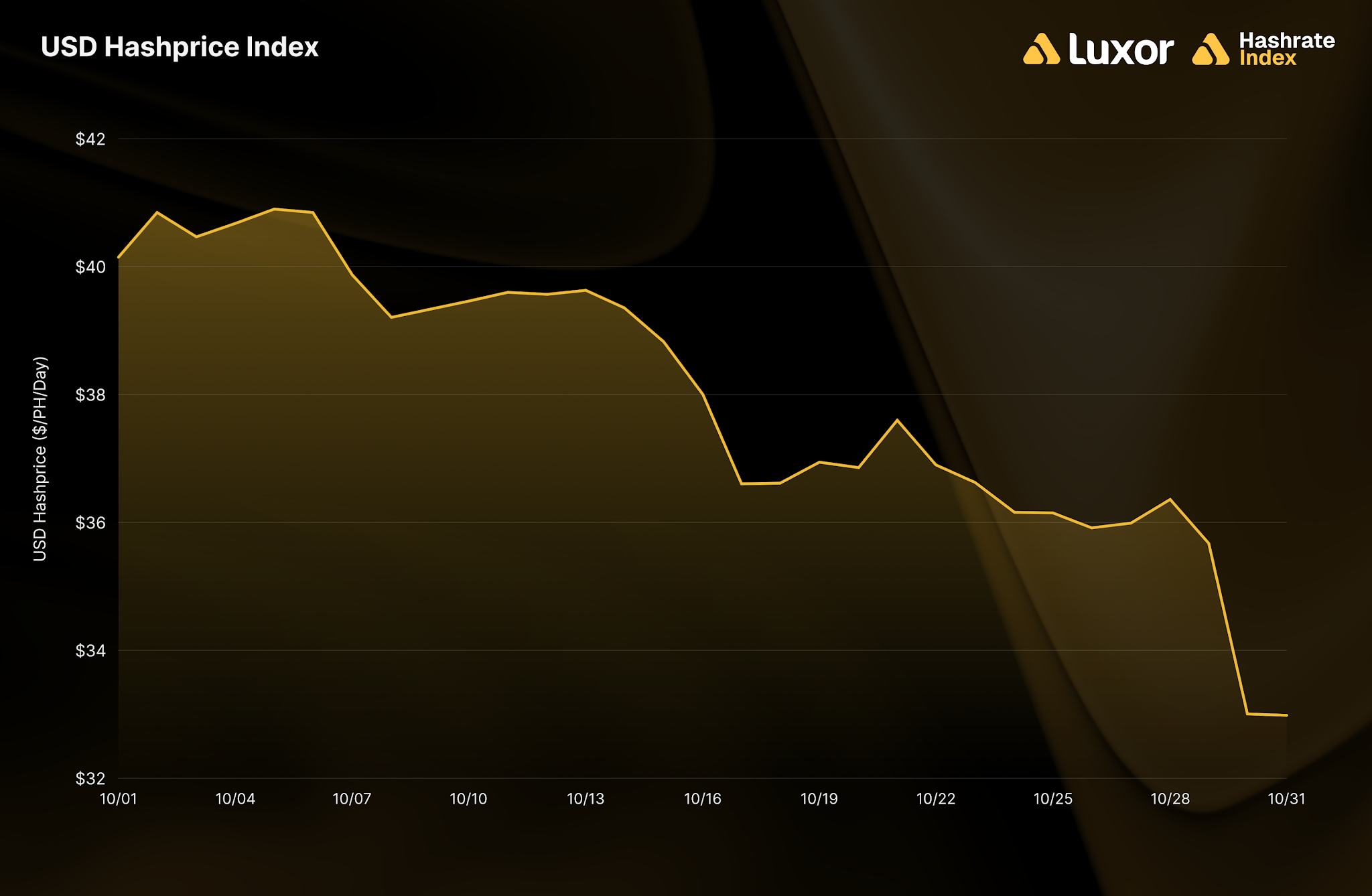
October squeezed miners from two directions
Luxor measured an October opening hashprice of $40.15 per PH/s/day and a closing value of $32.98, a drop of $7.17. Meanwhile, Bitcoin’s reported price fell from $84,049 to $77,332 and mining difficulty rose 11.76%, from 132.76 trillion to 148.36 trillion. A lower coin price reduces dollar-denominated rewards; rising difficulty spreads available block rewards over more mining work.
Difficulty increased 5.92% on October 16 and another 5.54% on October 29. BitcoinVersus.Tech documented the second adjustment and its effect on mining revenue. Luxor calculated that the seven-day average network hashrate rose from 976 to 1,067 EH/s between September 30 and October 31, partly as Texas miners resumed operations after the summer grid-demand period.
Forward contracts suggest a pause
A hashrate forward lets participants fix exposure to future mining revenue rather than relying only on prevailing daily returns. Luxor’s November 2 mid-market marks for five monthly USD-denominated contracts, November through March, stood between $32.38 and $33.50 per PH/s/day. The comparable spot reading was $33.10. Over October, forward quotations fell 11.6% to 15.5%, less than the 19.1% drop in spot measured over the same October 5–November 2 window.
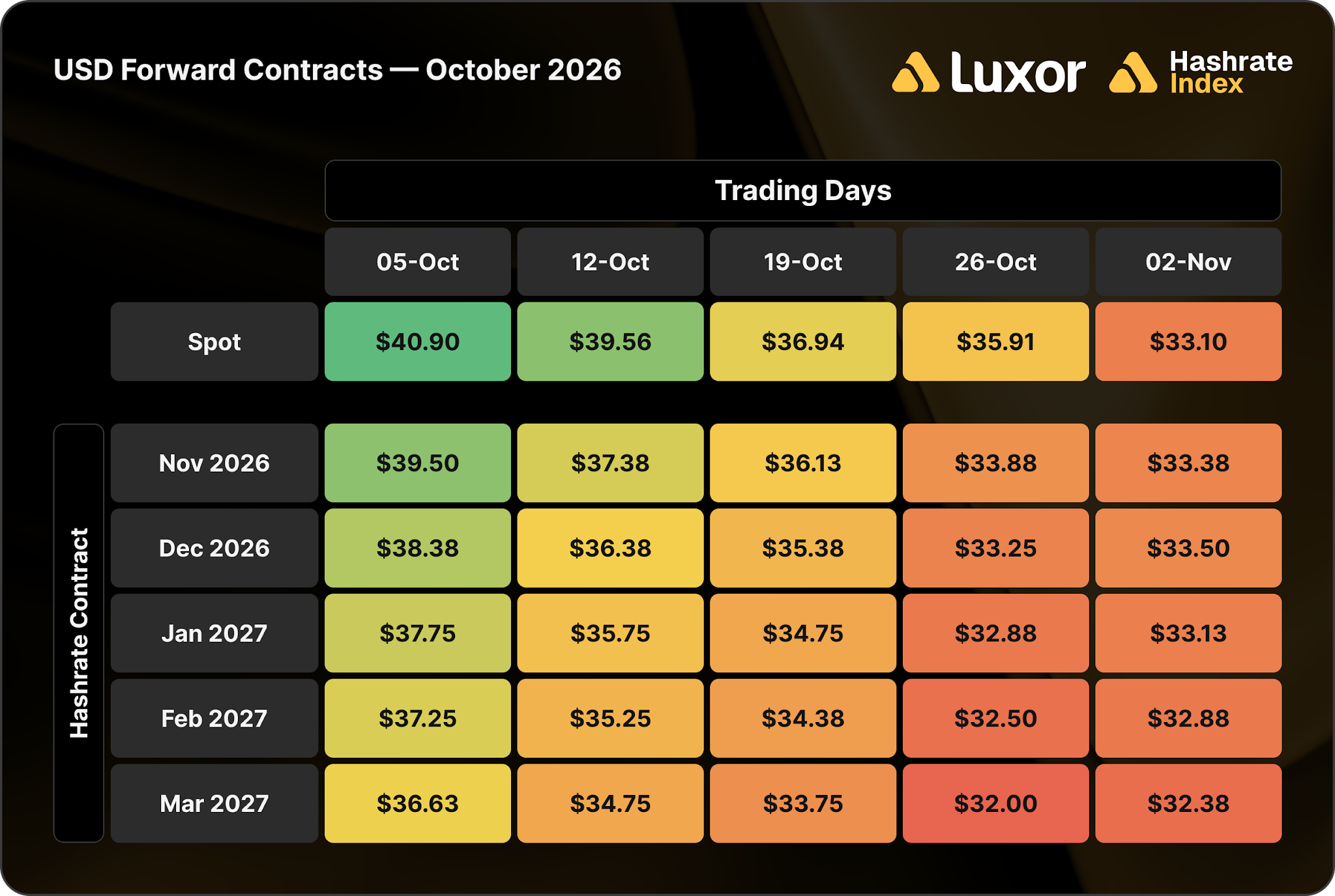
At the $32.98 October closing spot rate, a hypothetical continuously productive 1 EH/s fleet would earn approximately $32,980 in gross mining rewards per day before costs. Actual production varies with pool mechanics, uptime, block luck, network conditions and fees. BitcoinVersus.Tech previously modeled electricity limits for a 200 TH/s Antminer S21.
Hedging offers certainty, not free money
October’s average spot settlement was $37.97 per PH/s/day. Luxor found that a one-month USD forward sold in September at $38.51 beat the eventual settlement by approximately 1.4%, while four earlier USD sales underperformed it. A contract can stabilize future receipts and still deliver less than spot mining. The analysis excludes trading fees, spreads and transaction-specific credit costs.
Luxor also reported 6%–13% annualized BTC-denominated financing spreads in its deliverable and non-deliverable hashrate markets. Earlier BitcoinVersus.Tech coverage explored how hashrate contracts can finance mining operations. Such financing carries counterparty and liquidity risks, not just mining-price exposure.
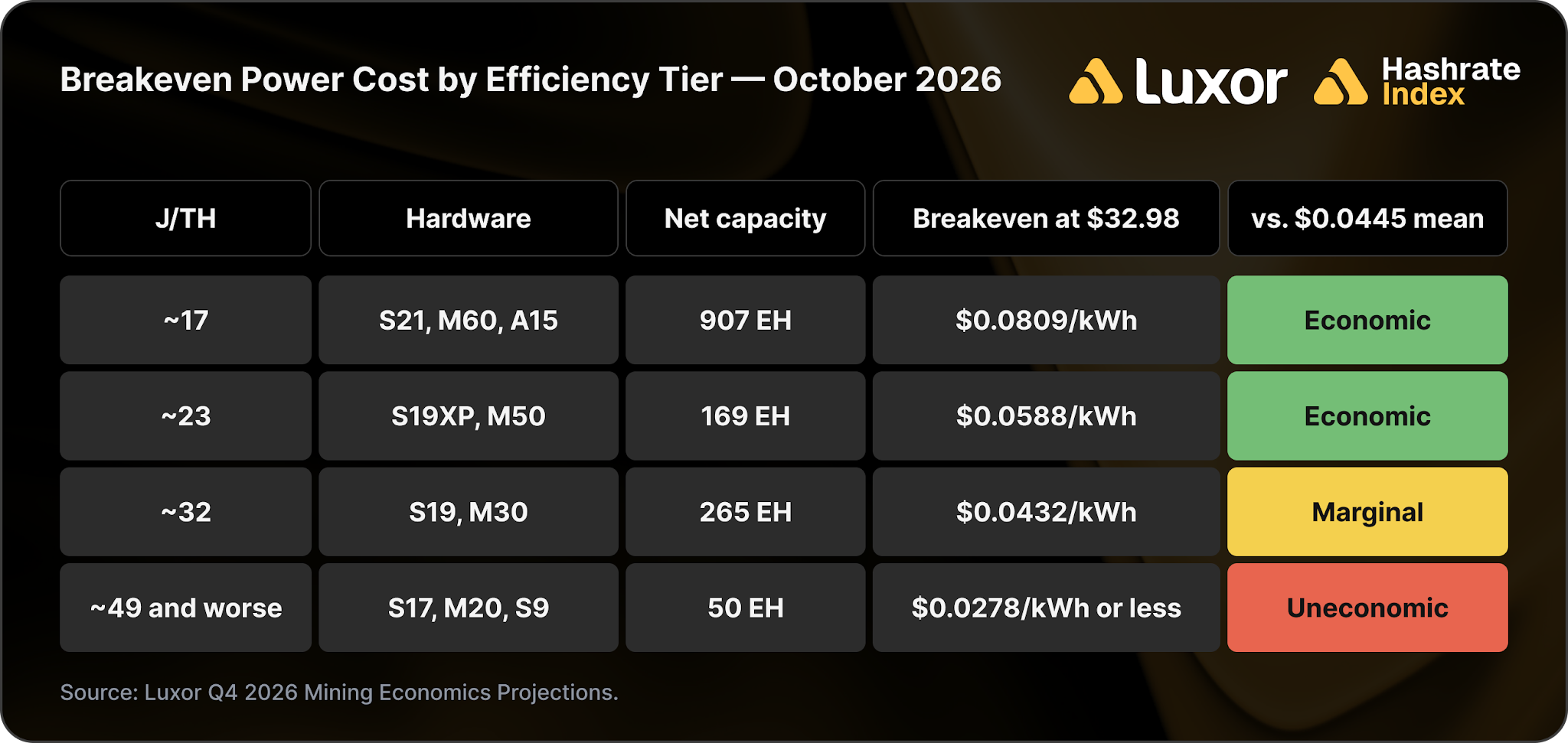
Power efficiency still determines survival
Luxor estimated that a roughly 32 J/TH mining fleet required electricity at or below 4.32 cents per kWh to break even on power at October’s closing hashprice. A roughly 49 J/TH fleet needed 2.78 cents per kWh or less. Those are model-based power-only thresholds; labor, repairs, capital expenses and miner depreciation further reduce profitability.
The immediate signal is modest forward-market pricing after a steep spot contraction, not proof that difficulty or Bitcoin prices have stopped moving. A change in coin price, grid conditions or active hashrate could materially shift the market before any contract settles.
Editor’s Note: The $32.38–$33.50 forward range, $33.10 November 2 spot snapshot, 17.9% October spot decline, hashrate, difficulty, hedging comparisons and electricity break-even examples were checked against Luxor’s November 5, 2026 October Hashrate Lookback and its November 2 market roundup. Historical settlement values are not current offers. Forward marks are indicative mid-market prices; costs, spreads and counterparty risk matter. The 1 EH/s illustration assumes constant hashprice and full uptime, excludes all operating costs and is not a forecast. Charts and featured cover originated with Luxor / Hashrate Index and are credited. No relevant verified official YouTube video was available. Independent public-browser and mobile layout verification remains outstanding.

To donate 5,000 sats, open the article on a separate display and scan the original QR code with a compatible Bitcoin wallet. On mobile, use another screen or your wallet’s supported image-scanning feature. Verify the destination 3C9o19EH5HSiwEPyCTmEKzxhNCbo2X6TTb before sending.
We volunteer daily to ensure the information on this platform is Verifiably True. If you would like to support the research, please scan QR code.
BitcoinVersus.tech is not a financial advisor. Coverage of Bitcoin mining economics and derivatives markets is for informational purposes.


Leave a Reply