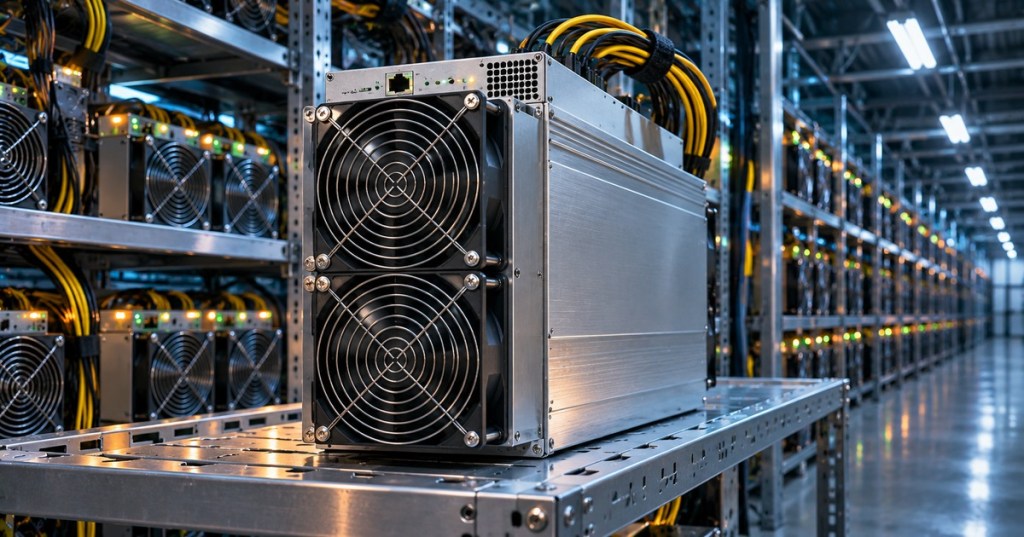
Bitcoin mining economics tightened into November 1, 2026, as estimated hashprice fell to about $33 per petahash per second per day, down from $36.20 on October 24. For the original Bitmain Antminer S21 rated at 200 TH/s and 3,500 W, those figures imply $6.60 in daily gross mining revenue and an electricity-only break-even price of approximately 7.86 cents per kilowatt-hour. This is a calculation, not a guaranteed payout.
Bitcoin’s difficulty reached 148.36 trillion on October 29, a 5.54% increase confirmed by blockchain records. The resulting competition helps explain why revenue per unit of hashrate matters more than total computing power alone. The November 1 hashprice reading is a provisional daily estimate that can change with Bitcoin prices, transaction fees and block production.
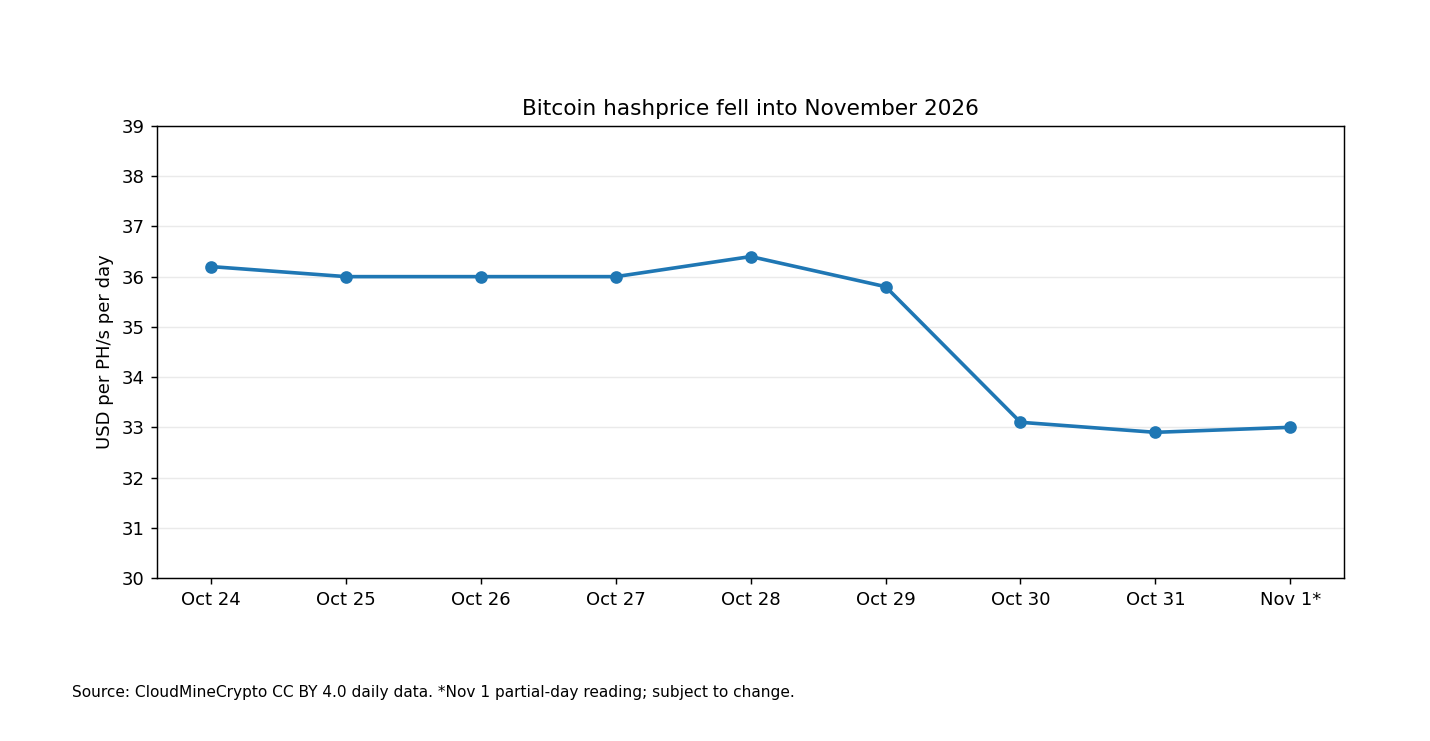
What one 200 TH/s machine earns
The S21’s 200 TH/s equals 0.2 PH/s, so 0.2 times $33 is $6.60 a day before expenses. Bitmain specifies 3,500 W at 25°C, equivalent to 84 kWh over 24 hours at continuous rated operation. At five cents per kWh, electricity consumes $4.20 and leaves $2.40 before other expenses. At eight cents, power costs $6.72, leaving a 12-cent daily shortfall even before cooling, hosting, maintenance, purchase cost and taxes.
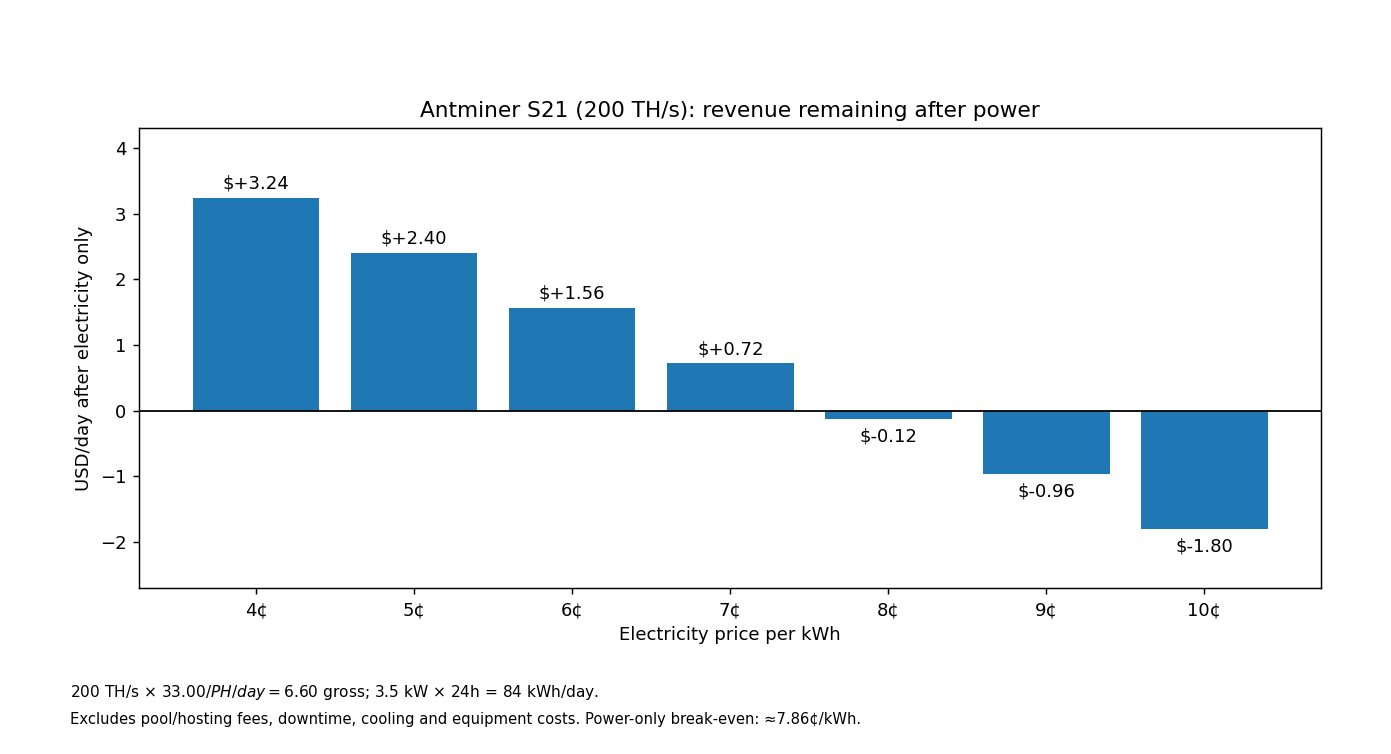
Why wall power matters more than advertised speed
The threshold is not a universal profitability point. Pool fees and downtime reduce realized revenue; cooling and power-distribution losses can raise effective energy costs. Actual hashrate and wall draw fluctuate, and a hosted miner may pay contract fees exceeding the power tariff. The distinction between nameplate and wall joules per terahash matters when comparing ASICs with different efficiency ratings.
For operators, the immediate decision is whether measured wall-power cost and accepted shares support keeping individual machines online. Compare the site’s October mining-profitability ranking with updated hashprice instead of carrying forward older revenue assumptions. More efficient equipment may face different thresholds; the latest air-cooled efficiency comparison explains why.
The next difficulty adjustment and Bitcoin’s market price will change these numbers. The October 29 difficulty report covers the network-wide event; today’s chart isolates what it means for one older 200 TH/s model. The examples are dated scenarios, not forecasts or an equipment-buying recommendation.
BitcoinVersus.Tech
BitcoinVersus.Tech Editor’s Note: We volunteer daily to ensure the credibility of the information on this platform is Verifiably True. If you would like to support our work and help further secure the integrity of our research initiatives, please scan the QR code below to donate 5,000 sats. For best results, scan the QR code from a laptop or larger screen.

Bitcoin address: 3C9o19EH5HSiwEPyCTmEKzxhNCbo2X6TTb. On a phone, open the QR image on another screen or copy and verify the address in your wallet before sending.
BitcoinVersus.tech is not a financial advisor. This media platform reports on financial subjects purely for informational purposes.


Leave a Reply