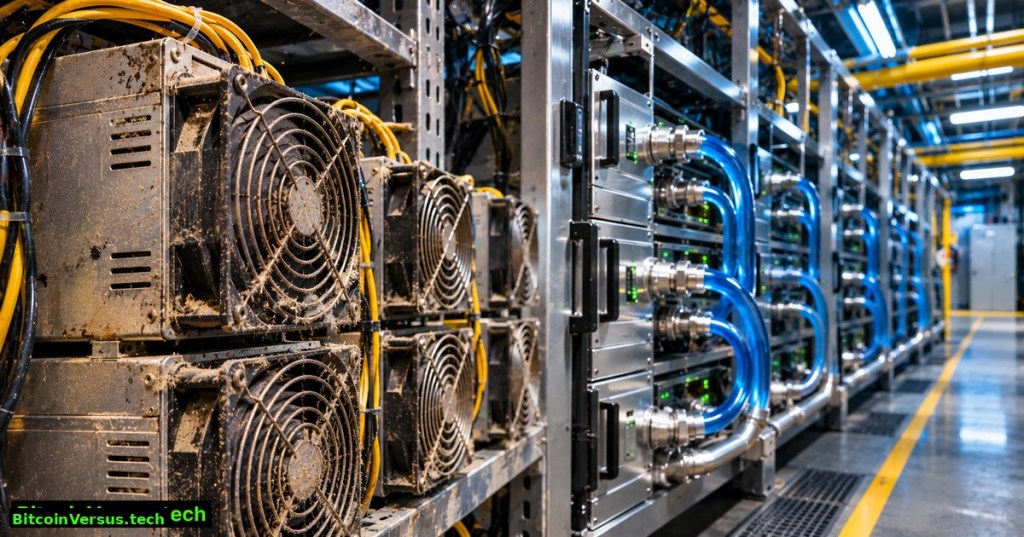
Bitcoin miners are confronting a narrow electricity-cost margin as hashprice trades near $28 per petahash per second per day. Data tracker Ziven recorded $27.79 per PH/s per day on November 20, 2026, with a seven-day network hashrate estimate around 1,009 EH/s and difficulty of 134.82 trillion. Those figures are a dated snapshot, not a guaranteed future mining payout.
The critical engineering question is how much electricity a miner consumes to produce the same quantity of hashes. At an identical reward rate, an 8.9-joule-per-terahash ASIC can tolerate a much higher electricity tariff than one operating at 28 J/TH. The margin still needs to support cooling, staff, repairs, pool charges and the cost of buying the machines.
Luxor Technology, June 2, 2026: an original-source explanation of hashprice, difficulty, transaction fees and the market for mining hashrate. Educational context predating the November 20 snapshot.
What $27.79 pays for one petahash
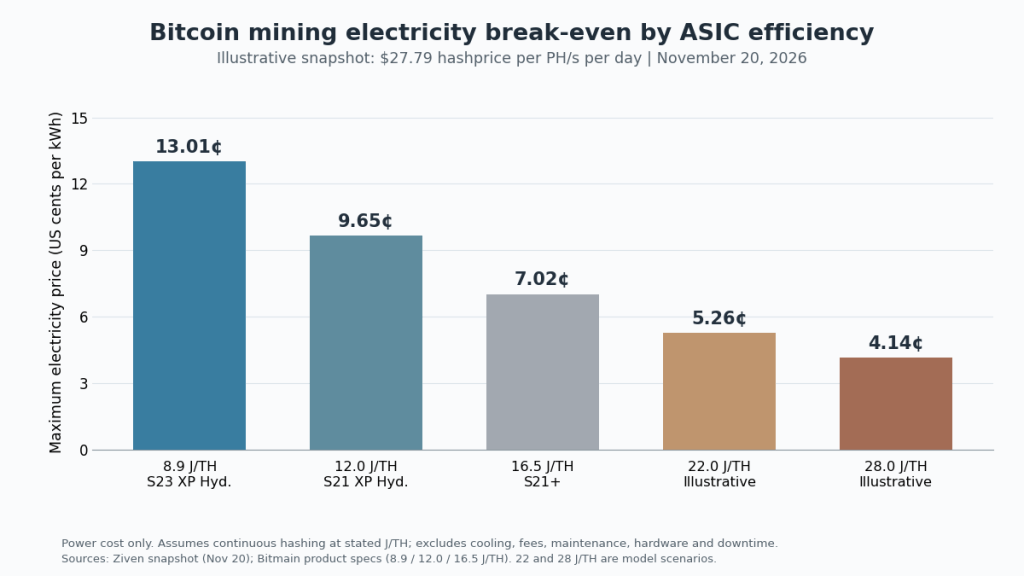
One petahash per second equals 1,000 terahashes per second. At a power efficiency of 12 J/TH, maintaining 1 PH/s consumes approximately 12 kilowatts, or 288 kilowatt-hours daily. Dividing $27.79 in expected gross daily revenue by 288 kWh yields an electricity-only break-even tariff of 9.65 cents per kWh.
The general calculation is: maximum power tariff in dollars per kWh = hashprice in dollars per PH/s per day ÷ (24 × J/TH). The relationship assumes continuous operation at the stated wall-plug efficiency, no interruptions and the observed hashprice. Pool fees or parasitic electrical loads lower the allowable tariff.
How three real ASIC specifications compare
BITMAIN lists the liquid-cooled S23 XP Hyd. at 600 TH/s and 5,340 watts, equivalent to 8.9 J/TH. At the snapshot hashprice, one unit would generate roughly $16.67 in expected gross revenue per day. At 10 cents/kWh, its specified 128.16 kWh daily draw would cost approximately $12.82, leaving about $3.86 before every other expense.
The company also lists the S21 XP Hyd. at 473 TH/s and 5,676 watts, or 12 J/TH. A 16.5 J/TH S21+ has an electricity-only break-even near 7.02 cents/kWh at the same hashprice. Both values assume rated power efficiency; hydro cooling pumps, dry coolers and auxiliary equipment increase the site-level electricity bill. Actual ASIC output also varies with temperature and settings.
Why lower difficulty does not fix every mine
Bitcoin mining difficulty fell 9.13% in the November 14 adjustment, improving expected block rewards for a constant individual hashrate compared with conditions immediately before the retarget. However, dollar-denominated hashprice also changes with Bitcoin’s market price, transaction fees and competition. An easier network does not guarantee an ASIC will cover its power bill.
Published network hashrate estimates also differ because a 24-hour block sample and a seven-day moving window can produce different answers. Hashrate is inferred from observed block production, not counted by a global electricity meter. Hashrate and hashprice describe different measurements, and operators should avoid treating either as an exact instantaneous fact.
BitMaker, July 23, 2026: independent technical analysis of miner shutdowns, newer ASICs, mining difficulty and the economics of low-margin machines. The video predates the current pricing snapshot.
The next decision is electrical, not merely financial
Power contracts make a crucial difference. The site previously examined a single miner at a $33 hashprice reference point and compared the 8.9 J/TH S23 XP Hyd. against older hardware. The latest snapshot presents a lower estimated revenue environment, making fleet tuning and utilization decisions more consequential.
Miners facing time-of-use tariffs should evaluate revenue against the hourly cost of operation. Recent Texas power-market analysis showed how changing electricity prices can render otherwise productive hashing uneconomic. The same logic applies to sites combining cheaper fixed-rate power, curtailment credits and newer ASICs.
A 13-cent electricity ceiling on a leading ASIC does not imply healthy profit at 13 cents. It marks the point where modeled mining revenue merely matches the machine’s own electrical consumption. Operators need a lower all-in tariff, reliable uptime and sufficient hardware life to create sustainable earnings.
Sources and methods
- Ziven, public miner network dashboard and November 20, 2026 hashprice snapshot
- BITMAIN S23 XP Hyd., 600 TH/s, 5,340 W, 8.9 J/TH
- BITMAIN S21 XP Hyd., 473 TH/s, 5,676 W, 12 J/TH
- BITMAIN S21+, 216 TH/s, 3,564 W, 16.5 J/TH
- Hashrate Index, mining hashprice and difficulty methodology
- Luxor Technology, Hashrate Markets Explained, June 2, 2026
- BitMaker, Is Bitcoin Mining Over?, July 23, 2026
Editor’s Note: We volunteer daily to ensure the credibility of the information on this platform is Verifiably True. If you would like to support to help further secure the integrity of our research initiative, please scan the QR code below

For mobile scanning, open the article on another display and scan the QR code with a Bitcoin wallet. The voluntary donation amount is 5,000 sats. Verify the receiving address 3C9o19EH5HSiwEPyCTmEKzxhNCbo2X6TTb before sending.
BitcoinVersus.Tech publishes technology and financial journalism for informational purposes and does not provide financial, investment, or legal advice.


Leave a Reply