
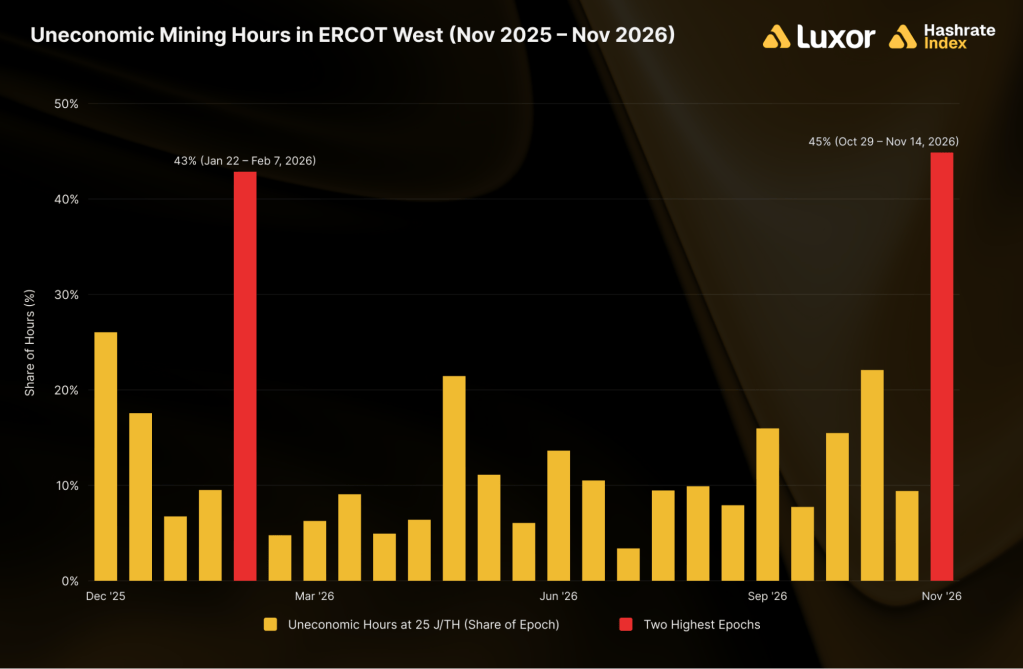
A sudden collapse in West Texas wind generation helped push Bitcoin mining electricity costs above the revenue of a modeled 25 J/TH ASIC during 45% of hours between October 29 and November 14, 2026, compared with just 9% during the previous difficulty period. The sharp reversal, documented in a November 17 Luxor Hashrate Index analysis, helps explain why even functioning miners sometimes earn more by shutting down than producing Bitcoin.
The result describes a specific fleet-efficiency model and ERCOT West real-time electricity prices, not a measured shutdown rate for every Texas mine. Luxor estimated gross mining revenue of approximately $54 per megawatt-hour consumed for a 25 joule-per-terahash machine over the October 29 to November 14 period, equivalent to 5.4 cents per kilowatt-hour before electricity and other operating expenses.
Official Luxor Energy tutorial published June 10, 2026, demonstrates automated Texas peak-load avoidance. The video predates November’s price disruption and is included for operating context. Watch source video.
A wind shortage and constrained transmission changed the economics
Luxor reported West Texas wind production falling from approximately 12.6 GW on November 4 to 1 GW on November 7–9. Import capacity was constrained on 345-kV transmission lines, leaving West Texas electricity approximately $47/MWh more expensive than the rest of the state on November 9. Average daily local prices ranged from $64 to $122/MWh between November 7 and 11, above the modeled $54/MWh miner revenue benchmark on several days.
After sunset, reduced solar production compounded the squeeze. West Texas evening prices averaged $80–$98/MWh over the cited period. A November 11 statewide shortage also produced prices around $500–$650/MWh near 9 p.m. in several ERCOT regions. Renewable intermittency alone does not explain all of the variation; transmission congestion, demand and generation dispatch influence wholesale pricing.
Why electricity mattered more than Bitcoin’s price
The share of uneconomic hours climbed 36 percentage points, from 9% to 45%. Luxor’s counterfactual model found that applying newer power prices while keeping the earlier mining revenue benchmark would have raised the share to 39%, a 30-point increase. Applying only the lower mining revenue at previous power prices would have reached 17%, an eight-point increase. The components are separate what-if calculations, not additive portions of an actual hourly ledger.
Bitcoin mining difficulty fell 9.13% on November 14 following slower block production. Luxor attributed much of the network’s temporary hashrate withdrawal to energy conditions, while warning that its regional estimate was not a direct measurement of every operator. The report also complements our earlier coverage of ERCOT large-load rules.
Bitcoin Magazine’s May 2026 energy panel features Luxor and industry participants discussing ERCOT, mining curtailment and the economics of flexible computing. Archival background, not footage of the November outage. Watch source video.
The financial choice: mine Bitcoin or sell back electricity
Miners exposed directly to spot prices may shut down to avoid losses, while operators with suitable fixed-price contracts may be able to return purchased power for credits. Riot Platforms’ September 30 Form 10-Q documents $24.664 million in third-quarter power credits, including $22.938 million from manual curtailment and $1.726 million from demand response. Those credits were earned before November and do not establish Riot’s earnings during the later spike.
An illustrative operator earning $54/MWh from mining while paying $35/MWh for contracted electricity keeps $19/MWh before other costs. If the contract instead permits power to be returned at a $100/MWh wholesale price, the $65/MWh credit beats mining margin by $46/MWh. Real eligibility depends on contract provisions, market rules and settlement arrangements. Our earlier Riot curtailment analysis and Luxor’s curtail-and-resume firmware controls explain the operating trade-offs.
A rebound could reverse the mining difficulty relief
West Texas power costs moderated to average daily prices of about $26–$43/MWh from November 13 to 15, and Luxor estimated network hashrate recovering toward 1,100 EH/s even as Bitcoin’s market price declined. Faster block discovery could cause a subsequent positive difficulty adjustment, but the magnitude remained a forecast based on incomplete block-interval data, not a confirmed retarget.
The case shows why grid-aware ASIC operation matters alongside chip efficiency. Power procurement, rapid controls, curtailment rights and local transmission constraints can determine profitability during short price shocks. Mining machines do not become more capable by switching off; operators can, however, preserve cash or obtain eligible power credits rather than hashing through a loss.
Primary sources and reporting method
Sources: Luxor Hashrate Index, November 17, 2026, using ERCOT electricity-price data and modeled mining energy hashprice; Riot Platforms Form 10-Q for Q3 2026. The time-window figures and chart reflect Luxor’s published model. They do not constitute a census of Texas mining shutdowns or guaranteed power-credit earnings.
Reporting Note: The original colored-pencil featured cover is conceptual artwork, not an actual photograph of the facilities discussed. The in-story chart is authentic Luxor research with attribution. Both YouTube videos predate the November 2026 event and illustrate grid-responsive mining technology.
Editor’s Note: We volunteer daily to ensure the credibility of information on our platform is Verifiably True. Support our research by scanning the QR code below to donate 5,000 sats.

For mobile scanning, open the article on another display and scan the QR code with a Bitcoin wallet. Verify receiving address 3C9o19EH5HSiwEPyCTmEKzxhNCbo2X6TTb before sending.
BitcoinVersus.tech provides technical and financial journalism for informational purposes only and does not provide investment, legal or cybersecurity assurance.


Leave a Reply