
Bitcoin mining difficulty fell 9.13% to 134.82 trillion on November 14, 2026, reversing the sharp increase registered two weeks earlier. The new target took effect at block 975,744, timestamped 05:02:50 UTC. For ASIC miners operating at unchanged hashrate, the adjustment raises expected Bitcoin subsidy earnings per hash by approximately 10.04%—although electricity bills, network fees and the market price of Bitcoin do not automatically improve.
Educational demonstration of how Bitcoin mining, SHA-256 and difficulty work, including a difficulty chapter around 09:42. Published April 26, 2024, before the November 2026 adjustment. Credit: Home Bitcoin Immersion Mining / YouTube. The video is background instruction, not contemporaneous footage.
What changed on the blockchain
The difficulty level decreased from 148,364,561,003,867 to 134,823,837,323,272. The percentage change is −9.1267%, rounded to 9.13%. Bitcoin retargets after every 2,016 blocks, aiming to keep the long-run average close to one block every 10 minutes. Miners do not vote on the new target, and no ASIC firmware update is needed to make the network adjustment take effect.
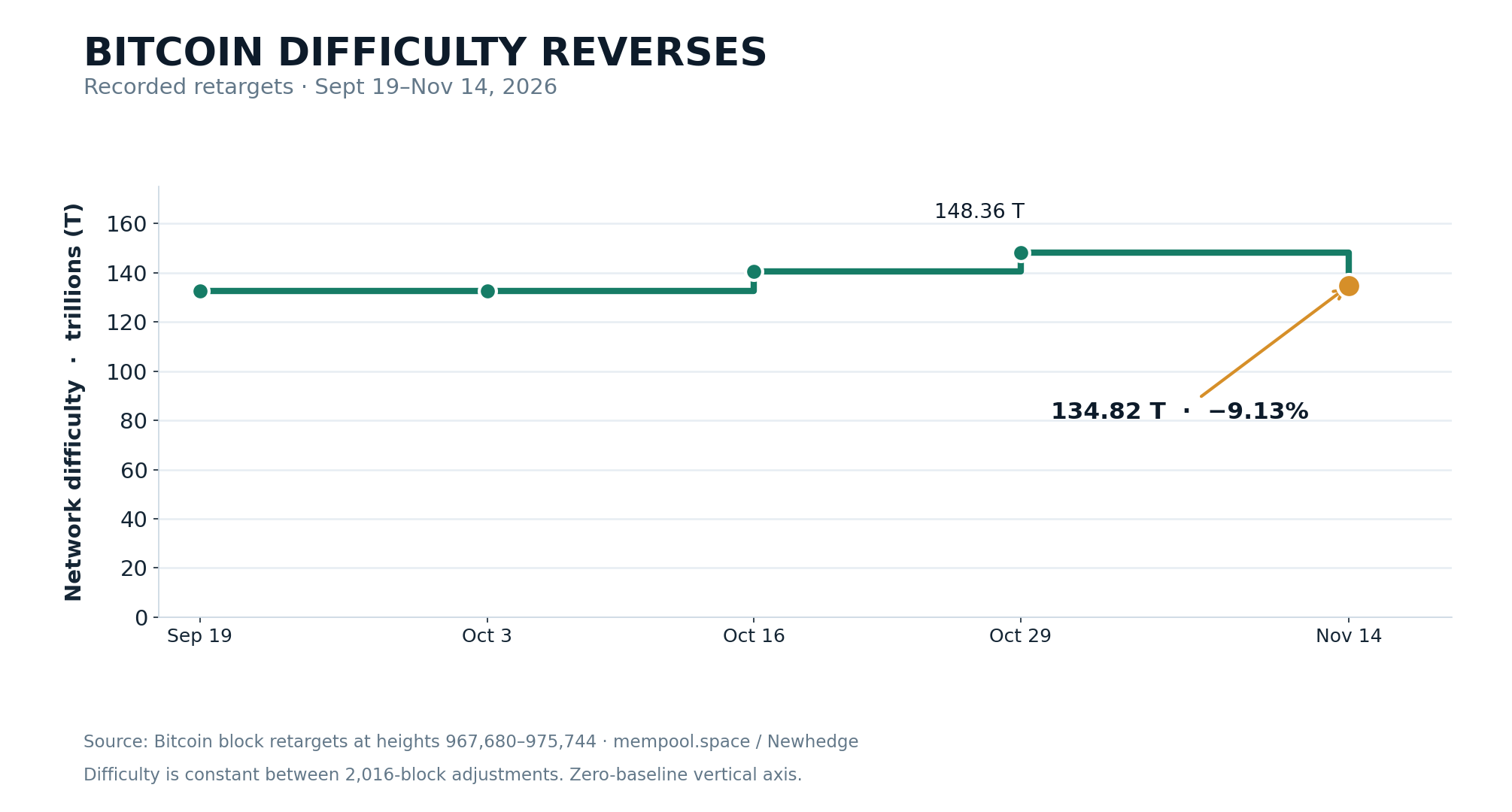
The previous October 29 increase to 148.36 trillion followed a 5.54% jump, leaving miners competing against a more demanding target. The subsequent 2,016-block period lasted roughly 15 days and 10 hours instead of the idealized 14 days. Slower block arrival implies lower effective hashing work over the period relative to the prior target, but block timing alone cannot identify which operators shut down machines or why.
What an unchanged mining machine earns
Difficulty and expected output move inversely. The new difficulty is approximately 90.87% of the old level, so an unchanged machine has 1 ÷ 0.908733 ≈ 1.10043 times its previous probability-adjusted daily Bitcoin subsidy, assuming an approximately 10-minute network block cadence and the same miner hashrate. The corresponding improvement is 10.04%, not 9.13%.
For a fleet producing 1 petahash per second (PH/s), the theoretical expected base subsidy rises from approximately 42,371 to 46,627 satoshis per day. The calculation uses a 3.125 BTC block subsidy, 86,400 seconds per day and Bitcoin’s difficulty-to-work factor of 2³². It excludes transaction fees and pool charges; actual daily results fluctuate because block discovery is random.
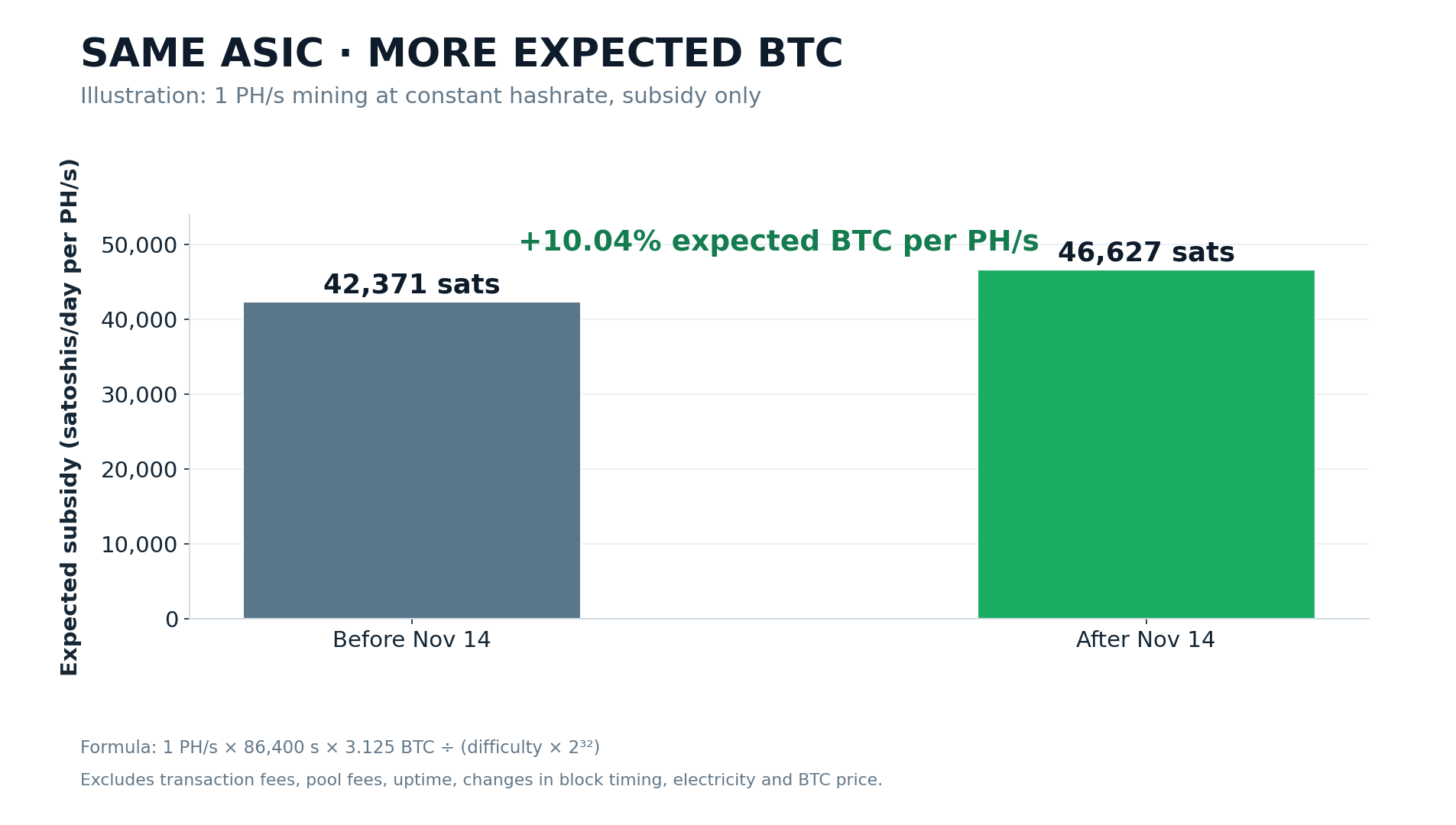
A 200 TH/s ASIC is one-fifth of 1 PH/s. Its expected subsidy would rise from roughly 8,474 to 9,325 satoshis per day under the same assumptions, while its electricity consumption per running hour would remain unchanged. BitcoinVersus.Tech previously modeled an S21-class miner’s power-cost threshold and explained hashrate versus difficulty. Both considerations remain essential when evaluating hardware economics.
Why profitability may not rebound
A difficulty cut is not proof that total mining profits rose. Bitcoin’s exchange price, the market value of transaction fees, power contracts, maintenance, cooling and ASIC depreciation all influence operating results. The Luxor hashprice discussion explains why miners track expected dollar revenue per unit of computing power, not difficulty alone. The recent Bitdeer efficiency and power-use analysis also demonstrates how fleet size changes aggregate consumption.
Mining capacity could return as conditions improve, reversing part of the short-term relief at a later retarget. Future difficulty estimates are provisional until the network actually reaches its next 2,016-block boundary. For now, the 9.13% fall is a verified network event; the 10.04% increase is a mathematical estimate for an unchanged mining position, not guaranteed earnings or a forecast of the next Bitcoin price.
Primary sources and calculations: Mempool open-source mining dashboard and recorded November 14 retarget; Bitcoin block 975,744; Newhedge historical difficulty table; Bitcoin Core proof-of-work implementation; verified 2024 educational mining-difficulty video. (134,823,837,323,272 ÷ 148,364,561,003,867 − 1) × 100 = −9.1267%; (148,364,561,003,867 ÷ 134,823,837,323,272 − 1) × 100 = +10.0433%. Expected satoshis/day at 1 PH/s = 10¹⁵ × 86,400 × 3.125 × 10⁸ ÷ (difficulty × 2³²).
Editor’s Note: The retarget, height and rounded difficulty are verifiable on the public Bitcoin blockchain and were cross-checked with independent tracking tables. The expected payout figures are theoretical averages at fixed hashrate and long-run 10-minute block cadence; they are not actual miner receipts, net profit, or a price prediction. The original 1200 × 630 colored-pencil featured cover is a conceptual mining illustration, not a photograph of the block’s producer. Original in-story charts use a zero baseline and cite their numerical inputs. The YouTube recording is historical educational context, not evidence that the November 14 event was filmed; independent live playback and mobile layout checks are reported separately. No unverified social-media post is represented as an authentic embed.

BitcoinVersus.Tech is volunteer-run and publishes independent educational technology reporting. An optional 5,000-satoshi donation supports ongoing research. Scan the original QR from a second screen with a compatible Bitcoin wallet; on mobile, use a wallet that supports scanning a saved image. Independently verify the recipient address 3C9o19EH5HSiwEPyCTmEKzxhNCbo2X6TTb and the payment amount before sending. Bitcoin transfers are generally irreversible.
We volunteer daily to ensure information on the BitcoinVersus.Tech platform is Verifiably True. Coverage is educational and informational and does not constitute financial or investment advice.


Leave a Reply