
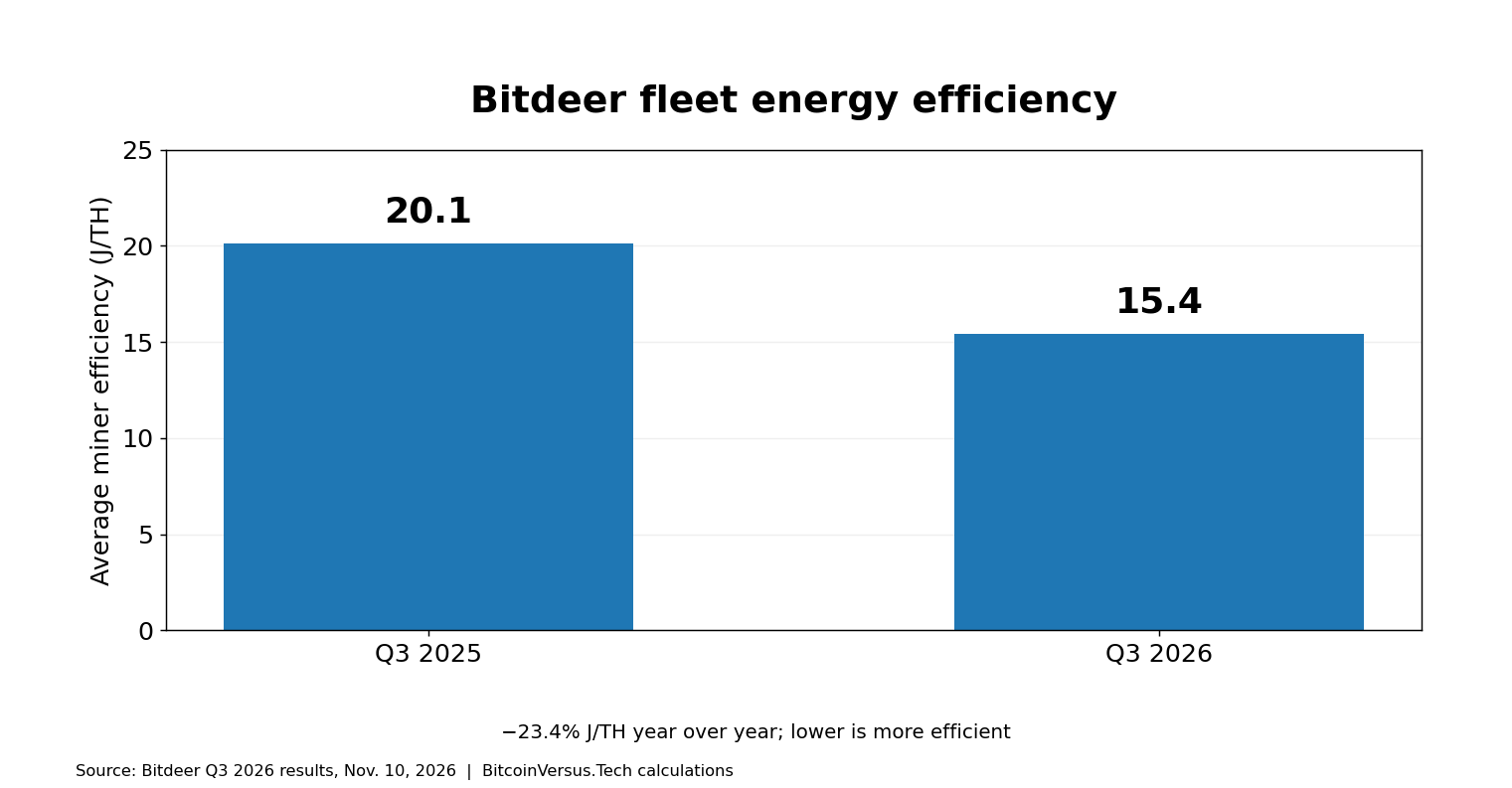
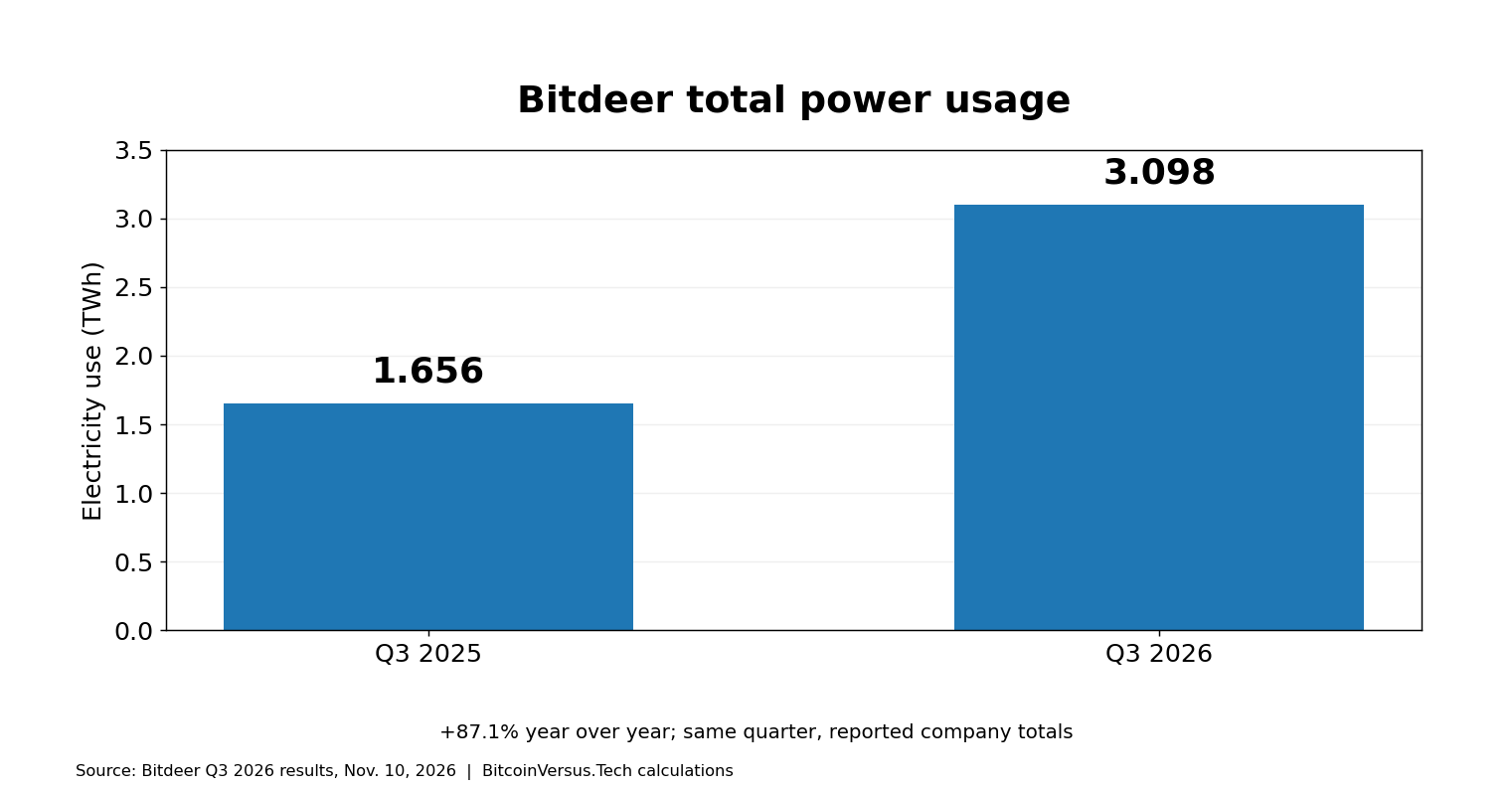
Bitdeer’s Bitcoin mining hardware became 23.4% more efficient per unit of hashing in Q3 2026, yet the company used 87.1% more electricity than a year earlier. The contrast, disclosed in Bitdeer’s November 10 earnings report, reflects a rapidly expanding mining fleet rather than a reversal in ASIC engineering progress.
Bitdeer reported average miner efficiency of 15.4 joules per terahash (J/TH), down from 20.1 J/TH in Q3 2025. Total quarterly power usage nevertheless climbed from 1.656 million megawatt-hours to 3.098 million MWh—equivalent to 1.656 and 3.098 terawatt-hours (TWh). Those figures are company-reported and unaudited.
Official Bitdeer demonstration of the SEALMINER A4 Ultra Hydro, published July 7, 2026. The video shows a product operating mode and does not independently verify Q3 fleetwide efficiency or electricity consumption. Credit: Bitdeer Official / YouTube.
A smaller energy cost per hash, a larger electricity footprint
J/TH measures the electricity required to sustain a given hashing rate: lower values mean less power is needed for identical computational output. At a constant 1 EH/s, 20.1 J/TH implies roughly 20.1 MW of miner load, while 15.4 J/TH implies 15.4 MW. The theoretical reduction is 4.7 MW, or 23.4%, before changes in utilization, site overhead and other loads.
Bitdeer simultaneously expanded its mining capacity. The company reported average self-mining hashrate of 79.6 EH/s during Q3 2026, compared with 29.1 EH/s a year earlier. A new co-mining operation contributed another 23.0 EH/s of average quarterly hashrate. Combined mining output rose to 3,855 BTC, versus 1,109 BTC in Q3 2025. More hashing across a much larger deployment can outweigh equipment-level efficiency gains.
SEALMINER chips improve efficiency, but fleet averages differ
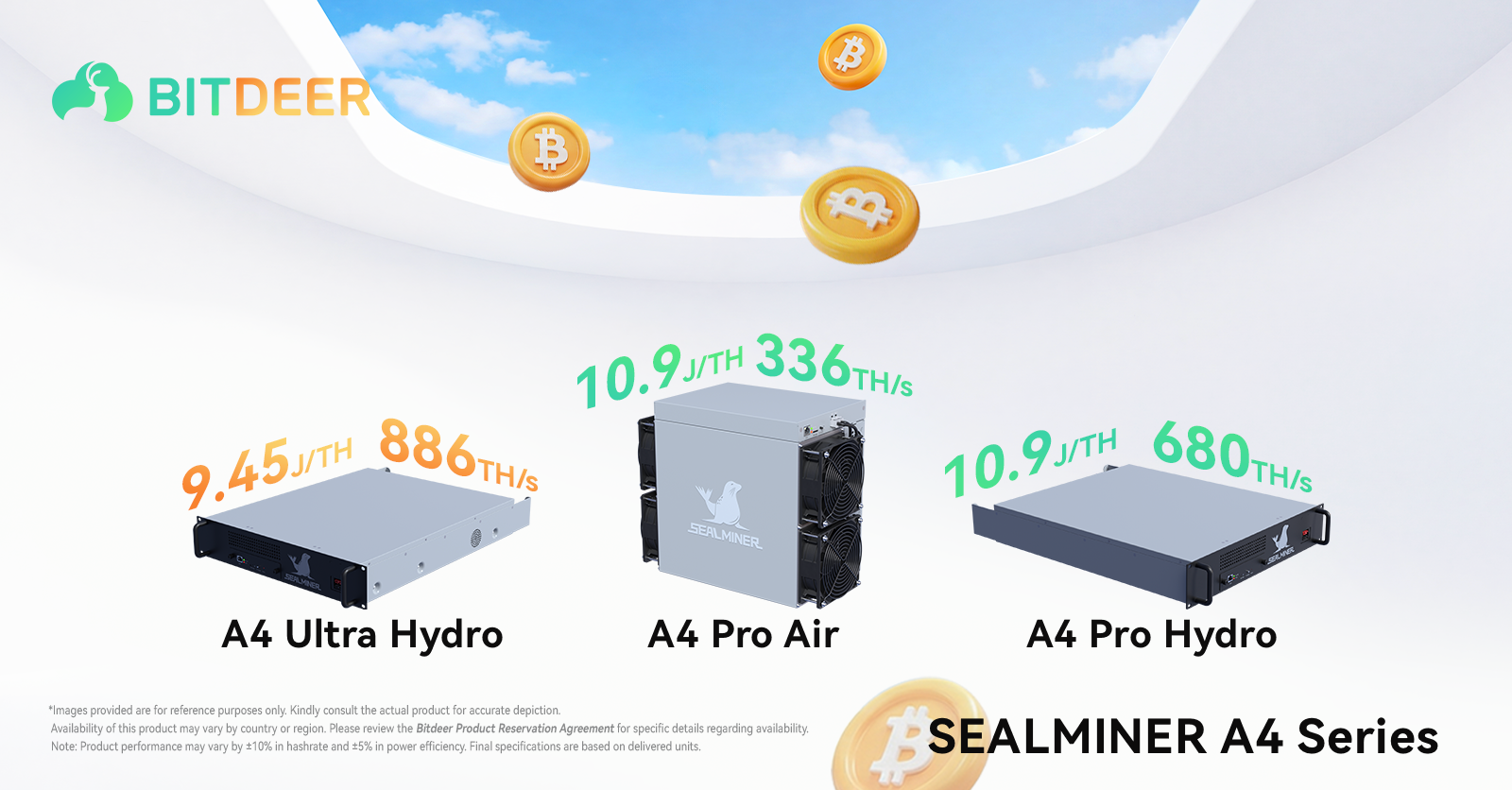
Bitdeer’s SEAL04 and SEALMINER A4 hardware offer a useful engineering comparison. Its A4 Ultra Hydro carries a manufacturer specification of 9.45 J/TH at 886 TH/s, substantially below the fleet average. However, a product specification, an individual chip demonstration and a weighted fleet figure describe different measurement boundaries. The 9.45 J/TH figure must not be treated as a measured average across Bitdeer’s operating sites.
Earlier BitcoinVersus.Tech coverage of Bitdeer’s falling external ASIC sales documented another side of its strategy: redirecting manufacturing output into proprietary and co-mining operations. The resulting fleet expansion helps explain rising company electricity demand.
Output gains do not guarantee stronger financial results
Average electricity prices also rose from $43 to $47 per MWh. Bitdeer recorded $320.7 million in total Q3 revenue, up from $169.7 million, while its net loss widened to $125.5 million from $30.1 million. Higher power and depreciation expenses were among the factors cited.
Equipment efficiency still matters for miners facing volatile Bitcoin prices and network difficulty. Recent PowerCompute fleet-replacement plans illustrate a different strategy: adding hashpower without increasing contracted electrical capacity. The latest ASIC efficiency comparison and our compute-per-joule analysis provide further context.
Bitdeer’s Q3 figures show why efficiency and total consumption must be reported separately. A lower J/TH rating establishes less miner power per hash—not lower aggregate electricity demand, lower grid impacts, or lower emissions. Those conclusions require information about fleet scale, operating hours, cooling overhead and each site’s actual electricity supply.
Primary sources and calculations: Bitdeer Q3 2026 results, Nov. 10; SEC 6-K exhibit; Bitdeer A4 specifications, Apr. 7; Bitdeer Official equipment demonstration, July 7. Calculation: (20.1−15.4)/20.1 = 23.38% less J/TH; (3,098,000−1,656,000)/1,656,000 = 87.08% more MWh. At constant 1 EH/s, 1 J/TH corresponds to 1 MW. Values rounded for readability.
Editor’s Note: Bitdeer’s Q3 2026 results are unaudited. The 15.4 and 20.1 J/TH figures describe average miner efficiency; the 3.098 TWh and 1.656 TWh figures describe total quarterly electricity usage. Metrics differ in scope and should not be divided to reconstruct site efficiency. The A4 image is manufacturer promotional media from April 2026; the official July YouTube video is archival product footage, not a recorded Q3 earnings presentation. The original colored-pencil 1200 × 630 cover is conceptual and does not depict a confirmed Bitdeer site. Two original charts use zero-based vertical bars, measured units and labeled periods. Playback and mobile layout require independent testing.

BitcoinVersus.Tech is volunteer-run and publishes independent educational technology reporting. An optional 5,000-satoshi donation supports ongoing research. Scan the original QR from a second screen with a compatible Bitcoin wallet; on mobile, use a wallet that supports scanning a saved image. Independently verify the recipient address 3C9o19EH5HSiwEPyCTmEKzxhNCbo2X6TTb and the payment amount before sending. Bitcoin transfers are generally irreversible.
We volunteer daily to ensure information on the BitcoinVersus.Tech platform is Verifiably True. Coverage is educational and informational and does not constitute financial or investment advice.


Leave a Reply