
OSNTC.041 examines forward error correction (FEC) on high-speed Ethernet links, where receivers use extra encoded information to recover certain transmission errors without requesting retransmission. On October 30, 2026, AMD published version 3.2 of its Versal 100G Ethernet MRMAC guide, documenting configurable FEC modes. The underlying technology predates that publication, but modern switch operators must understand how FEC interacts with optical modules, cables and port settings.
Cisco Optical Transceiver Tutorials, “Forward Error Correction for 100 GE QSFP,” published December 2016. Original manufacturer training on FEC for high-speed QSFP links; historical instruction rather than a current 400G qualification test. Credit: Cisco / YouTube, cross-referenced by HostingJournalist.
How Ethernet FEC works
A transmitter adds redundant symbols to each encoded block. A receiving decoder uses the additional information to detect and correct errors within the code’s limits. RS-FEC uses Reed–Solomon codes, while BASE-R FEC uses a different scheme. IEEE Ethernet clauses and the approved optical specification—not an assumed port speed alone—determine the required mode. Older OSFOEC.004 on PAM4 and bit-error ratio explains why faster multilevel signaling demands stronger signal-integrity margins.
Juniper’s 400G optics guide identifies RS(544,514), also associated with KP4 FEC, as the standardized 400G Ethernet code. Its 544-symbol codeword includes 514 data symbols and 30 parity symbols; up to 15 symbol errors can be corrected within the stated codeword model. A correction limit does not guarantee recovery from every distribution of physical errors.
Matching modes across the link
A FEC mismatch may keep a physical link down even when the optics and receive power appear acceptable. Cisco’s ACI FEC compatibility guide distinguishes CL74, CL91 and KP-FEC behaviors across supported hardware. Some 100G module types use host FEC, while other designs perform correction inside the optical module. Never assume identical FEC simply because two pluggables both say 100G.
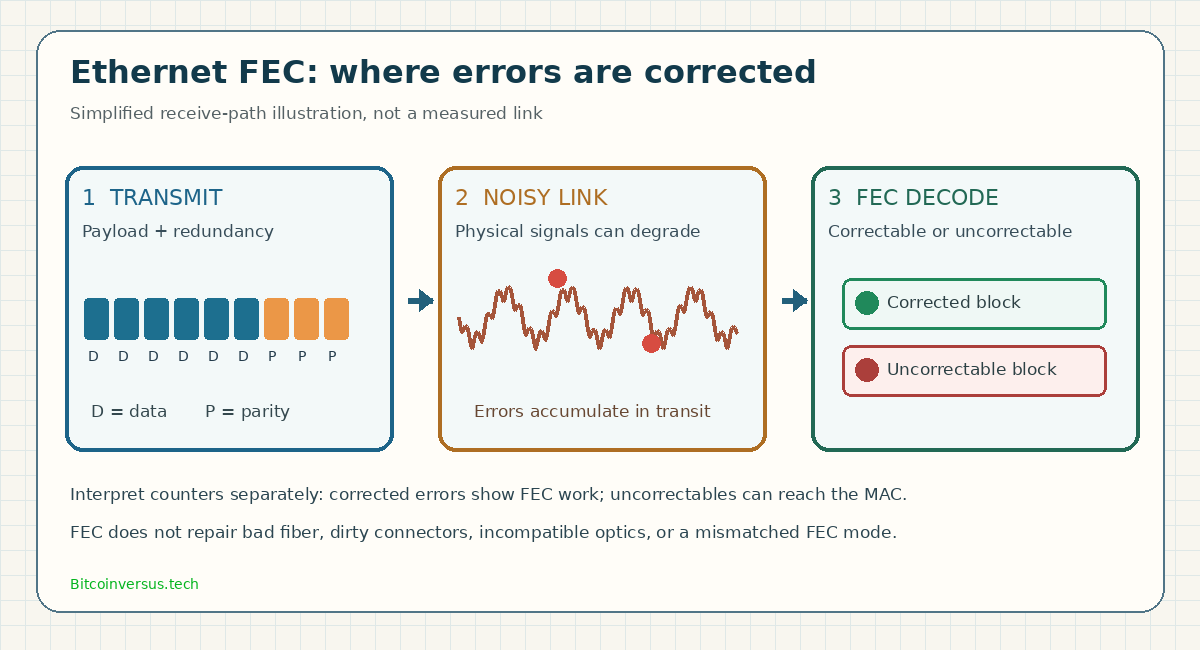
Corrected and uncorrectable counters
Corrected-codeword or corrected-symbol counters mean the receiver detected recoverable errors; they do not necessarily represent corrupted Ethernet frames delivered to software. Uncorrectable events, frame errors and link resets deserve separate investigation. For example, 1,200 corrected codewords in 600 seconds equal two corrected codewords per second. The ratio alone cannot establish optical compliance or the number of incorrect bits.
Before interpreting a counter, identify its unit, sampling period and whether it tracks pre-FEC or post-FEC behavior. Compare readings with interface loss-of-signal alarms, CRC/FCS counters, optical transmit/receive power and vendor-defined thresholds. Read OSNTC.040 on storm control to distinguish Layer 2 traffic suppression from physical-layer decoding.
Vitex Talks, “The Pros & Cons of Forward Error Correction in Data Center & Telecom Optical Networks,” October 19, 2023. Optical-transceiver supplier introduction to FEC benefits, additional latency and interoperability considerations. Credit: Vitex Direct / YouTube.
Read-only troubleshooting workflow
- Confirm the exact switch, adapter, optic and cable models, configured speed, breakout layout and both link-partner identities.
- Record each end’s operational FEC mode before proposing configuration changes; verify against vendor support matrices.
- Inspect supported corrected and uncorrectable counters over equal time windows and compare with FCS errors and optical diagnostics.
- Review OSNTC.036 LLDP port mapping and OSNTC.021 physical-port troubleshooting before escalating.
- Document suspected incompatibility, approved change control, validation criteria and a rollback plan; do not disable required FEC on a production link.
FEC improves reliability but cannot repair dirty connector faces, broken fibers, incompatible modules or inadequate optical margins. Its encoding and decoding introduce overhead and some latency. Device- and standard-specific implementation rules take priority over generic optimization advice.
Primary references: AMD 100G MRMAC Product Guide, version 3.2, October 30, 2026; Cisco, Understanding FEC in Optical Transceivers; Juniper 400G guide; Juniper FEC interface reference; Cisco ACI modes. The 1,200 ÷ 600 calculation is hypothetical, not operational telemetry.
Editor’s Note: OSNTC.041 is an educational chapter anchored to AMD’s October 2026 documentation update, not a report of a newly invented FEC standard or a measured network outage. The original 1200 × 630 colored-pencil cover contains restrained headings and a neon-green Bitcoinversus.tech watermark at bottom left. The original in-story illustration is conceptual. YouTube identities and publisher references were cross-checked, but playback, full-page mobile rendering and physical equipment behavior were not independently tested. No production configuration was changed.

BitcoinVersus.Tech is volunteer-run and publishes independent technical education. An optional 5,000-satoshi donation supports further research. Scan the original QR from a second screen using a compatible Bitcoin wallet. On the same phone, use a wallet that can import a saved QR image when supported. Independently verify recipient address 3C9o19EH5HSiwEPyCTmEKzxhNCbo2X6TTb and amount before sending. Bitcoin payments are generally irreversible.
We volunteer daily to ensure the information on BitcoinVersus.Tech is Verifiably True. Coverage is for education and information only; it is not an authorization to change production-network configurations, professional engineering certification, financial advice or investment advice.


Leave a Reply