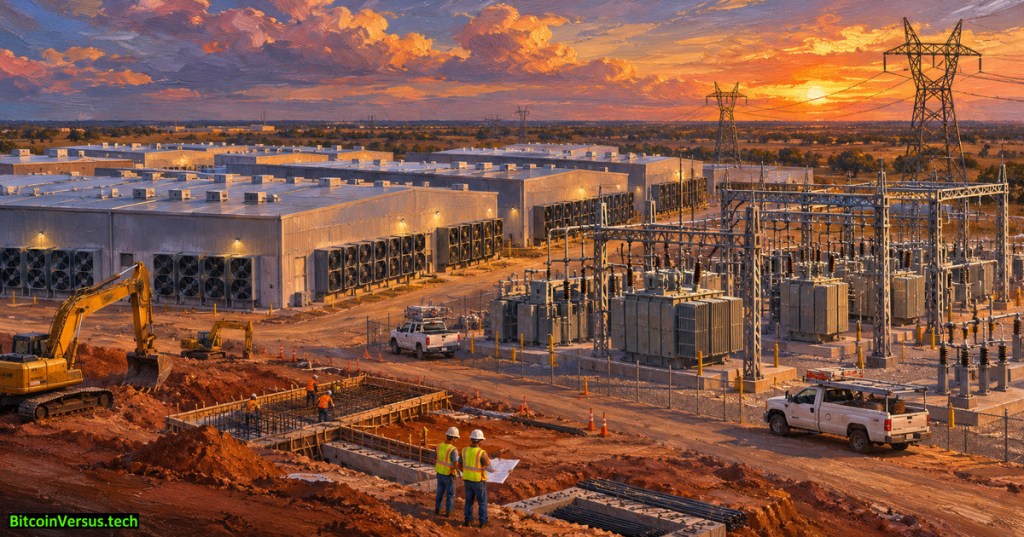
ROCKDALE, Texas — Bitcoin mining infrastructure company Bitdeer Technologies Group has construction underway on a 179-megawatt electrical-load expansion at its Rockdale campus. A November 10, 2026 quarterly disclosure says the company expects phased energization to begin during the fourth quarter of 2026. The addition is planned for cryptocurrency mining, colocation, and artificial-intelligence cloud workloads, rather than being committed exclusively to Bitcoin ASICs.
Bitdeer’s infrastructure schedule, dated October 31, distinguishes the 563 MW already online at Rockdale from the 179 MW still in its development pipeline. Adding the figures produces a possible 742 MW combined campus electrical capacity after full completion, a 31.8% increase over the reported online base. The combined figure is an arithmetic scenario, not an assertion that 742 MW is energized today. Read the company’s SEC-filed infrastructure table.
Archival company footage: Bitdeer’s Rockdale mining data center, filmed and published in October 2022. The video does not document the 2026 expansion.
What 179 megawatts means in engineering terms
Megawatts measure the rate at which a facility can draw electricity, not how much Bitcoin it will produce. If a full 179 MW load operated continuously for one 365-day year, the theoretical consumption would be 1.568 terawatt-hours: 179 MW × 8,760 hours = 1,568,040 MWh. Real use would vary with energization dates, curtailment, equipment installation, operating utilization, and the eventual mix of mining and AI customers.
A site-scale expansion requires more than installing additional ASIC racks. Operators must coordinate utility service, transformers, switchgear, protection studies, distribution equipment, cooling, network links, and commissioning. The SEC filing confirms that construction of the load increase is underway but does not provide a detailed new-building count, incremental rig inventory, installed transformer schedule, or verified completion percentage.
Bitcoin mining remains part of the operating model
Rockdale’s existing 563 MW remains classified for crypto, colocation and AI cloud operations. Bitdeer also says it recently acquired approximately 200 acres near that existing facility to support future AI and high-performance computing development. The company has not disclosed how many of the additional 179 MW will ultimately serve SHA-256 mining rather than other compute workloads.
The allocation matters because bitcoin ASIC performance is typically measured as joules per terahash (J/TH), while AI facilities are often compared by critical IT megawatts, rack density, and cooling capability. Bitdeer reported 15.4 J/TH average miner efficiency for the third quarter, a company-wide figure that cannot be directly applied to the unenergized Rockdale expansion. BitcoinVersus.Tech’s analysis of Bitdeer’s Q3 efficiency examines the difference between better chips and growing total energy demand.
Additional archival company footage: Bitdeer’s Rockdale, Texas, data center, published July 2022. It depicts the established operation, not the announced 179 MW construction phase.
Expansion and execution risks
Bitdeer’s development schedule illustrates how project readiness differs from contracted or online capacity. Its Fox Creek Bitcoin mining project targets late 2027 service, while the company’s Knoxville conversion was delayed by critical electrical-equipment deliveries. Separately, its Project Kati deployment demonstrates how energized host capacity and installed mining machines are different milestones.
At Rockdale, the next independently useful disclosures would identify the first energized portion of the 179 MW, the date it entered service, site-level electrical utilization, and the split between ASIC mining and AI compute. Until those details arrive, describing all 742 MW as operating Bitcoin mining capacity would overstate the evidence.
Sources and publication notes
- Bitdeer SEC-filed Q3 2026 results and infrastructure summary (published November 10, 2026; project status dated October 31)
- Bitdeer Official: Mining Datacenter in Rockdale (October 2022)
- Bitdeer Official: Rockdale Texas mining data center (July 2022)
Cover: original editorial oil painting, not a photograph or verified rendering of the new works.
Editorial disclaimer: Electrical capacity and schedule are company disclosures, not independently certified commissioning results. Engineering calculations are illustrative and are not forecasts of electricity use, hashrate or financial returns.
We volunteer daily to ensure the credibility of the information on this platform is Verifiably True. If you would like to support to help further secure the integrity of our research initiative, please scan the QR code below.



Leave a Reply