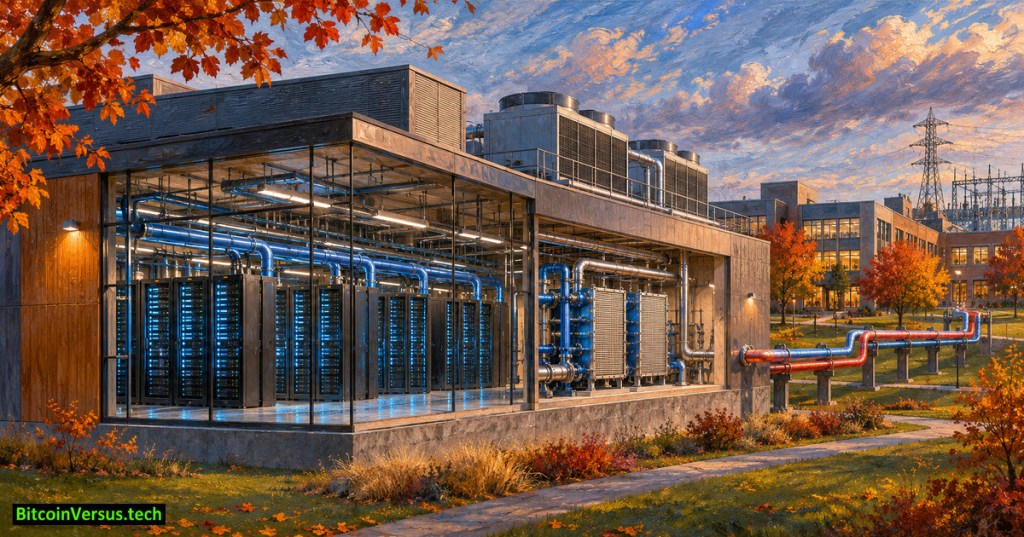
BUFFALO, N.Y., November 23, 2026. New York has broken ground on a permanent academic AI computing center designed to do more than train models: its waste heat is slated to help warm nearby university buildings. The November 19 ceremony launched Empire AI Gamma, the next phase of a statewide shared supercomputing initiative, on the University at Buffalo’s North Campus. University officials report a 46,000-square-foot building on Service Center Road, near an existing electrical substation, with operations targeted for late summer 2028.
Empire AI combines public institutions, private universities and philanthropic funding. Its overall program exceeds $500 million, a consortium-level investment rather than a disclosed price tag for the new building. The $40 million NVIDIA-powered Beta system began full operations in August; Gamma represents the planned permanent facility and expanded computing capacity.
Official November 19 groundbreaking footage from the New York governor’s office. Open directly on YouTube.
From chip cooling to campus heating
UB’s published engineering FAQ describes direct-to-chip liquid cooling, air-based dry coolers and heat recovery for campus buildings. Rather than reject all server heat outdoors, the planned network would capture useful thermal energy during colder months to reduce natural-gas demand. High-efficiency water-based cooling is expected primarily during the hottest weather.
The physical logic matters. Electricity consumed by processors, memory, fans and power conversion ultimately becomes heat. Liquid arriving directly at high-density chips can carry thermal energy toward heat exchangers with less dependence on high-volume room airflow. Reusing the recovered heat may lower separate building-heating demand, but it does not make server electricity consumption disappear. Actual savings will depend on supply temperature, heat-pump requirements, seasonal demand and measured operating data.
UB states the computing center will initially draw up to 5 MW, with planned upgrades to 20 MW. At continuous full rated draw, 5 MW corresponds to 43.8 GWh over 8,760 hours; 20 MW corresponds to 175.2 GWh. Those figures are illustrative annual electricity scenarios, not forecasts or measured consumption. Actual loads and utilization are not yet disclosed. Nor has UB provided a complete public power-usage-effectiveness or heat-reuse dataset for the future campus.
Research access, not just more accelerators
Beta already reports 11 times the training capacity, 40 times the inference performance and eight times the storage of the earlier Alpha phase, according to New York officials. Those comparisons describe improvements against Empire AI’s own first system, not universal GPU benchmark gains. The consortium reports more than 1,500 registered users and hundreds of research projects spanning medicine, wildfire prediction, advanced manufacturing and climate science.
Governor’s full Empire AI event from the New York governor’s office. Open directly on YouTube.
The promised architecture also raises an accountability test. Buffalo’s climate gives dry coolers an advantage, but annual water withdrawals, cooling energy, captured heat and backup-generator emissions need independent measurement once equipment is commissioned. UB says its electricity purchasing includes onsite and offsite solar plus renewable-energy certificates; matching annual renewable purchases is not identical to demonstrating zero carbon emissions every hour.
The schedule is not completely uniform across official announcements: New York’s November 19 release describes completion by early 2028, while UB’s November 20 report targets late summer 2028. The university also says the project is outside the state’s temporary commercial data-center moratorium because it is academic and below the stated 50 MW threshold. Both timetable and eventual efficiency warrant updates as construction advances.
Why engineers should watch Gamma
Gamma is a practical test of whether shared AI computing can integrate computing demand, thermal design and campus energy systems at a moderate scale. The decisive evidence will be operating data, particularly delivered research throughput per kilowatt-hour, measured water use and recovered heat displaced from boilers, rather than construction renderings or projected efficiency labels.
Related BitcoinVersus.tech coverage: U.S. hyperscale electricity use; NVIDIA’s Vera computing rack; dense liquid-cooled servers; and low-latency data-center networking.
We volunteer daily to ensure the credibility of the information on this platform is Verifiably True. If you would like to support to help further secure the integrity of our research initiative, please scan the QR code below.



Leave a Reply