
OLED monitors are moving rapidly from luxury gaming upgrades toward a larger mainstream market. In a November 18, 2026 report, market researcher TrendForce found that global OLED monitor shipments doubled from the third quarter of 2025 to the third quarter of 2026, while growing another 13% versus Q2 2026. ASUS retained the largest share, but MSI overtook Samsung to claim second place. The finding measures branded monitor shipments, not every panel manufactured or every monitor purchased by an end user.
ROG Global’s July 2026 official video introduces new Tandem RGB Stripe OLED gaming monitors with dual-mode refresh rates. It shows a specific product family, not TrendForce’s quarterly shipment audit. Watch the manufacturer’s original video.
ASUS leads at 21.7%, while MSI passes Samsung
TrendForce assigned 21.7% of Q3 OLED monitor shipments to ASUS, supported by supply improvements for premium 27-inch QHD 540 Hz panels. Its shipments rose 6% quarter over quarter, below the market’s 13% expansion. MSI reached 14.5%, gaining 1.7 percentage points in a quarter through demand for 27-inch QHD models and a new 320 Hz lineup. Samsung fell to 11.3% share, with relatively stable shipment volume diluted by faster-growing competitors. LG Electronics held 8.6%, followed by Dell at 8.2%.
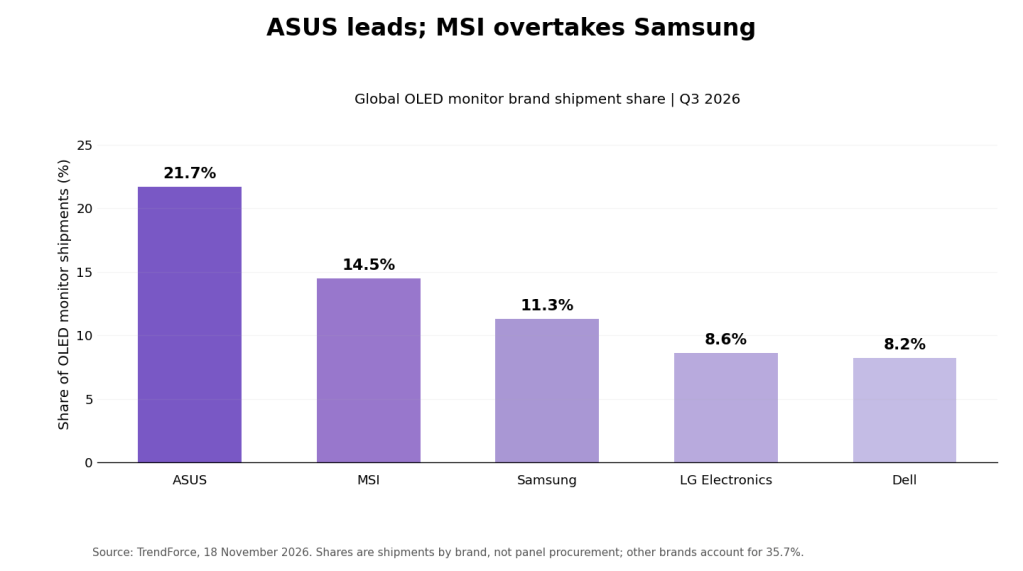
The five leading brands therefore represented 64.3% of reported shipments, leaving 35.7% across other brands. A rising market can lift a vendor’s unit shipments even when its percentage share falls. TrendForce has not disclosed a complete quarterly unit total in the public summary, so doubling shipments should not be rewritten as a precise number of monitors sold.
Falling OLED prices change the buying decision
A separate October 8 Omdia report found that mainstream 27-inch, 240 Hz OLED gaming monitors had seen price cuts exceeding 40% in 2026. Omdia projected 6.1 million OLED monitor panel shipments for the full year, up 79% from 2025. That forecast counts display panels and a different period, so it cannot be treated as the Q3 branded monitor total from TrendForce. Omdia expects panel shipments to grow to 7.5 million in 2027, conditional on production and demand.
Why gamers are choosing OLED
Each OLED pixel emits its own light. Black pixels can turn off rather than relying on an LCD backlight, improving dark-scene contrast. Rapid pixel transitions help moving objects appear clearer at high refresh rates, although real results depend on motion settings and frame delivery. A 240 Hz monitor can refresh every 4.17 milliseconds; a 540 Hz model every 1.85 milliseconds. Those are theoretical frame intervals, not measured input lag, game frame rate, or proof that every player will perceive the same improvement.
MSI Gaming’s official January 2026 MEG X QD-OLED teaser shows its premium OLED product direction. Manufacturer promotional material, not a direct record of the Q3 shipments or independent panel testing. Watch MSI’s video on YouTube.
High refresh rates still have trade-offs
OLED monitors can face image retention, permanent burn-in after prolonged static content, and text-fringing behavior that varies by subpixel layout. Price, brightness, warranty terms, port bandwidth, variable refresh-rate support and actual measured response should matter alongside peak hertz. An OLED panel is also not interchangeable with the oxide transistors used by some LCD displays.
Related BitcoinVersus.Tech coverage examines ASUS’s 720 Hz OLED esports monitor, TCL’s faster gaming-display transistors, SteamOS HDMI 2.1 variable-refresh support, and low-power color e-paper. The technologies serve different performance and power requirements.
The next meaningful test is whether stronger panel supply and falling retail prices translate into sustained sell-through, acceptable burn-in rates and more affordable products across regions. TrendForce’s Q3 numbers confirm rapid shipment growth; they do not establish that OLED has become the majority of all PC monitors.
Primary sources: TrendForce, November 18, 2026; Omdia, October 8, 2026. Market shares are from TrendForce branded-monitor shipments; Omdia’s panel counts and future forecast use different definitions. Percentages and refresh intervals were calculated from rounded reported figures.
We volunteer daily to ensure the credibility of the information on this platform is Verifiably True. If you would like to support to help further secure the integrity of our research initiative, please scan the QR code below.



Leave a Reply