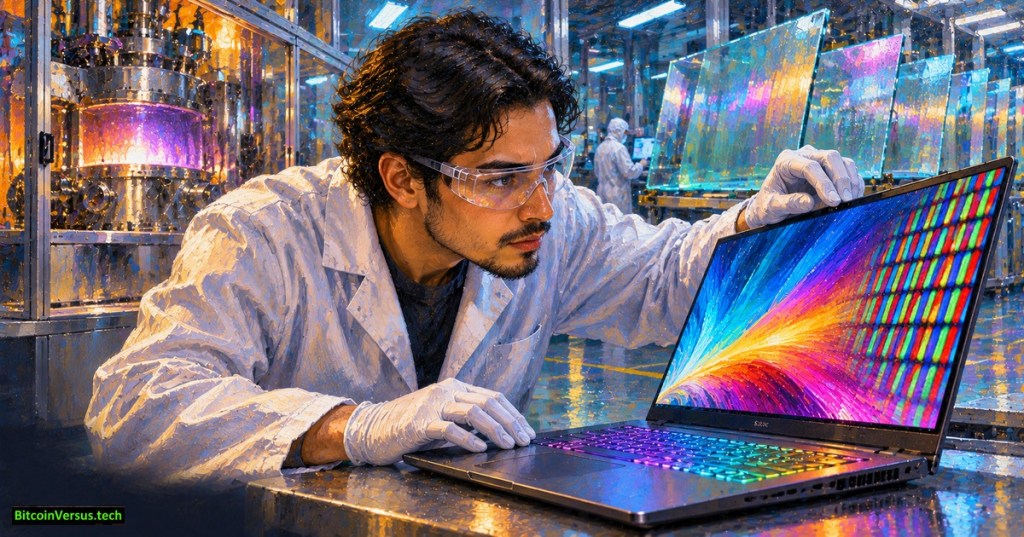
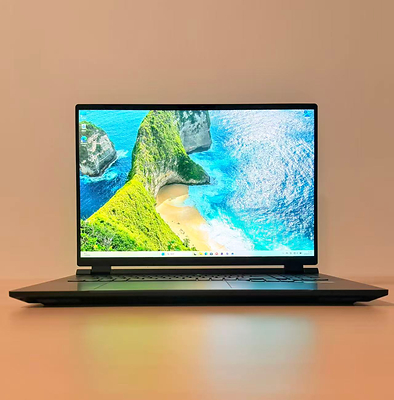
The smallest transistors inside a laptop display can determine how fast its pixels receive electrical signals and how much power the panel consumes. On November 20, 2026, China’s TCL CSOT said it had entered mass production of an ultrahigh-mobility oxide thin-film-transistor backplane on an 8.6-generation manufacturing line. The company reported an average electron mobility of 51.6 cm²/(V·s) and identified an 18-inch high-refresh gaming notebook panel as the first disclosed product. Production status and laboratory metrics come from TCL’s own release; independent yield and finished-panel measurements were not supplied.
TCL CSOT’s official CES 2026 video introduces its display technologies. Historical product-showcase footage, not a November mass-production inspection. Watch on YouTube.
Why electron mobility matters to a screen
An active-matrix liquid-crystal display uses a thin-film transistor, or TFT, at each pixel circuit to charge and hold an electrical state. Electron mobility describes how readily charge carriers move through the semiconductor under an electric field. Higher mobility can support greater drive current through a similar-sized device, allowing faster pixel charging or smaller transistors when the surrounding design permits.
TCL says its prior high-mobility oxide process reached about 30 cm²/(V·s) in 2025. The newer reported average of 51.6 represents 72% greater carrier mobility, calculated as (51.6 − 30) ÷ 30. That does not mean games render 72% faster, pixels switch 72% quicker or the notebook uses 72% less power. Device mobility is one variable within the complete display system.
The manufacturing problem is keeping every transistor consistent
TCL attributes the change to continuous rotary-target sputtering, stacked oxide films, interface-defect repair and control of hydrogen and oxygen near the insulating layers. It reports film-thickness nonuniformity below 5%. High mobility alone can make transistor behavior harder to control: threshold-voltage drift, gate control and self-heating must also be managed. TCL says its design adds thermal adjustments and an updated gate-driver-on-array architecture.
The 8.6-generation designation refers to the scale of the display glass-processing line, not an 8.6-nanometer transistor fabrication node. It should also not be confused with TCL’s separate 8.6-generation inkjet-printed OLED line, which entered an equipment move-in phase in October. The oxide development discussed here is primarily a backplane advance for LCD panels.
Why gaming and battery life are both targets
Oxide TFTs can have very low off-state current, helping a pixel maintain its state when a static image needs few updates. TCL says the improved drive current also supports shorter charging periods at high refresh rates and smaller transistor footprints that leave more area for light transmission. A gaming display might therefore offer fast motion when needed while refreshing documents less frequently. Actual power consumption still depends on backlights, panel timing, resolution, brightness and controller design.
TCL CSOT’s official SID Display Week 2026 recap shows earlier display research and demonstrations. It does not verify an independently tested 18-inch retail panel. Watch on YouTube.
For comparisons, BitcoinVersus.Tech previously covered ASUS’s 720 Hz OLED esports monitor and the fundamentals of LCD operation. Our OLED technology guide explains why an emissive OLED pixel differs from a backlit LCD. Recent flexible sensor-display research explores another set of backplane trade-offs.
Mass production is not the same as a finished laptop launch
TCL has identified its 18-inch notebook panel, but the November announcement does not establish its retail device maker, shipping price, battery-runtime improvement or independently measured refresh-rate specification. The company describes the reported process as mass-produced, yet provides no public production yield, monthly substrate volume or customer shipment audit. Those omissions matter when separating a fabrication milestone from a product someone can purchase.
The next meaningful tests are measured transistor stability across production panels, independently verified refresh and pixel-response behavior, whole-display energy consumption at equal brightness and confirmed commercial notebook shipments. TCL’s advance is an important claim about making faster oxide semiconductors at scale, not proof that every resulting display outperforms OLED.
Primary references: TCL CSOT, November 20 oxide-process announcement; TCL CSOT, November 6 OLED-line update; TCL CSOT display technology overview.
We volunteer daily to ensure the credibility of the information on this platform is Verifiably True. If you would like to support to help further secure the integrity of our research initiative, please scan the QR code below.



Leave a Reply