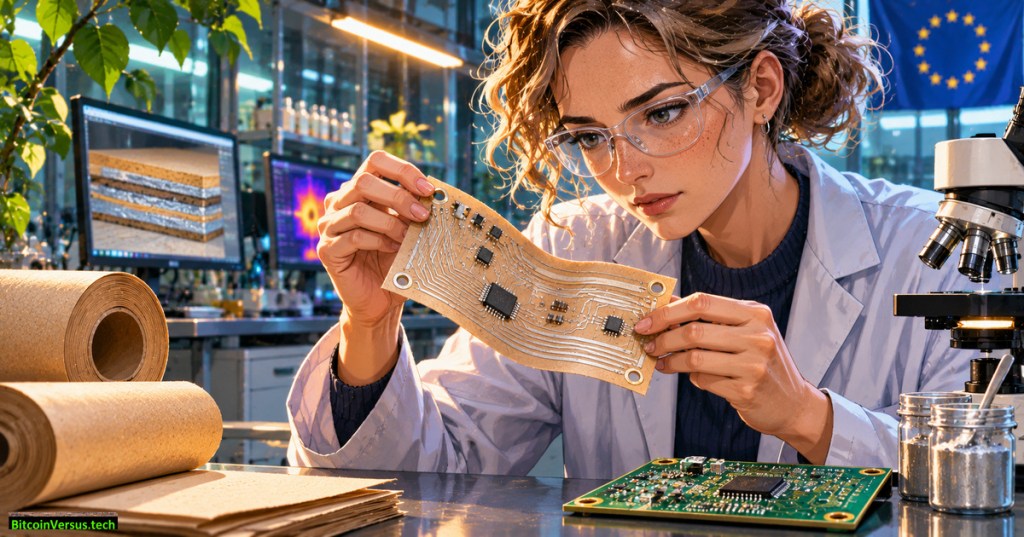
Imagine a functioning circuit board built not on fiberglass and epoxy, but on specially treated paper. A European research consortium has demonstrated exactly that, including four-layer boards, electrically connected vias and working electronics. In results released November 19, 2026, the EU-funded CircEl-Paper project, coordinated by Fraunhofer ISC, also reported recovering up to 89% of the silver during a laboratory recycling test. The work targets disposable electronics, not an immediate replacement for every conventional printed circuit board.
Official CircEl-Paper project interview featuring a researcher from the Printed Electronics Arena, released in February 2025. The video explains the paper-PCB research program, not the final November 2026 recycling measurements. Watch the original project video.
Four layers, plated holes and a paper substrate
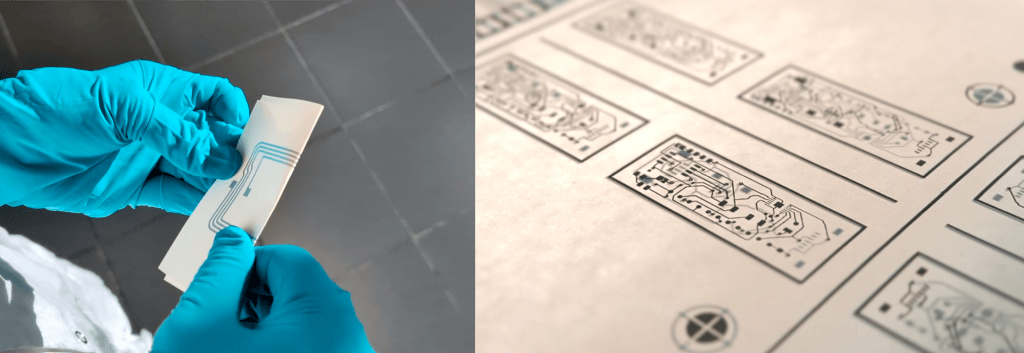
Ordinary multilayer PCBs generally use FR4, a glass-fiber-reinforced epoxy that supplies stiffness, electrical insulation and heat resistance. The composite is difficult to separate into constituent materials at end of life. CircEl-Paper researchers substituted engineered paper composites, then tested lamination, conductive tracks and plated-through vias that electrically join different circuit layers. Their demonstrators included double-sided and four-layer constructions, produced using both adapted conventional PCB methods and roll-to-roll printing.
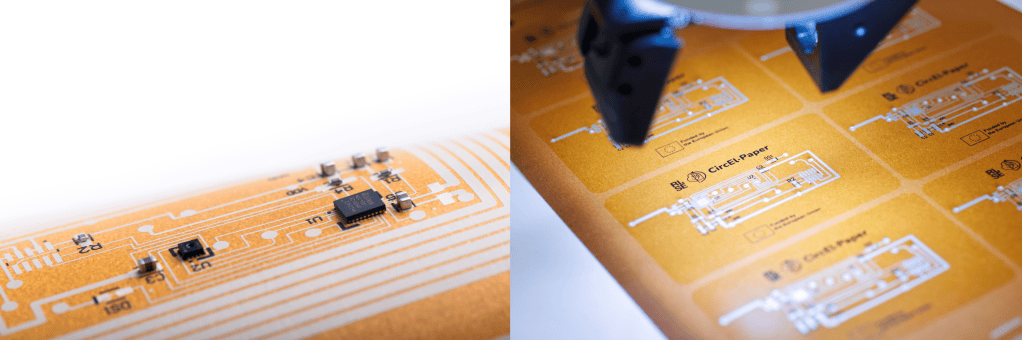
A usable paper substrate cannot simply be copier paper. Flame resistance, moisture uptake and surface roughness must be controlled, and harsh conventional PCB processing chemicals can damage cellulose. The team used treated paper, suitable adhesives and gentler processing conditions. Some additives improve the board’s performance while making recycling harder, so electrical reliability and material recovery have to be optimized together.
Up to 89% silver recovered, not 89% of all circuit waste
The consortium developed conductive ink containing recycled silver and bio-based binders. Its SECTR formulation can be processed at temperatures starting around 50°C. During adapted recycling tests, silver recovery reached 83% with untreated papers and 89% with impregnated papers. The separated fraction was incorporated into new conductive ink. The figures refer to silver recovered in specific experiments, not a claimed 89% reduction in electronic waste, carbon emissions or manufacturing expenses.
Official English-language CircEl-Paper film prepared by Joanneum Research. The film explains the project’s environmental aims and methods, before the publication of its final 2026 results. Watch the project film on YouTube.
Three working prototypes, from sensors to greeting cards
The researchers completed three demonstrations: a roll-to-roll-printed glucose-sensing device, a four-layer time-temperature monitor for sensitive freight, and a foldable sound-playing greeting card. The release reports that each implementation worked. No medical regulatory clearance, production-volume yield or worldwide product launch has been established. Unlike a high-power mining hashboard, a disposable sensor could be an appropriate first application for the less durable substrate.
What must be solved before mass production
Silver is conductive, but it is also expensive, so recovering it matters economically as well as environmentally. Recycling trials separated cellulose fibers, metal and polymers. Recovered fibers from impregnated boards can retain treatment chemicals; their safe reuse needs additional evaluation. The team performed life-cycle assessments and toxicity modeling, yet its laboratory demonstrations do not establish a universal environmental advantage for every possible product.
The engineering background is familiar to BitcoinVersus.Tech readers: PCB layers and stackups, component assembly, board inspection and functional testing, and interconnect cracks after thermal cycling. Paper boards would need suitable reliability testing before being trusted in high-value infrastructure.
The next milestone is independent qualification across humidity, bending, temperature cycling, electrical loss, manufacturing yield and industrial-scale recycling. CircEl-Paper has demonstrated a plausible laboratory route toward circular disposable electronics, not yet a drop-in replacement for conventional multilayer circuit boards.
Primary sources: Fraunhofer-coordinated November 19 results; official CircEl-Paper use cases; European Commission project reporting. The silver percentages are project-reported experimental recovery yields, not independently measured industry averages.
We volunteer daily to ensure the credibility of the information on this platform is Verifiably True. If you would like to support to help further secure the integrity of our research initiative, please scan the QR code below.



Leave a Reply