
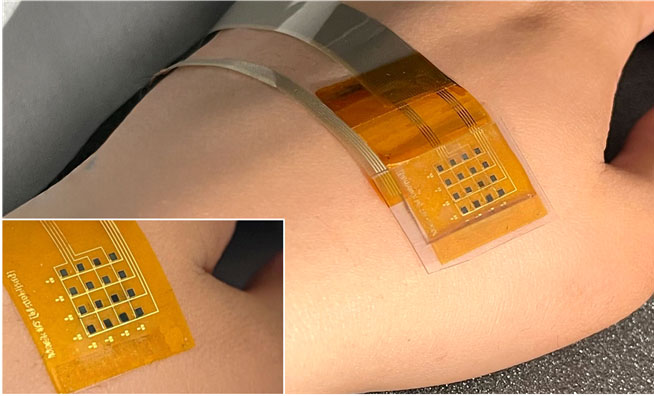
Imagine a factory worker seeing a colored warning on a package while a robot reads a separate infrared pattern on the same label. Researchers at KAIST and Yonsei University have built a flexible electronic display for both visual channels. Announced November 16, 2026, the prototype has 16 independently controlled pixels. Its patterns remained detectable by a near-infrared (NIR) camera after researchers curved the film across a hand, and during dark and hazy laboratory conditions. The device is experimental, not yet a factory-ready electronic tag.
One surface can address humans and machines
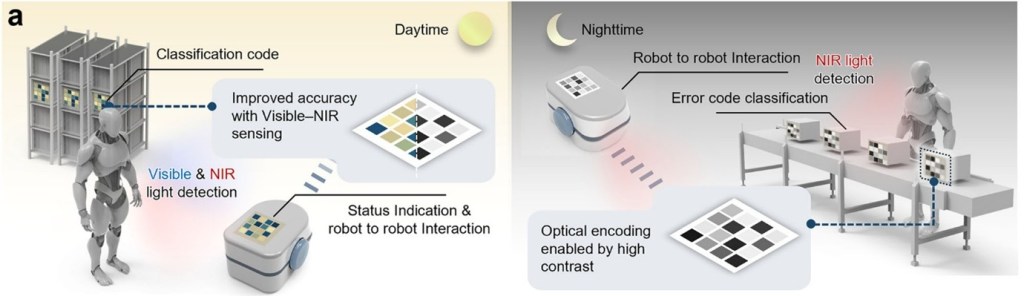
Humans interpret visible colors. Robot vision systems can also sense near-infrared light outside human perception. The prototype modulates both visible appearance and reflected NIR brightness as its pixels switch. A worker might recognize a colored package status, while a suitably equipped robot interprets contrast in the same display. The researchers have not demonstrated that one label can independently and securely transmit two unrelated messages, or that an autonomous warehouse fleet can use it reliably without supervision.
Display manufacturer Ynvisible explains electrochromic materials and reflective display stacks in a May 2025 technical webinar. Its commercial technology differs from KAIST’s research prototype; the recording is background, not footage of the November experiment. Watch the source webinar.
How the display changes color without a backlight
The researchers used PEDOT, a conductive polymer that changes its optical absorption when voltage is applied. Higher absorption makes a reflective pixel darker; lower absorption allows more light to return. The effect is called electrochromism. A multilayer optical resonator amplifies control over reflected wavelengths, allowing one active material system to influence the visible and NIR bands. The display relies on reflected light, unlike a conventional backlit screen.
Each of the 16 pixels has its own thin-film transistor, an electronic switch enabling an individually addressed pattern. The flexible substrate can bend, and a gel electrolyte reduces leakage risk compared with a liquid configuration. For dark-environment tests, researchers illuminated the label with infrared light that a dedicated NIR camera could detect after reflection. A fully dark room without suitable NIR illumination would not provide the same signal.
Could a future robot read its next assignment?
Reconfigurable labels might eventually display changing work status on bins, packages, garments or curved industrial equipment without replacing printed stickers. A robot could read updated patterns in lighting conditions that defeat ordinary visible-color recognition. However, dirt, camera viewing angles, NIR illumination, label wear and software integration could all limit practical reliability. The display does not automatically know which job the robot should perform; another computer must provide the information.
The Signal Path demonstrates a different working electrochromic segmented display, showing its electronic driving and optical behavior in an independent 2021 lab test. It does not test the KAIST device. Watch the original bench demonstration.
Sixteen pixels are only the beginning
The peer-reviewed study in npj Flexible Electronics was published October 20. Researchers still need larger arrays, repeatable bending endurance, verified reading accuracy and a completed link from the NIR camera to robot control systems. KAIST did not announce mass production, pricing or battery-life measurements for a commercial product.
Related BitcoinVersus.Tech coverage examines high-resolution artificial vision, miniature wearable displays, robot connectivity, and service-robot adoption statistics. They illustrate adjacent technologies, not proof of commercial readiness for the new label.
The next critical test is whether an actual robot can repeatedly read correct patterns across distance, dust, vibration, low light and many bending cycles. Until then, the advance is a compact demonstration of shared human-and-machine visual communication, with the industrial deployment still ahead.
Primary sources: KAIST News Center, November 16, 2026; Jeong and colleagues, npj Flexible Electronics, October 20, 2026. All performance statements are attributed to the research team.
We volunteer daily to ensure the credibility of the information on this platform is Verifiably True. If you would like to support to help further secure the integrity of our research initiative, please scan the QR code below.



Leave a Reply