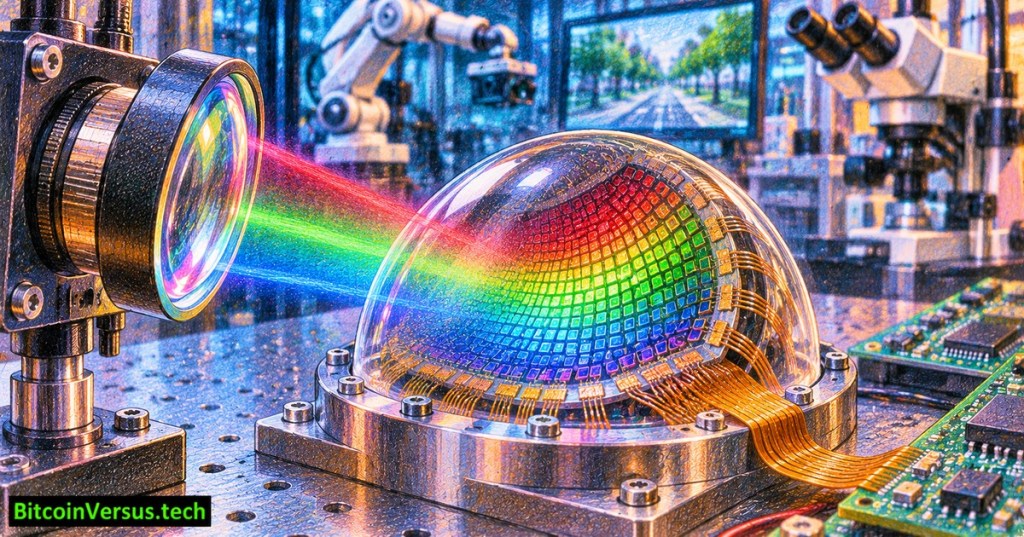
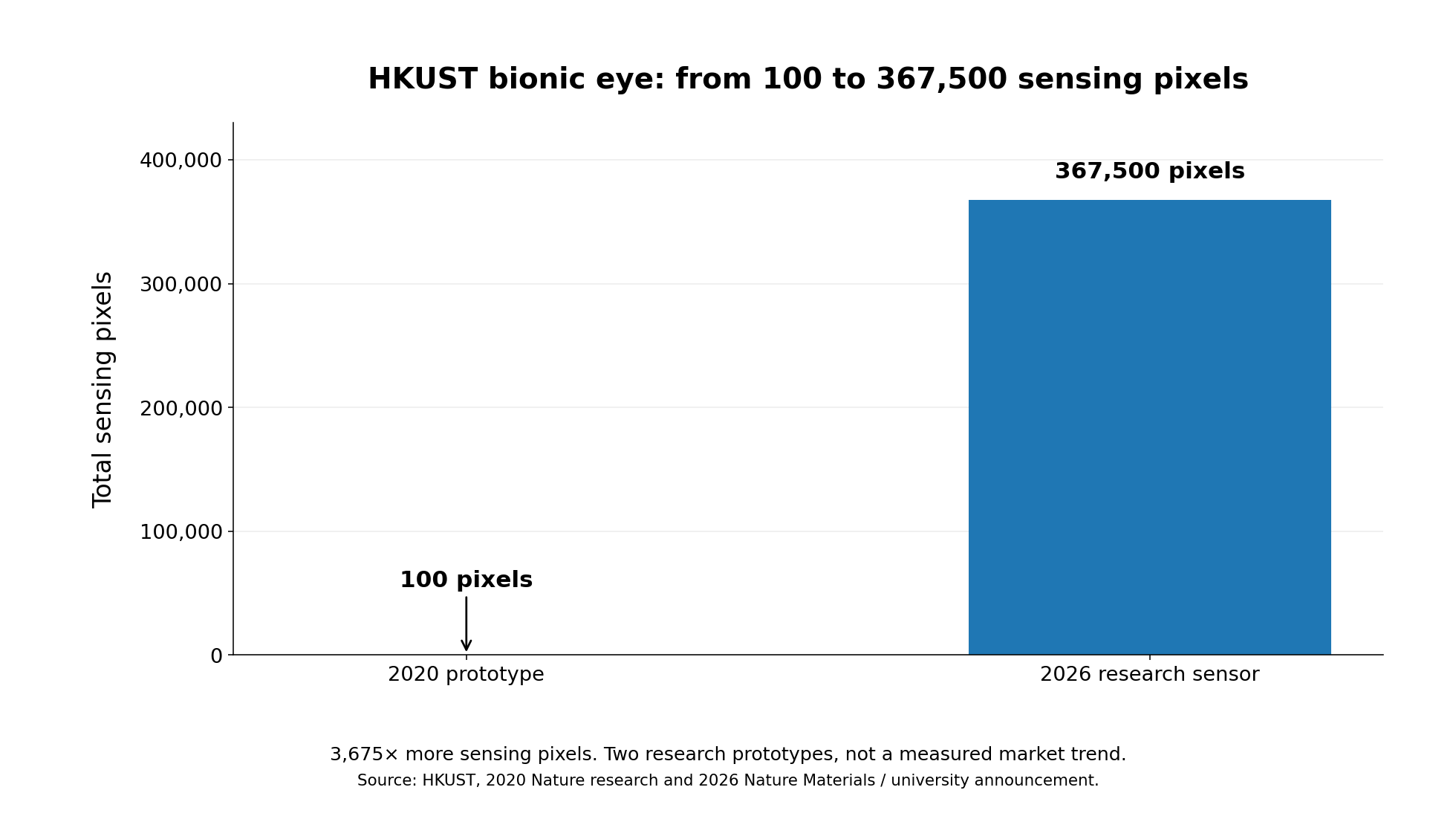
Researchers at the Hong Kong University of Science and Technology (HKUST) have built a curved artificial eye containing 367,500 light-sensing pixels, full-color detection and a field of view exceeding 160 degrees. The university highlighted the prototype on November 13, 2026, following an August 17 publication in Nature Materials. Rather than using a conventional flat camera chip, the device places multiple sensitive layers along a hemispherical artificial retina.
The pixel count is especially striking compared with HKUST’s 2020 artificial eye, which had only 100 sensing pixels. The new prototype offers 3,675 times as many sensing positions, calculated as 367,500 divided by 100. The comparison describes two laboratory prototypes from the same research line, not a direct commercial camera performance benchmark.
HKUST’s official 2022 video documents its earlier three-dimensional artificial eye. The footage illustrates the research lineage, not the 2026 prototype.
How a curved sensor gained 3,675 times more pixels
Making densely packed electronic pixels on a rounded surface presents a manufacturing problem. Standard photolithography is optimized for flat wafers. The HKUST team instead used a three-dimensional laser-assisted fabrication process to build light-sensitive structures on curved substrates, according to its official research announcement.
The artificial retina includes separate red-, green- and blue-sensitive regions in a tandem configuration. Researchers report 1,905 pixels per inch on the curved sensor surface and sensitivity spanning 300–800 nanometers. Its geometry helps reduce optical aberrations across a wide viewing angle, potentially allowing compact imaging systems to use less complex corrective optics.
Detecting movement without sending every frame
The researchers also explored a different approach to detecting movement. A conventional camera sends repeated full frames for external processing, even when little changes. HKUST’s event-driven sensor responds to relevant changes within its sensing structure, allowing selected motion information to be represented without transferring an entire image sequence.
HKUST’s official December 2024 video shows its distinct artificial compound-eye research for robotic vision. Background footage only; the newer 2026 project uses a different retinal design.
For the reported experimental tasks, the team calculated a bandwidth-demand reduction exceeding 99.95% against frame-based imaging while achieving 98.6% motion-recognition accuracy. Those numbers describe the study’s selected comparisons and evaluation conditions. They do not establish equivalent savings in deployed wireless networks or universal accuracy on real roads.
What the 98.6% figure does not prove
The published methods also leave an important engineering gap: a large fabricated pixel array is not automatically a high-speed video camera. Experimental image reconstruction relied on controlled illumination and sequential readout arrangements rather than demonstrating continuous, full-array, real-time video capture. A detailed technical review of the readout method notes the distinction.
A machine-vision product would need robust pixel addressing, readout electronics, packaging, calibration and power measurements under real working conditions. Comparisons with current CMOS camera modules would also require matching the same resolution, exposure, frame rate and lighting requirements. No commercial deployment or medical implantation was announced.
What comes next
HKUST’s earlier work illustrates the progression. A separate compound-eye design presented in 2024 used a pinhole array to support robotic motion tracking. The newest curved-retina project instead focuses on higher pixel density, full-color vision and sensing motion within the device. Both share inspiration from biological vision, but the designs are not interchangeable.
The applications could include autonomous robots inspecting crowded areas, drones tracking moving objects, and compact sensors where optical size and data traffic matter. BitcoinVersus.Tech has separately reported on color and depth camera sensors, robot planning latency, onboard computation for flying robots and long-range lidar for autonomous trucks.
Lead researcher Zhiyong Fan has discussed a future sensor with more than one million pixels. Such a device remains an ambition, not a result from the current study. The immediate accomplishment is a substantially denser curved research sensor that combines color imaging and event-driven motion response, while real-time readout and product-level reliability remain open challenges.
Primary sources and original demonstrations
- HKUST announcement, November 13, 2026
- Nature Materials: An aberration-corrected bionic eye for full-colour vision and event-driven motion detection, first published August 17, 2026
- HKUST research publication record
- HKUST official 2022 3D artificial-eye video
- HKUST official 2024 artificial compound-eye video
- Technical analysis of experimental readout limitations
Editor’s Note: We volunteer daily to ensure the credibility of the information on this platform is Verifiably True. If you would like to support to help further secure the integrity of our research initiatives, please scan the QR code below

For mobile scanning, open the article on another display and scan the QR code with a Bitcoin wallet. Verify the receiving address 3C9o19EH5HSiwEPyCTmEKzxhNCbo2X6TTb before sending.
BitcoinVersus.Tech provides technology and engineering journalism for informational purposes. Prototype performance does not establish commercial camera or medical-device readiness.


Leave a Reply