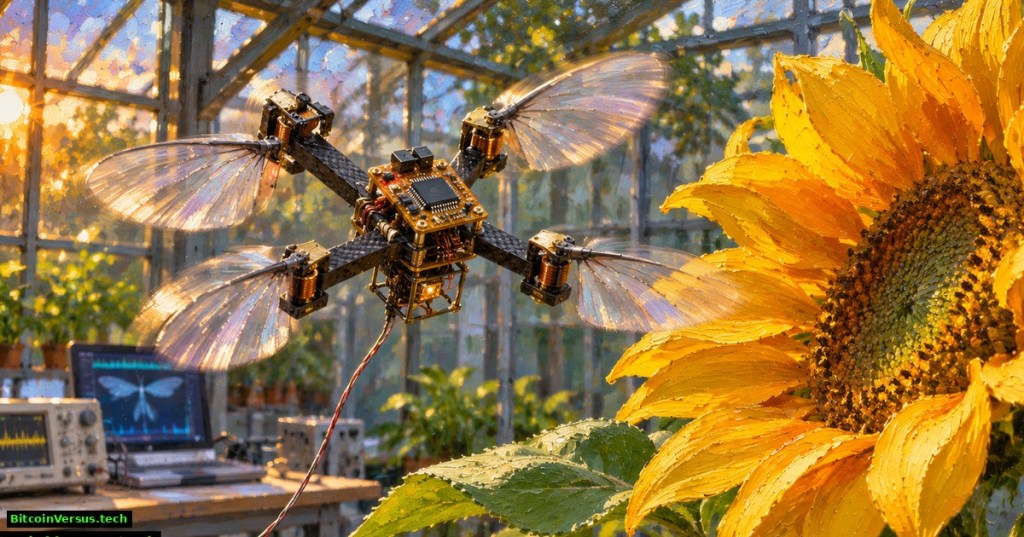
MIT engineers have demonstrated an insect-scale flying robot capable of carrying its own navigation sensors and computer, replacing the external motion-capture cameras previously needed to stabilize its flight. Announced on November 18, 2026, the four-wing microrobot carried an electronics package weighing just 244 milligrams and guided itself along controlled trajectories, including a careful landing on a sunflower. One critical limitation remains: the robot still receives electrical power through a tether. Its sensing and computation are onboard, but it is not a battery-powered autonomous drone. MIT published the demonstration and research details alongside a paper in Science Robotics.
Original MIT research demonstration, November 2026: a four-wing microrobot uses onboard sensors and computation to maneuver and land. A power tether is still present.
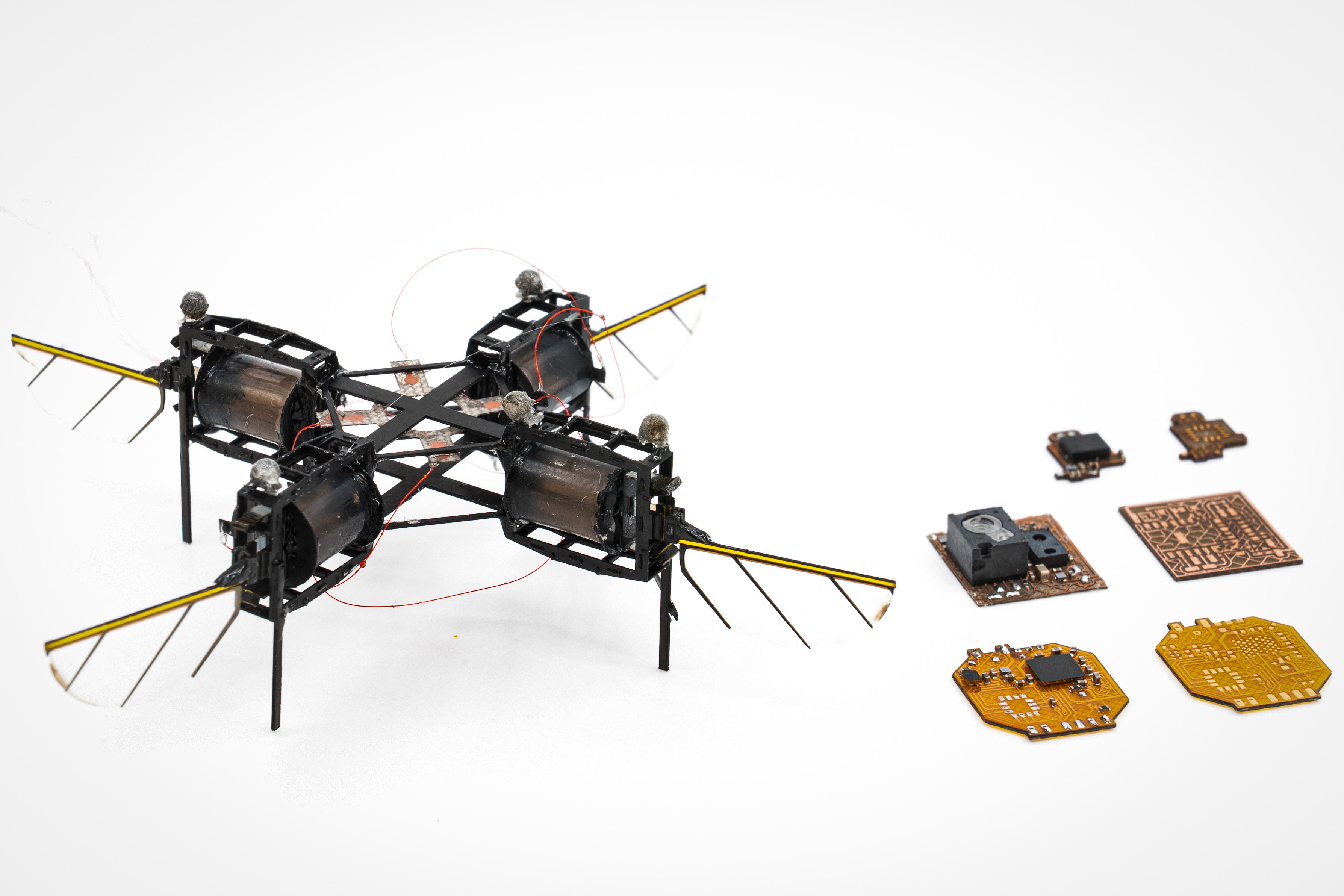
244 milligrams of sensors and computer
The payload combines an inertial measurement unit for orientation, an optical-flow sensor for lateral motion and a time-of-flight sensor for altitude. A miniature microcontroller processes those measurements onboard. Previously, the team’s small flyers relied on laboratory cameras tracking their absolute position, making movement beyond specially instrumented spaces difficult. The new aircraft instead estimates motion locally, using rapid updates to limit accumulated drift.
Researchers increased the size of the robot’s soft artificial muscles by 50% while tuning their geometry. MIT reports a 46% increase in net lifting force and a lift-to-weight ratio of 1.9, providing enough margin for the added electronics. The wings are driven by compact soft actuators, not the spinning propellers used by conventional quadcopters.
Why fast estimates matter more than a perfect map
An optical-flow sensor detects image motion as the robot moves. Combined with inertial and height measurements, the onboard estimator can react quickly to disturbances. MIT says its flight demonstrations achieved position errors of only a few centimeters, comparable to experiments using external cameras. The controller still accepts high-level position commands from a human operator, however, so the sunflower landing should not be described as fully self-directed flower selection.
The electronics consumed approximately 6% of total power in the team’s accounting, with the remaining energy primarily used by the wing actuators. A future onboard battery, power circuitry and camera would add both weight and electricity demand. Current experiments demonstrate an important control capability, rather than a complete field-ready robot.
Archival Science X video, December 2025, credited to Yi-Hsuan Hsiao and colleagues: an earlier MIT flying microrobot demonstrates rapid maneuvers. The older research used external flight control and does not demonstrate November 2026 onboard sensing.
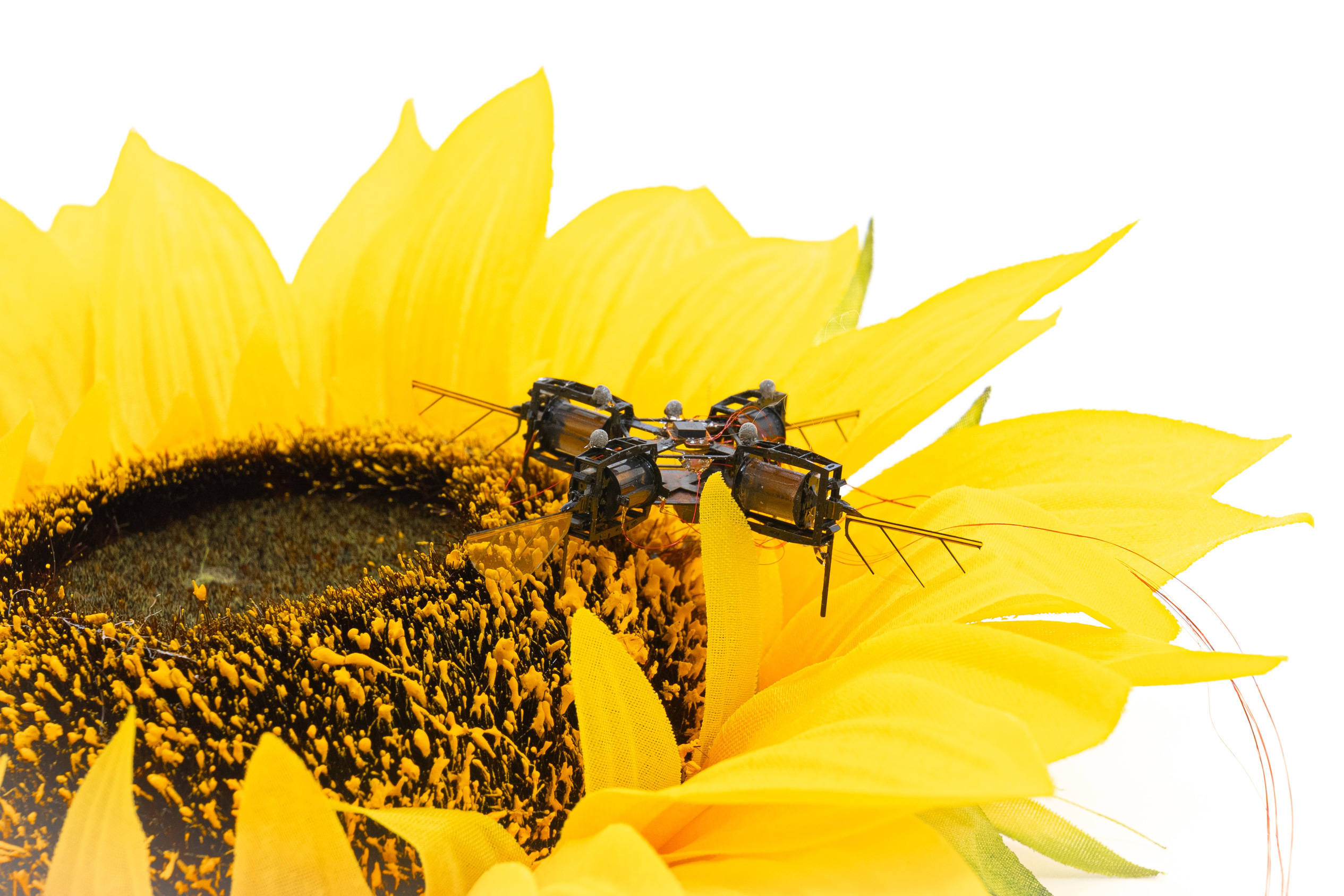
A careful landing, not autonomous pollination
MIT guided the aircraft around plants before landing on a sunflower, demonstrating the precision needed for future agricultural applications. Autonomous pollination would require identifying particular flowers, planning safe approaches, reliable energy storage and repeated field operation. None was established by the new laboratory result. The researchers are now pursuing a tiny camera for object recognition and obstacle avoidance, followed by onboard power.
The work fits a wider robotics trend toward carrying perception and control closer to the machine. BitcoinVersus.tech recently examined NXP’s drone development tools, Ring’s indoor flying camera concept, and battery-density proposals for drones. Hardware packaging, power budgets and control stability create different trade-offs at every scale.
The next engineering hurdle
An autonomous robot smaller than a paperclip must solve several problems at once: stabilize itself without room cameras, power its wings, recognize obstacles and survive collisions. MIT’s achievement addresses the sensing and onboard computation portion. Fully untethered operation remains a future objective, not a current capability. Prospective uses in agriculture, search and rescue or narrow industrial spaces will need substantially more validation before real deployment.
Prior reporting on biohybrid artificial muscle systems shows another engineering path toward miniature machines. The next credible milestone for MIT will be a powered, untethered robot making decisions from its own observations outside instrumented laboratories.
Primary sources: MIT News, November 18, 2026; Science Robotics paper: Controlled Flight of an Insect-Scale Flapping-Wing Robot via Integrated Onboard Sensing and Computation; MIT’s December 2025 prior flight-control work. Images used with credit to the researchers and MIT News.
Editor’s Note: We volunteer daily to ensure the credibility of the information on this platform is Verifiably True. If you would like to support our work and help further secure the integrity of our research initiatives, please scan the QR code below to donate 5,000 sats.

Disclaimer: BitcoinVersus.tech publishes independent technical journalism for education, not engineering certification, investment guidance or a claim of commercial readiness. Laboratory research results require further validation before deployment.


Leave a Reply