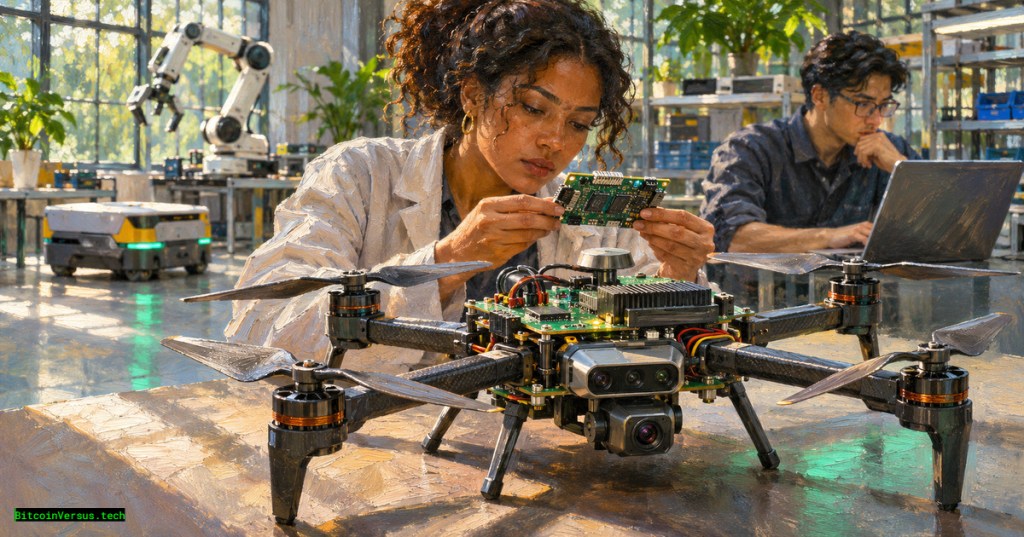
NXP Semiconductors has introduced an open robotics development platform intended to reduce the integration work behind drones and other autonomous machines. Announced November 9, 2026, the hardware-and-software package combines processing, sensors, flight control, communications and motor control. NXP says developers can obtain initial drone functionality in 30 minutes using its prepared reference designs—not build or certify a complete aircraft in half an hour.
The launch builds on NXP’s Neural Axis Architecture, which distributes computational work between higher-level AI processing and time-critical controllers close to motors and sensors. The distinction matters: a robot cannot depend on a slow or unpredictable AI response whenever a motor needs immediate correction.
NXP Developer Zone’s official June 2026 keynote explains Neural Axis and physical AI. The recording predates the November robotics-platform launch and provides architectural context.
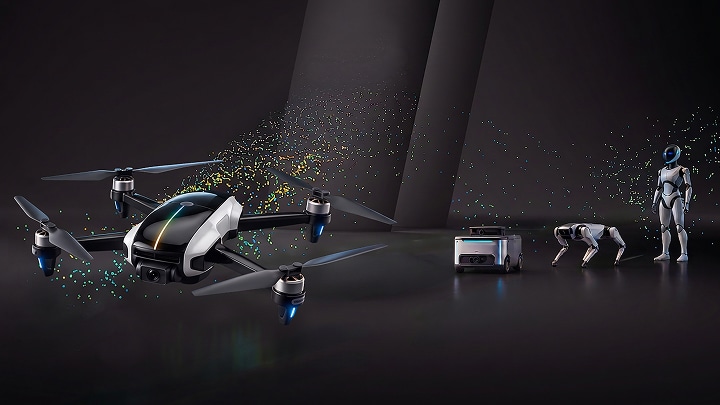
Four hardware blocks, one development workflow
NXP’s first reference designs target drones. The NavQ95, built around an i.MX 95 applications processor, handles autonomy computing and flight-control workloads. A Tropic vehicle/flight management unit uses an i.MX RT1064 microcontroller. The 100BASE-T1 sensor node is based on the MCX N947, while an AM32-compatible electronic speed controller uses an MCX A13 microcontroller.
Together, the components address different operating requirements rather than forcing an application processor to perform every task. High-level perception demands compute resources; stabilization and power electronics demand predictable timing. A modular approach also lets developers replace individual subsystems without redesigning an entire control stack.
What the open SDK actually includes
The official SDK page lists ROS 2 Jazzy, PX4, CogniPilot Cerebri, Zephyr, NuttX and AM32, along with connectivity tools including Zenoh, MAVLink and 100BASE-T1 Ethernet. NXP’s public GitHub repository explains a key implementation detail: the SDK primarily coordinates upstream firmware versions, builds and prebuilt binaries rather than owning all underlying firmware.
That arrangement can simplify compatibility management, but open-source availability does not guarantee every software stack runs on every reference board. The repository’s platform matrix distinguishes supported combinations. Its documented build path uses Docker on Ubuntu 24.04 LTS and calls for at least 25 GB of free storage—practical requirements beyond the headline setup claim.
NXP Developer Zone’s August 2026 discussion of physical AI and industrial-edge technology supplies additional background; it is not a demonstration of the newly announced SDK.
Why the robotics industry cares
Robot deployment increasingly combines sensing, AI inference, networking and electromechanical control. Recent GXO–Apptronik warehouse plans show the commercial interest in humanoid systems, while Robust AI’s Carter warehouse robot illustrates a more task-specific approach. Neither deployment is identified as an NXP platform customer.
On the software side, NVIDIA’s GR00T 2 training research explores learned manipulation, whereas NXP’s announcement primarily tackles the engineering infrastructure underneath autonomous behavior. Meanwhile, Rockwell’s industrial edge controller highlights a related push to bring computing and control closer together.
Thirty minutes is not a field-readiness test
NXP calls the drone reference designs and SDK available now, but its 30-minute statement describes initial functionality under a prepared development workflow. It is not independently verified proof of safe flight, reliable obstacle avoidance, security hardening, regulatory compliance or fleet operation. Those milestones still require application-specific engineering, environmental testing and appropriate safety assessment.
Additional enablement for service robots, autonomous mobile robots and other autonomous machines is expected in the second half of 2027, according to NXP. Until then, drones remain the launch focus. The measurable near-term test will be whether independent developers can repeat the setup, integrate new subsystems and shorten real engineering schedules rather than simply execute a reference demonstration.
Primary references: NXP launch announcement (November 9, 2026); NXP Robotics SDK documentation; NXP Robotics SDK source and supported-platform matrix.


Leave a Reply