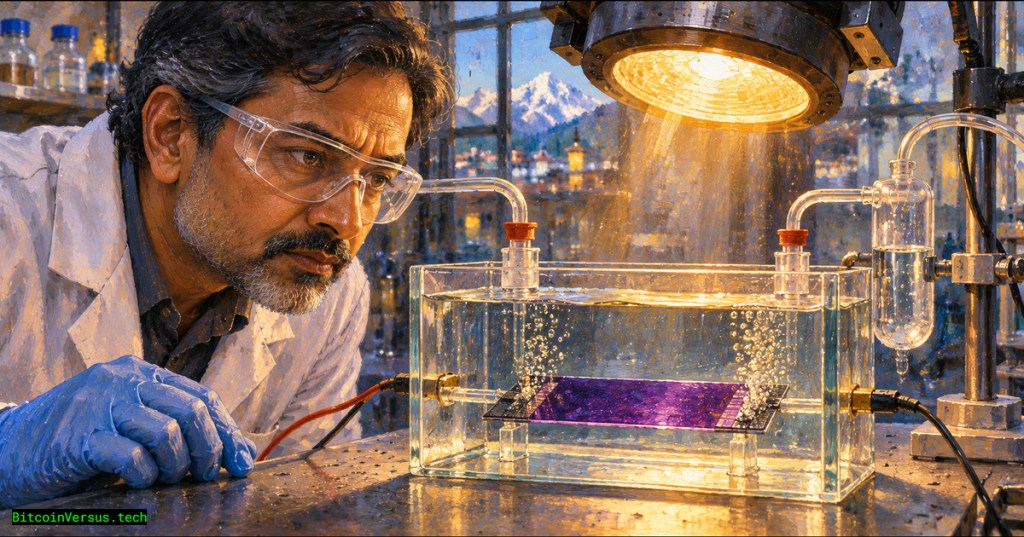
Researchers at Switzerland’s EPFL have demonstrated an organic semiconductor sheet that splits water into hydrogen and oxygen using simulated sunlight without an externally applied voltage. Published November 11, 2026, in Nature Energy, the experiment ran for more than two hours and achieved about 0.1% solar-to-hydrogen efficiency. The milestone establishes a new device architecture, not commercially competitive hydrogen production.
Solar hydrogen systems seek to turn sunlight directly into a storable fuel rather than first sending electricity through a separate electrolyzer. Traditional solar cells and electrolysis equipment can perform the job, but integration adds equipment and electrical connections. The broader difference between energy sources and usable fuels is explored in BitcoinVersus.Tech’s clean-versus-renewable energy guide.
EPFL’s official January 2023 video explains an earlier artificial-leaf system that uses sunlight to generate hydrogen from atmospheric moisture. Archival research context, not footage of the November 2026 organic sheet. Credit: EPFL / YouTube.
One organic film, two chemical roles
The laboratory team, led by Nicolas Diercks and Jin Su Park with Kevin Sivula, worked with a blend of light-absorbing organic polymers deposited on conductive fluorine-doped tin-oxide glass. The central idea is that one semiconductor mixture can perform either half of water splitting depending on the molecular contact layer beneath it.
A carbazole-derived contact, identified as 2PACz, makes the overlying film operate as a photocathode that supports hydrogen evolution. A naphthalimide-derived contact, NI-PA, makes another region function as a photoanode for oxygen evolution. Engineers printed the contrasting molecular contacts side by side in patterned domains, then added reaction catalysts.
Those catalysts matter. The demonstration uses platinum and iridium-oxide co-catalysts; a polymer-based light absorber does not make the entire apparatus free of precious metals. Scientists still need to improve both activity and material selection before low-cost mass production becomes plausible.

The measurement and its limits
Under simulated one-sun illumination, the combined sheet produced hydrogen and oxygen in the expected two-to-one molecular ratio. EPFL reported a stabilized hydrogen rate of 1.3 micromoles per hour per square centimeter. No external electrical bias was supplied, but the cell still required illumination, electrolyte, a prepared substrate and catalysts.
The underlying work follows earlier research in candidate materials for solar fuels and batteries. The new contribution is specifically a unified, solution-processed organic photocatalyst sheet rather than the first artificial-photosynthesis device of any type.
A key challenge appeared when the scientists changed the pattern size. Their paper and accompanying announcement describe weaker charge extraction around the boundaries when domains were reduced from one millimeter to 100 or 10 micrometers. More finely patterned regions therefore did not automatically raise output.
The team also tested spray deposition as an alternative to carefully stamped molecular patterns. That method produced unbiased water splitting, but at only about 0.01% estimated efficiency in the reported configuration. Easier fabrication is useful only if its performance can also improve.
EPFL’s official April 2019 video documents an earlier concentrated-sunlight hydrogen device and campus pilot facility. A different technology, shown for historical comparison—not the organic photocatalyst-sheet experiment. Credit: EPFL / YouTube.
Scaling faces a steep efficiency gap
Two hours of operation under a solar simulator cannot establish years of outdoor durability, full-system economics or reliable performance across changing weather and water conditions. Those considerations differ from SunHydrogen’s separately reported hydrogen-panel development, which uses another architecture and different test conditions. Efficiency figures across the two projects are not a like-for-like comparison.
Hydrogen may serve industrial processes, seasonal energy storage and chemical production, but direct solar-fuel generation remains a research field. A future integrated hydrogen system would still require gas separation, storage and safety equipment. The feasibility of energy systems without grid connections is discussed separately in our off-grid power analysis.
EPFL identifies more effective light-absorbing molecules, improved selective contacts and better catalyst placement as next steps. A meaningful commercial milestone would require much higher efficiency, long-lived operation under real sunlight, and independently verified fabrication costs. For now, the result demonstrates that molecular design can give a common organic semiconductor two different jobs in one water-splitting sheet.
Sources and methodology: EPFL/LIMNO original announcement, November 11, 2026; Nature Energy peer-reviewed article, DOI 10.1038/s41560-026-02160-0; EPFL open-access publication record and source data; Tech Xplore’s university-sourced research summary. Laboratory figures are reported by the investigators; BitcoinVersus.Tech did not reproduce the experiment.
Editor’s Note: The demonstration uses simulated sunlight and an experimental chemical cell. The reported 0.1% conversion efficiency is far below a commercially established solar-hydrogen system, and the two-hour operation period does not demonstrate industrial durability. The original 1200 × 630 cover is fine-art oil painting of a fictional scientist, not a documentary EPFL laboratory photograph. Its secondary BitcoinVersus.tech wordmark was reproduced from the original uploaded sample, maintaining its typography, spacing, bottom-left position, and tight neon-green-on-black presentation. The EPFL scientific visualization is an official attributed illustration. Both official videos depict different, earlier EPFL hydrogen projects; actual playback on every device remains untested.

BitcoinVersus.Tech is volunteer-run and publishes independent technical journalism. An optional 5,000-satoshi donation supports ongoing research. Scan the original QR from a second screen using a compatible Bitcoin wallet; on the same phone, use a wallet that can import a saved QR image when supported. Independently verify recipient 3C9o19EH5HSiwEPyCTmEKzxhNCbo2X6TTb and the 5,000-satoshi amount before sending. Bitcoin transfers are generally irreversible.
We volunteer daily to ensure the information on BitcoinVersus.Tech is Verifiably True. Technical and financial coverage is educational and informational, not personalized engineering, securities, tax or investment advice.


Leave a Reply