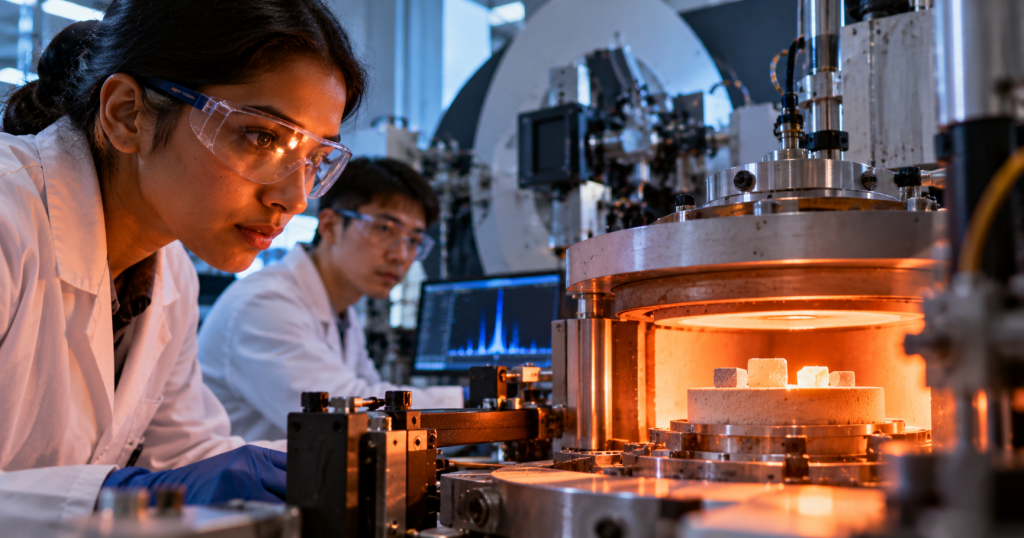
Researchers have found useful materials hiding in the middle of ordinary heating reactions—temporary phases that normally disappear before scientists ever study the final product.
A team led by the University of Warwick tracked how specially designed metal-containing precursor molecules changed as they were heated. The work uncovered several previously unknown intermediate materials, including a new form of bismuth vanadate, BiVO₄, a semiconductor already widely studied for solar-driven water splitting and hydrogen production.
The research appears in Nature Communications, while Warwick’s research summary highlights the broader idea: scientists may be overlooking useful materials by focusing only on what exists before heating and what remains after heating is finished.
The Interesting Material Appeared Before The Final Material
Materials synthesis is often treated like a simple transformation: start with one set of chemicals, add heat, and characterize whatever solid comes out at the end. The Warwick team instead watched the reaction while it was happening.
They used solid-state nuclear magnetic resonance spectroscopy, X-ray diffraction, pair-distribution-function analysis, and related methods to track structures that appeared at intermediate temperatures. Those short-lived structures included amorphous phases and crystalline phases that disappeared again as heating continued.

They Found A New Form Of Bismuth Vanadate
One of the most important discoveries was a previously unknown kinetically stabilized form of bismuth vanadate that the researchers named β-BiVO₄. Before this work, the literature described three main BiVO₄ polymorphs. The new phase adds another atomic arrangement to a material that has already been studied thousands of times.
The team found that β-BiVO₄ forms during the heating pathway but becomes less stable as temperature rises. In some experiments it represented a large fraction of the bismuth-containing material around intermediate temperatures before the system moved toward more stable final phases.
Its Electronic Structure Is Different
The new phase is not just the same chemistry arranged differently for no practical reason. Density-functional calculations showed a substantially larger band gap than the common monoclinic BiVO₄ structure. Depending on the computational method, the calculated increase was about 1.09 to 1.58 electron volts.
That difference matters because a semiconductor’s band gap affects which wavelengths of light it can absorb and how its electrons behave after absorbing that light. Changing the atomic structure can therefore change where the material fits in solar-fuel systems, catalysts, heterojunctions, sensors, and other electronic or photoelectrochemical devices.
BiVO₄ Is Already Important In Solar-Fuel Research
BiVO₄ is widely studied as a photoanode because its electronic structure lets it absorb visible light while helping drive water-oxidation reactions. The U.S. Department of Energy describes photoelectrochemical water splitting as a pathway where semiconductor materials convert sunlight directly into chemical energy by helping split water into hydrogen and oxygen.
The Warwick study does not mean β-BiVO₄ is immediately a better solar-fuel material. Its larger band gap changes how it interacts with light, and the new phase is metastable. The significance is that the researchers found a previously inaccessible structure inside a familiar material system and showed that its electronic properties are meaningfully different.
Another Hidden Phase Could Matter For Batteries
The same heating experiments also produced amorphous mixed-valence vanadium-oxide intermediates. The researchers tested these phases electrochemically and found that they could take up substantial amounts of lithium.
That does not turn them into a finished commercial battery chemistry, but it shows why intermediate phases are worth studying. A material that exists only during a reaction can still have useful electrochemical behavior if scientists learn how to isolate or stabilize it.
This connects with the broader battery-material problem BitcoinVersus.Tech has been following, from new approaches to obtaining battery-grade lithium to the way solid-state battery technology is being pushed toward high-power infrastructure.
The Bigger Discovery Is The Method
The most important result may be the strategy rather than any single compound. Materials scientists often search for new structures by changing chemical composition. This work shows another route: keep watching during the transformation itself.
By controlling precursor chemistry, temperature, and heating pathways, researchers may be able to deliberately trap useful phases that normally exist only briefly. That creates a much larger search space for batteries, catalysts, solar-energy materials, and electronics without requiring entirely new elements.
It is the same reason materials research matters to the wider energy transition covered in BitcoinVersus.Tech’s clean-versus-renewable energy explainer: generating cleaner power depends not only on building more infrastructure, but also on finding materials that absorb light, move ions, survive heat, and store energy more effectively.
What Comes Next
The researchers only examined a small set of precursor systems. Their next challenge is determining how general the phenomenon is and whether other apparently ordinary heating reactions contain metastable structures with useful optical, catalytic, electronic, or electrochemical properties.
If the answer is yes, materials science may have been throwing away interesting compounds simply because researchers waited until the furnace was finished before looking closely.
Editor’s Note
The featured image is original photorealistic editorial artwork created specifically for this story and is not reused in the body. The body image is a separate scanning electron microscope photograph of a BiVO₄ photoelectrochemical surface. The YouTube video is embedded as a responsive native Gutenberg player, and the Reddit discussion is embedded directly in the article. No normal story text is placed inside cards, panels, callouts, or text boxes.
BitcoinVersus.Tech content is provided for informational and educational purposes.


Leave a Reply