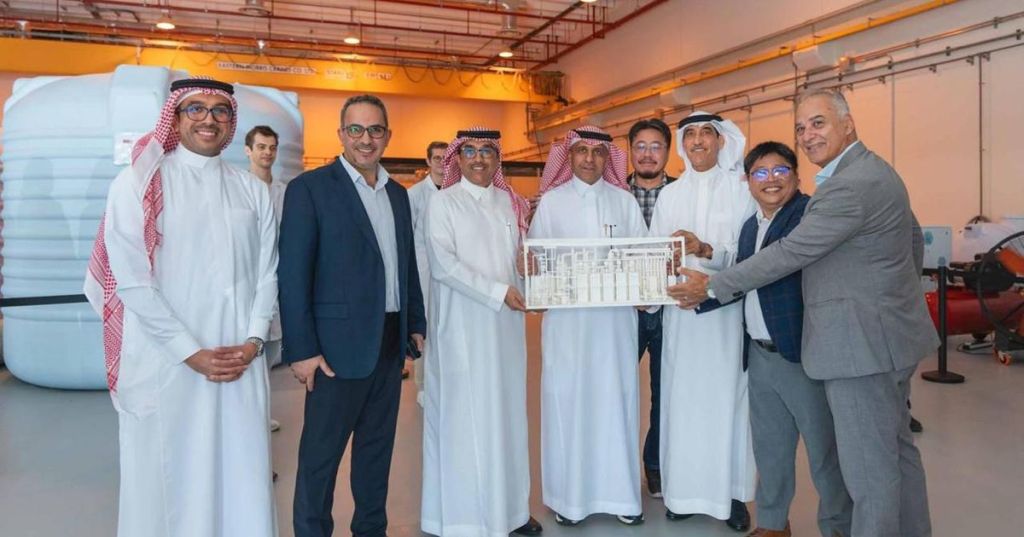
Saudi Aramco and National Energy Services Reunited are turning a familiar oilfield byproduct into a potential battery-material feedstock. Under a new agreement announced October 8, NESR will execute Saudi Arabia’s first direct lithium extraction project using its LiThara platform, targeting 2,000 tonnes per year of battery-grade lithium carbonate with commissioning and first production planned for late 2027.
The agreement, disclosed by NESR and confirmed in Reuters reporting, carries a contract value of up to approximately $200 million over five years. The project combines Aramco’s subsurface and reservoir expertise with NESR’s brine pre-treatment, direct lithium extraction, and carbonation technologies.
The interesting part is not simply that Saudi Arabia wants lithium. It is where the lithium may come from: high-salinity brines already encountered through decades of oil and gas operations.
What The New Project Is Supposed To Do
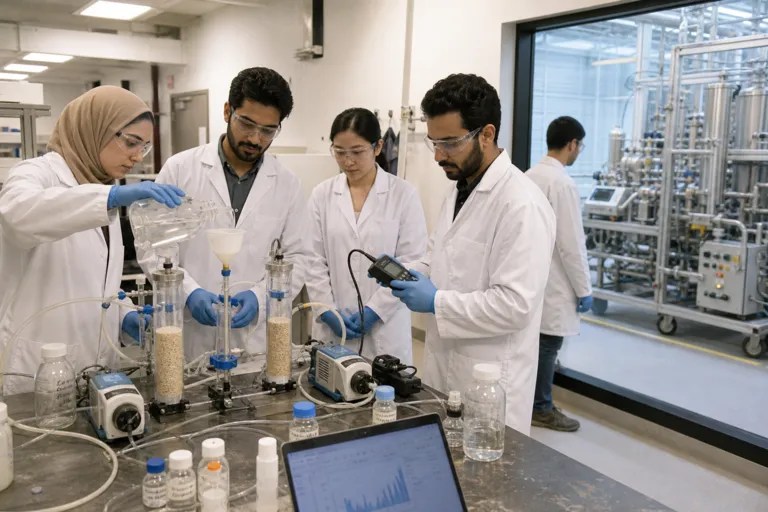
NESR says its environmental and decarbonization business will deliver the project on a turnkey basis. The LiThara platform combines three main steps: conditioning the incoming brine, selectively removing lithium from that brine, and converting the recovered lithium into lithium carbonate suitable for battery supply chains.
The target output is modest compared with the world’s largest hard-rock and brine lithium operations, but this is a demonstration project rather than a fully scaled commercial mine. At 2,000 tonnes per year, the main goal is to prove that the Saudi feedstock and process can consistently produce battery-grade material at useful recovery rates and costs.
If that works, the same modular approach could potentially be replicated at other brine sources where Aramco already has drilling data, wells, pipelines, fluid-handling expertise, and field infrastructure.
Why Oilfields Produce Brine In The First Place
Oil wells do not produce only oil. Many reservoirs also bring large volumes of salty underground water to the surface. That produced water can contain dissolved minerals, including lithium ions, depending on the geology.
Historically, produced water has mostly been treated as a fluid-management problem: separate it from hydrocarbons, treat it where necessary, and reuse or reinject it. Direct lithium extraction changes the economic question. Instead of asking only how to dispose of the brine, operators can ask whether useful minerals can be removed first.
That makes oilfield brine especially interesting to companies that already possess subsurface models, well access, pumps, separation equipment, water-treatment systems, and decades of reservoir data.
Direct Lithium Extraction Avoids Giant Evaporation Ponds
Conventional brine lithium production can rely on enormous evaporation ponds that concentrate lithium-bearing saltwater over long periods. Direct lithium extraction, or DLE, tries to separate lithium much more selectively using materials or processes that preferentially capture lithium ions while leaving much of the sodium, magnesium, calcium, and other dissolved material behind.
The exact chemistry varies by vendor. Some systems use adsorption media, others use ion exchange, membranes, solvents, or combinations of separation technologies. The common objective is faster recovery from brines that may be too dilute or chemically difficult for traditional evaporation routes.
NESR says LiThara integrates brine pre-treatment with DLE and downstream carbonation. That final carbonation step matters because automakers and battery producers do not buy “lithium ions in water.” They need a standardized chemical product such as lithium carbonate that can move into cathode-material manufacturing.
Aramco Has Been Building Toward This For Years
The NESR agreement is not Saudi Arabia’s first experiment with lithium recovery. Aramco has previously worked with King Abdullah University of Science and Technology and Lithium Infinity, or Lihytech, on direct lithium extraction from oilfield brines. Earlier Saudi pilot work demonstrated that lithium could be recovered from these fluids and helped move the idea from laboratory research toward field deployment.
Aramco also signed a minerals collaboration framework with Ma’aden focused on transition minerals. In 2025 the company said it had identified lithium concentrations exceeding 400 parts per million in some areas of its operations and was evaluating commercial production by 2027.
That broader effort explains why the current NESR contract is more important than a single pilot skid. Aramco is attempting to apply the same subsurface knowledge that made it one of the world’s largest oil producers to a new class of underground resource.
The 2,000-Tonne Project Is Smaller Than Aramco’s Broader Goal
Aramco’s 2025 sustainability reporting describes an ambition to reach approximately 5,000 tonnes per year of lithium carbonate equivalent through aquifer-based direct lithium extraction. The newly announced NESR demonstration project targets 2,000 tonnes per year of battery-grade lithium carbonate.
Those are not contradictory figures. The 2,000-tonne figure refers to the specific demonstration project disclosed this week. The 5,000-tonne figure is Aramco’s broader stated lithium-production ambition.
The gap is useful because it shows what comes next if the demonstration works: more modules, more brine feedstock, or additional production sites would be needed to move from demonstration-scale output toward the larger corporate target.
Battery-Grade Purity Is The Real Engineering Test
Recovering some lithium from salty water is not the same as producing battery-grade lithium carbonate. Oilfield brines can contain large concentrations of competing ions and other contaminants, and every extra purification step adds equipment, reagents, energy use, and cost.
That is why the demonstration plant’s most important result will not simply be tonnes produced. Engineers will be watching recovery efficiency, chemical consumption, water handling, impurity removal, uptime, operating cost, and whether the product consistently meets battery-grade specifications.
This mirrors the challenge facing newer battery chemistries and storage technologies generally. BitcoinVersus recently covered sodium-ion batteries moving toward grid scale and solid-state battery systems aimed at high-power infrastructure. New battery technologies still depend on reliable, economical material supply chains.
Oilfield Infrastructure Could Become A Critical-Minerals Advantage
Saudi Arabia’s unusual advantage is not just geology. Aramco already operates one of the world’s largest subsurface-data and fluid-handling infrastructures. That existing network could reduce some of the cost and execution risk that a standalone lithium startup would face when drilling wells, characterizing reservoirs, building roads, installing pumps, and managing brine.
In other words, the same industrial system built to produce hydrocarbons may also become useful for producing battery minerals. That does not make DLE automatically cheap or commercially successful, but it changes the starting point.
If the 2027 demonstration delivers battery-grade material at competitive cost, Saudi Arabia would gain a domestic lithium source that can support its growing EV, battery, and stationary-storage ambitions. BitcoinVersus has also covered the increasing importance of large-scale energy storage, where lithium remains one of the dominant chemistries today.
This Is Still A Demonstration, Not A New Lithium Giant
The project should not be confused with a proven commercial lithium basin. NESR and Aramco still need to demonstrate sustained recovery, product purity, reliability, and economics under real field conditions.
That uncertainty is exactly why the project matters. Direct lithium extraction has generated years of excitement, but the technology ultimately has to survive pumps, fouling, variable brine chemistry, maintenance cycles, and commodity-price pressure outside the laboratory.
By late 2027, Aramco and NESR should have a much clearer answer to a fascinating industrial question: can an oilfield’s salty produced water become a dependable feedstock for the battery economy?
Editor’s note: The 2,000-tonne annual target refers to the NESR-Aramco demonstration project. Aramco’s separate 5,000-tonne lithium carbonate equivalent figure is a broader corporate ambition disclosed in its sustainability reporting.
Disclaimer: BitcoinVersus.Tech publishes technology, energy, and critical-minerals news for informational and educational purposes.


Leave a Reply