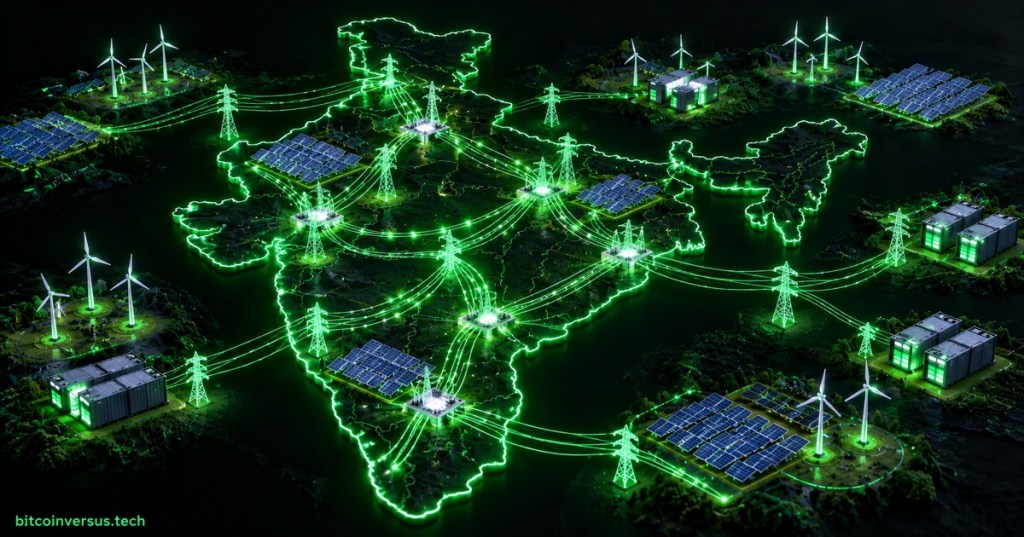
India has approved Green Energy Corridor Phase III, a grid-integration program designed to support transmission for up to 135 GW of renewable electricity while adding 50 GWh of battery energy storage.
The official Cabinet announcement says the program will expand intra-state transmission systems so renewable-rich regions can move power more effectively while battery systems help manage intermittency, congestion, curtailment and evening demand.
The scale is notable because the plan explicitly links new transmission capacity with storage. Adding solar and wind is not enough if the grid cannot move or time-shift the electricity they produce.
135 GW of renewable power needs a stronger path to the grid
Green Energy Corridor Phase III is intended to enable evacuation of up to 135 GW of renewable energy across Indian states and union territories. That means substations, transmission lines, pooling infrastructure and related grid equipment must expand in parallel with generation.
An October 1 X post summarizing the decision highlighted the 135 GW transmission target, 50 GWh of battery storage and the broader goal of strengthening power grids across the country.
Reuters reported that the program is designed to strengthen transmission while adding battery storage as India continues scaling non-fossil generation faster than some parts of its grid can absorb it.
The 50 GWh battery target changes how the corridor works
The battery component is not a side program. The plan provides for 50 GWh of Battery Energy Storage Systems at renewable-generation sites or other locations where they improve grid flexibility.
That gives operators another tool when solar output peaks before demand, wind generation arrives at inconvenient hours, or transmission corridors become congested. Instead of curtailing power immediately, storage can shift part of that energy into later demand windows.
BitcoinVersus.Tech recently examined a different storage architecture in the Viejas flow-battery project in California, where long-duration storage is paired with a microgrid rather than a nationwide transmission program.
Transmission is becoming as important as generation
Renewable projects can be technically complete and still underperform if interconnection, transmission or balancing infrastructure is late. The Green Energy Corridor model attacks that problem directly by building the pathway from generation site to load center rather than treating the power plant as an isolated asset.
The same bottleneck is showing up in the United States. BitcoinVersus.Tech recently covered FERC’s delay of PJM’s 6.8 GW backstop procurement, where the argument is not whether more capacity is needed, but how quickly it can be added and how the costs should be allocated.
Battery chemistry will matter as storage scales
A 50 GWh deployment target is large enough to support multiple storage technologies, suppliers and project formats. Lithium-ion remains the dominant commercial option, but the scale of future grid requirements is also driving interest in chemistries optimized for cost, cycle life and material availability rather than vehicle-level energy density.
BitcoinVersus.Tech has also tracked sodium-ion batteries moving toward grid-scale deployment, a reminder that storage technology will likely diversify as utilities begin buying tens of gigawatt-hours rather than isolated pilot systems.
India is building an integrated renewable-power system
The most important part of Green Energy Corridor Phase III is the architecture. Generation, transmission and storage are being planned as parts of one power system rather than three separate industries.
If implementation follows the approved design, the program will give India more room to add renewable generation without creating the same level of congestion and curtailment pressure that has slowed projects in other markets. Adding clean generation is only the first step; the grid has to be able to move it, store it and deliver it when demand actually arrives.
BitcoinVersus.Tech
Advertisement
Editor’s Note
We volunteer daily to ensure the credibility of the information on this platform is Verifiably True. If you would like to support to help further secure the integrity of our research initiatives, please donate here: 3C9o19EH5HSiwEPyCTmEKzxhNCbo2X6TTb
BitcoinVersus.tech is not a financial advisor. This media platform reports on financial subjects purely for informational purposes.


Leave a Reply