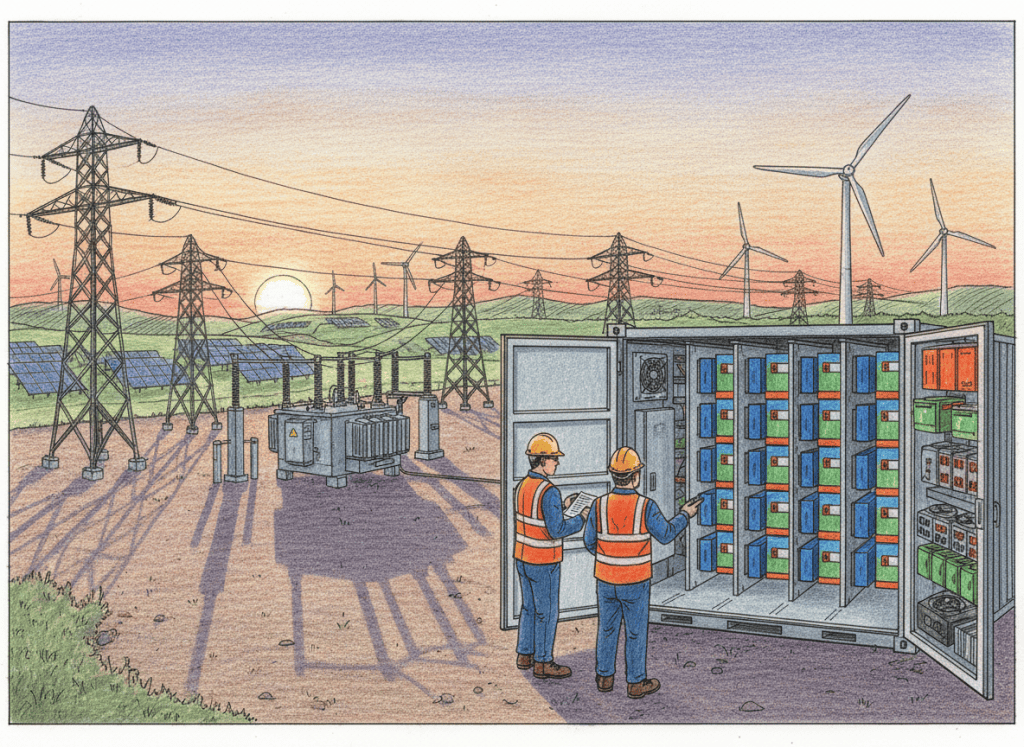
Lithium-ion batteries dominate modern energy storage, but another chemistry is beginning to move from laboratory development toward infrastructure-sized hardware.
HiTHIUM has unveiled the ∞Power N4.0MWh, a 4 MWh sodium-ion energy-storage system containing its new ∞Cell N785Ah sodium-ion cell. The company says full-scale production and deliveries are planned for 2027.
That does not mean sodium-ion has suddenly replaced lithium-ion. It means manufacturers are beginning to design sodium chemistry around the scale, lifetime and electrical architecture expected of stationary grid infrastructure.
A 785 Ah Sodium-Ion Cell
HiTHIUM says its N785Ah cell is designed for a 20,000-cycle service life and storage durations between two and eight hours. The complete system has a claimed design life of 30 years. Those are manufacturer specifications rather than independent long-term field measurements, an important distinction for technology that has not yet accumulated decades of commercial operating data.
One particularly interesting engineering decision is manufacturing compatibility. HiTHIUM says the sodium-ion cell can use its existing 1,000 Ah lithium-ion manufacturing platform, including cell and system-integration production lines. If that compatibility translates successfully to high-volume manufacturing, sodium-ion production could potentially reuse parts of an industrial base already built for lithium batteries rather than requiring completely independent factories.
800 to 1,500 Volts
The system is designed for power-conversion equipment operating between 800 and 1,500 volts. That voltage range connects this development with another infrastructure transition BitcoinVersus.tech recently examined in 800 VDC Is Moving From Data-Center Concept to Working Hardware.
HiTHIUM says its battery-management system can estimate state of charge to within 2.5%, while its combined air-and-liquid thermal-management architecture reduces auxiliary energy consumption compared with the company’s previous sodium-ion design. The company reports 24-hour comprehensive efficiency above 88%. Again, those figures should be treated as company specifications until large deployments provide independently comparable operating data.
Sodium Is Not Simply “Better Lithium”
Sodium-ion and lithium-ion batteries move ions between electrodes during charge and discharge, but their materials and performance characteristics differ. Sodium is abundant and geographically widespread, potentially reducing some material-sourcing pressures. Sodium-ion systems can also be attractive where physical size and weight matter less than they do in a long-range electric vehicle.
The tradeoff is that sodium-ion cells generally have lower energy density than leading lithium-ion chemistries. That makes stationary energy storage a particularly logical early market: a battery container beside an electrical substation does not have to carry itself down a highway.
China’s battery tax policy adds another variable. Beginning September 1, 2026, lithium-ion batteries are subject to a 2% consumption tax, while sodium-ion batteries are exempt through the end of 2028 under the announced policy.
Energy Storage Becomes Infrastructure
The convergence of grid storage, high-voltage power conversion and alternative battery chemistry makes this more than a battery-material story. It is an infrastructure story.
Bitcoin mining sites, AI data centers, renewable-energy projects and electrical grids increasingly depend on technologies that can move large quantities of power while absorbing short-term changes in generation and demand. BitcoinVersus.tech’s earlier examination of Bitcoin mining efficiency and daily electricity costs illustrates why even relatively small changes in electrical efficiency become substantial when equipment operates continuously at megawatt scale.
Whether sodium-ion becomes a major part of that infrastructure will ultimately depend on manufacturing cost, usable cycle life, efficiency, reliability and real-world deployment—not simply laboratory chemistry. But a 4 MWh product entering a stated production roadmap is a meaningful step toward finding out.
Primary source: HiTHIUM — Next-Generation Integrated Sodium-Ion Energy Storage Solution
Additional technical reporting: pv magazine — HiTHIUM 4 MWh sodium-ion BESS
BitcoinVersus.Tech Editor’s Note:
We volunteer daily to ensure the credibility of the information on this platform is Verifiably True. If you would like to support to help further secure the integrity of our research initiatives, please donate here: 3C9o19EH5HSiwEPyCTmEKzxhNCbo2X6TTb
https://x.com/1BitcoinVersus/status/1937006164555993338
BitcoinVersus.tech is not a financial advisor. This media platform reports on financial subjects purely for informational purposes.


Leave a Reply