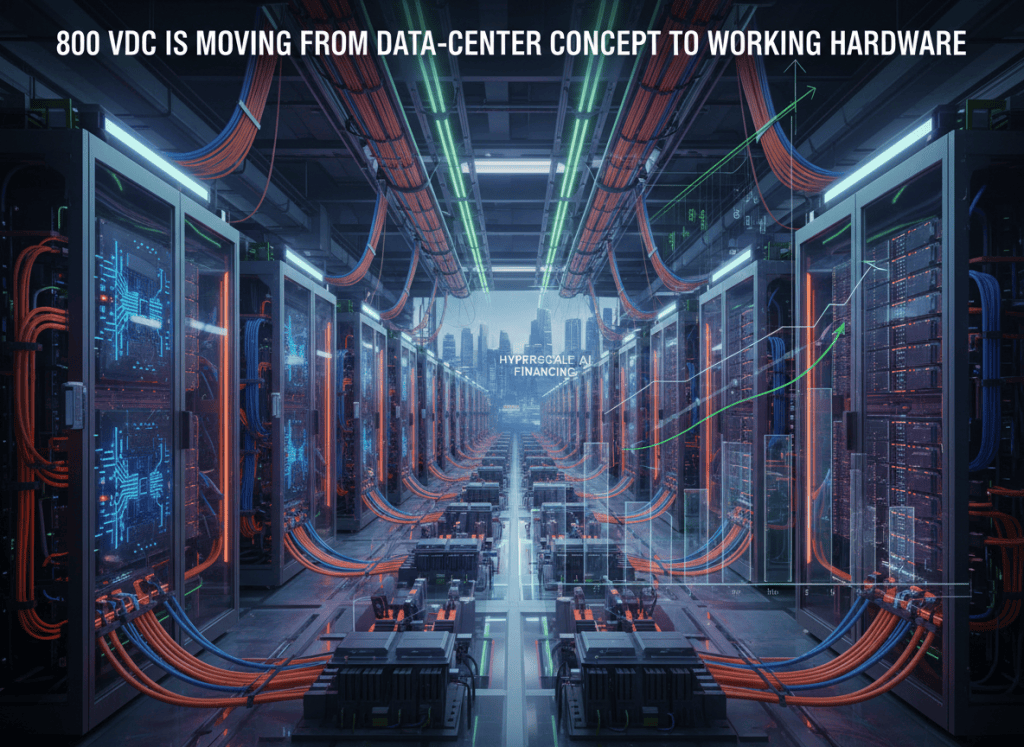
Data-center electrical architecture is beginning a major transition: 800-volt direct-current distribution is moving from specification work into physical hardware, laboratory validation and near-term deployment products for high-density computing.
The engineering reason is straightforward. Modern processors and accelerators ultimately operate on DC power, while conventional data centers distribute AC through much of the facility and perform several voltage and AC/DC conversions before power reaches the compute hardware. As rack density climbs toward hundreds of kilowatts and megawatt-class systems, conversion losses, conductor current, copper requirements and equipment footprint become increasingly important.
Why 800 VDC Changes the Power Path
NVIDIA’s current 800 VDC architecture proposes reducing the number of conversion stages between the utility feed and the compute rack. The company says higher-voltage DC distribution can lower current, copper use and cable bulk compared with rack-level 54 VDC and conventional facility AC distribution while supporting substantially higher rack power.
The electrical relationship helps explain the approach. Since P = V × I, increasing distribution voltage allows the same power to be transmitted at lower current. Conductor heating follows Ploss = I²R, so reducing current can sharply reduce resistive losses for a given conductor resistance. NVIDIA says its 800 VDC work is being developed with Google, Microsoft and the Open Compute Project, with more than 80 equipment and infrastructure companies participating in the surrounding ecosystem.
The Architecture Is Reaching Working Hardware
On September 10, 2026, SolarEdge reported that its three-phase medium-voltage-to-800-VDC conversion stage was operating under load in its engineering laboratories. The company also published an 800 VDC protection and grounding framework developed with NVIDIA while full-path system validation continues.
That protection work is important because high-voltage DC changes fault-management requirements. AC current naturally crosses zero each cycle, which assists interruption. DC does not, so breakers, solid-state protection, isolation, grounding and arc management become critical engineering issues when distribution voltage and available fault energy rise.
Texas Instruments is developing the power-conversion side of the same ecosystem. TI’s 2026 800 VDC reference architecture includes an 800 V-to-6 V DC/DC bus converter rated at 97.6% peak efficiency, followed by a 6 V-to-below-1 V multiphase stage for advanced GPU cores. TI is also showing 800 V hot-swap protection, a 30 kW AC/DC power supply and 800 V capacitor-bank designs.
What Technicians and Engineers Will Actually See
For electrical engineers and data-center technicians, 800 VDC is not simply a higher-voltage power supply. It changes busways, switchgear, connectors, overcurrent protection, grounding, energy storage, isolation, conversion topology, maintenance procedures and training. NVIDIA says its MGX-compatible 800 VDC power rack is planned as a hybrid path for existing AC facilities, with broader native 800 VDC architectures following as the ecosystem matures.
The same power-conversion fundamentals are familiar in Bitcoin mining. BitcoinVersus.tech’s Power Supply Unit Overview for Bitcoin Mining explains how mining hardware converts facility power into the low-voltage DC rails required by ASIC systems. The site’s Energy Production: Power Distribution overview covers the broader electrical path that sits upstream of compute equipment.
The key development in 2026 is therefore not that 800 VDC has suddenly become universal. It has not. The more important shift is that the architecture is progressing from reference designs and standards work into functioning conversion stages, protection frameworks and vendor hardware intended for real data-center deployment. That makes 800 VDC an electrical-infrastructure trend worth watching as compute density continues to rise.
BitcoinVersus.Tech Editor’s Note:
We volunteer daily to ensure the credibility of the information on this platform is Verifiably True. If you would like to support to help further secure the integrity of our research initiatives, please donate here: 3C9o19EH5HSiwEPyCTmEKzxhNCbo2X6TTb
https://x.com/1BitcoinVersus/status/1937006164555993338
BitcoinVersus.tech is not a financial advisor. This media platform reports on financial subjects purely for informational purposes.


Leave a Reply