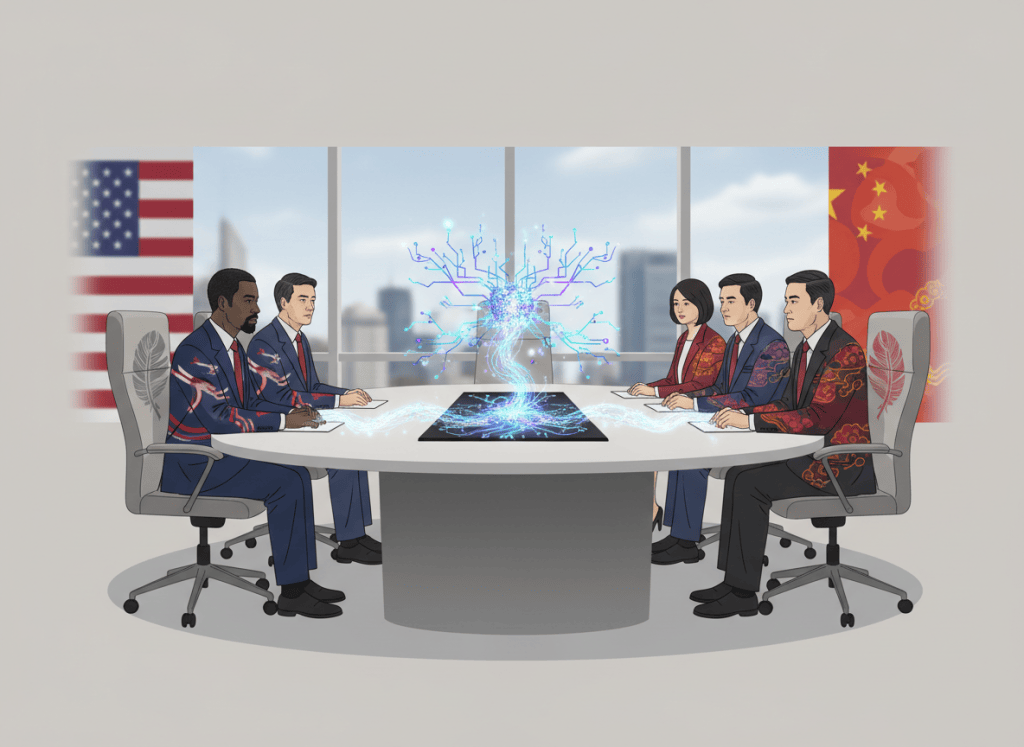
U.S. and Chinese officials are considering a new communication mechanism intended to reduce the national-security risks associated with increasingly capable artificial-intelligence systems.
U.S. Treasury Secretary Scott Bessent and Chinese Vice Premier He Lifeng discussed the proposal during economic and trade talks in New York on September 20, 2026. According to reporting on the negotiations, Washington proposed an AI safety notification mechanism through which the two countries could communicate about significant AI incidents carrying national-security implications.
The proposal does not constitute an agreement. China’s public response has so far been limited, and important details—including what events would trigger a notification, what information would be exchanged and whether participation would be binding—remain unresolved.
That distinction matters. At this stage, the mechanism is best understood as a diplomatic proposal rather than an operating international AI-safety system.
AI Moves Into U.S.-China Diplomacy
The talks show how quickly artificial intelligence is moving from a technology-policy issue into conventional international diplomacy.
The United States and China operate two of the world’s most consequential AI ecosystems. Competition encompasses advanced semiconductors, data centers, models, energy infrastructure and military applications, but increasingly capable systems also create risks that could cross national borders.
A notification framework could function somewhat like other diplomatic communication channels intended to reduce misunderstanding during potentially dangerous incidents. Topics discussed around the proposal include national-security risks from AI, while U.S. officials said export controls on sophisticated AI chips and semiconductor manufacturing equipment were not part of the proposed mechanism.
That does not mean Washington and Beijing have reached a common position on AI regulation. Significant disagreements remain over technology controls, trade and national security.
Trade Remains Part of the Same Conversation
AI was only one part of the September 20 negotiations.
The two governments also discussed implementing a previously announced U.S.-China Board of Trade intended to identify areas where tariffs on non-strategic goods could potentially be reduced. Consumer products, agricultural goods, energy and medical devices were among the areas discussed, while strategic trade disputes remain separate issues.
The combination is notable because modern AI infrastructure itself depends heavily on international supply chains: semiconductor manufacturing equipment, advanced packaging, memory, networking hardware, power equipment and critical minerals can all become elements of technology policy.
BitcoinVersus.tech has separately examined these physical layers through its recent coverage of China’s CXMT fifth-generation DRAM production and 800 VDC data-center power infrastructure.
What Happens Next
The proposed AI notification mechanism is expected to remain part of discussions surrounding the next meeting between President Donald Trump and Chinese President Xi Jinping.
Whether it becomes a formal agreement will depend on negotiations that have not yet occurred publicly.
For now, the important development is narrower but significant: AI safety has entered direct high-level U.S.-China economic and diplomatic talks alongside trade and national security.
That places artificial intelligence in a category increasingly similar to other strategic technologies where competition and risk-management discussions can occur simultaneously.
BitcoinVersus.Tech Editor’s Note:
We volunteer daily to ensure the credibility of the information on this platform is Verifiably True. If you would like to support to help further secure the integrity of our research initiatives, please donate here: 3C9o19EH5HSiwEPyCTmEKzxhNCbo2X6TTb
https://x.com/1BitcoinVersus/status/1937006164555993338
BitcoinVersus.tech is not a financial advisor. This media platform reports on financial subjects purely for informational purposes.


Leave a Reply