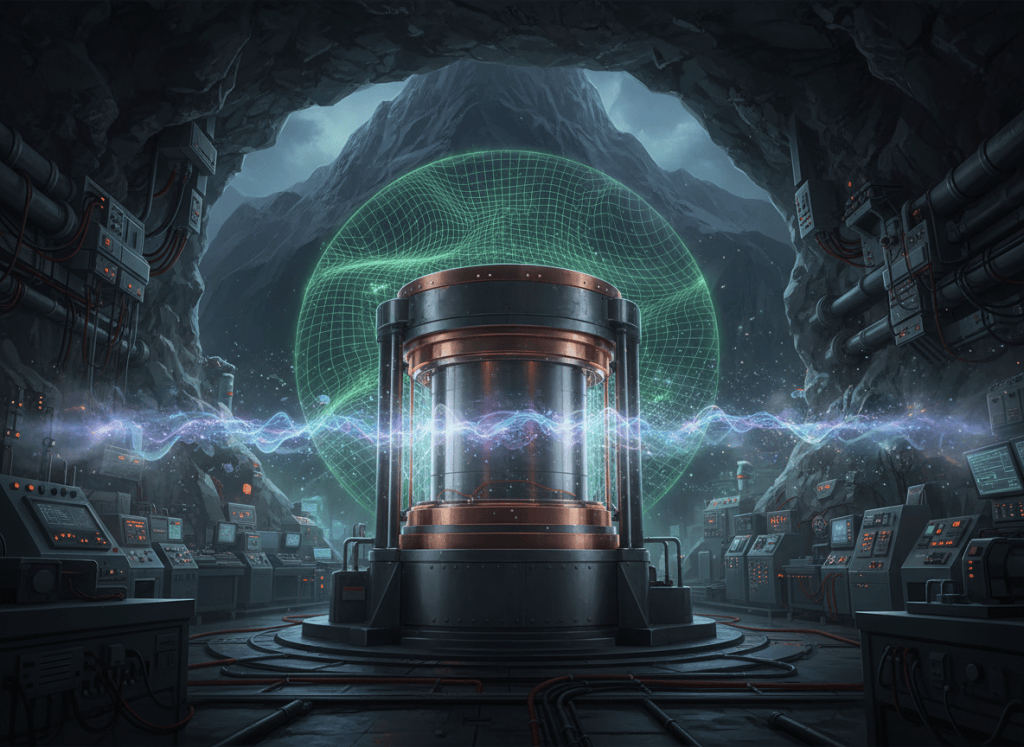
A precision experiment beneath Italy’s Gran Sasso mountain has ruled out a specific theoretical model proposing that tiny fluctuations in spacetime cause quantum superpositions to decay into the classical states observed at everyday scales.
The result is important because it converts part of a long-running quantum-gravity debate into something experimentally testable. It does not establish that gravity has no role in quantum decoherence, nor does it resolve the quantum measurement problem. Instead, the experiment excludes the tested generalized Károlyházy model within the parameter regime examined by the researchers.
The Hypothesis: Spacetime Fluctuations Destroy Superposition
Quantum mechanics permits a system to exist in a superposition of possible states. At macroscopic scales, however, objects do not normally display such behavior. The transition from observable quantum effects toward classical behavior is described through decoherence, but the deeper relationship between gravity, quantum mechanics and measurement remains an open research problem.
In the 1960s, Hungarian physicist Frigyes Károlyházy proposed that spacetime contains unavoidable microscopic fluctuations. In the model tested by the new experiment, those fluctuations would gradually disrupt quantum superpositions. The same mechanism should make charged particles accelerate randomly and emit an extremely faint electromagnetic-radiation signature.
That radiation provides a way to test the hypothesis without directly observing the proposed spacetime fluctuations.
62 Days Beneath 1.4 Kilometers of Rock
Researchers from the VIP Collaboration performed the measurement at the INFN Gran Sasso National Laboratory, where approximately 1.4 kilometers of rock suppresses cosmic radiation and other background interference.
The team used a high-purity germanium detector protected by copper and lead shielding and collected data for 62 days. After estimating and subtracting expected background radiation, the researchers searched for the additional radiation spectrum predicted by the generalized Károlyházy model.
They found no such signal. The peer-reviewed result was published in New Journal of Physics as Experimental exclusion of a generalized Károlyházy gravity-induced decoherence model.
What the Experiment Does—and Does Not—Show
The distinction between a model and an established physical law is essential here. Károlyházy’s proposal is a theoretical attempt to explain why macroscopic objects do not remain in observable quantum superpositions. The absence of the predicted signal is evidence against the particular tested formulation; it is not evidence that every possible gravity-related collapse mechanism is false.
Other gravity-induced collapse frameworks use different assumptions and can make different predictions. Earlier Gran Sasso work, for example, placed strong experimental constraints on a natural parameter-free version of the Diósi-Penrose model. The broader question of how quantum mechanics and gravity fit together remains unresolved.
The result nevertheless demonstrates a useful principle for theoretical physics: a theory becomes much more scientifically informative when it produces a measurable consequence that can survive—or fail—an experiment.
Theory Is Moving Closer to Measurement
Quantum gravity is often associated with energy scales far beyond present laboratories, but precision measurements can test some lower-energy consequences proposed by quantum-gravity-inspired models. In this case, a theory about microscopic spacetime fluctuations ultimately became a prediction about radiation detectable with a shielded semiconductor crystal.
That connection between abstract models and physical instrumentation also links theoretical physics to semiconductor and quantum-device engineering. BitcoinVersus.tech has previously examined quantum-material research at MIT and the hardware/software intersection in IBM and AMD’s quantum-computing collaboration.
The new Gran Sasso result does not tell physicists what the final theory of quantum gravity is. It does something more limited and experimentally concrete: it tells them one tested explanation did not produce the signal nature was expected to reveal.
BitcoinVersus.Tech Editor’s Note:
We volunteer daily to ensure the credibility of the information on this platform is Verifiably True. If you would like to support to help further secure the integrity of our research initiatives, please donate here: 3C9o19EH5HSiwEPyCTmEKzxhNCbo2X6TTb
https://x.com/1BitcoinVersus/status/1937006164555993338
BitcoinVersus.tech is not a financial advisor. This media platform reports on financial subjects purely for informational purposes.


Leave a Reply