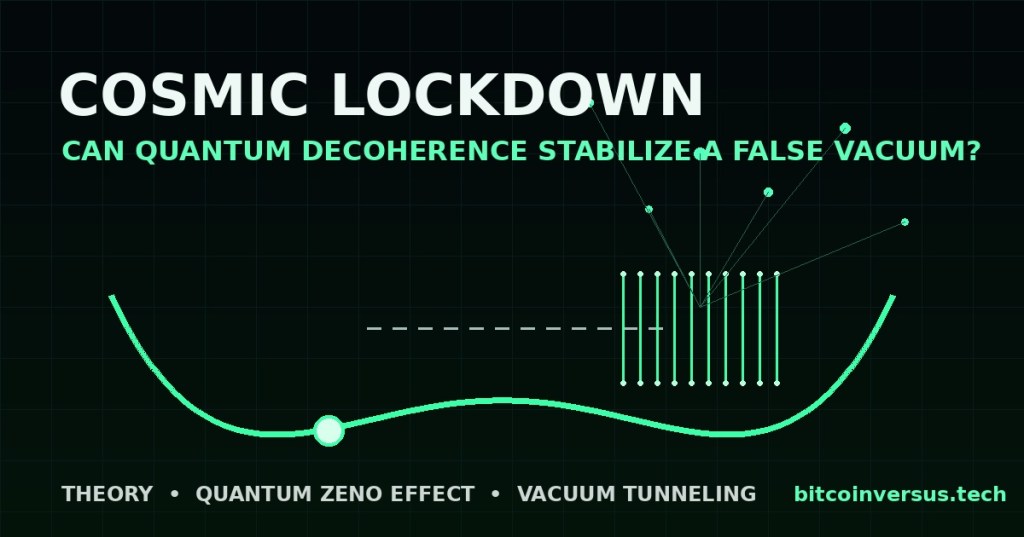
One of the strangest possibilities in modern physics is that the universe may not occupy the absolute lowest-energy state available to it. If some quantum field sits in a higher-energy “false vacuum,” quantum mechanics says there can be a nonzero chance of tunneling into a deeper state.
A new theoretical study argues that the universe’s own environment may make that tunneling much harder after a field settles into a vacuum. In Syracuse University’s October 5 report, researchers describe a mechanism they call “cosmic lockdown”: decoherence can suppress later vacuum tunneling and effectively pin a quantum field into the state it has already reached.
A false vacuum is like a ball sitting in the wrong valley
The easiest way to picture a vacuum is as a landscape of valleys. The deepest valley is the true vacuum—the lowest-energy state. A shallower valley can behave like a false vacuum: stable enough to hold a field for a very long time, even though a deeper state exists somewhere else in the energy landscape.
Classically, a ball trapped in one valley cannot cross a hill unless it has enough energy. Quantum mechanics changes that rule. A quantum state can have some probability of appearing on the other side of an energy barrier, a process called tunneling.
BitcoinVersus.Tech recently covered another experiment at the boundary between quantum mechanics and gravity in our report on a quantum free-fall test of Einstein’s equivalence principle. Both questions ask how familiar quantum behavior changes when placed inside the large-scale structure of spacetime.
The new ingredient is decoherence
Quantum systems are almost never perfectly isolated. They interact with nearby fields, particles and other environmental degrees of freedom. Those interactions gradually destroy delicate quantum superpositions through a process called decoherence, making the system behave more classically.
The researchers modeled a scalar field in an expanding universe with two possible vacuum states and coupled that field to environmental degrees of freedom. Their paper, “Cosmic Lockdown: When Decoherence Saves the Universe from Tunneling,” finds that decoherence does not necessarily choose the initial vacuum for the field. Instead, once the field has decohered, later tunneling between the vacua becomes strongly suppressed.
That distinction matters. The environment does not simply force every field into the lowest-energy state. Rather, it can act like a lock after the field has already settled somewhere.
The mechanism resembles the quantum Zeno effect
The researchers connect cosmic lockdown to the quantum Zeno effect—the counterintuitive idea that repeated interaction or observation can inhibit a quantum system’s evolution. In everyday language, the environment keeps “checking” the field so often that the field becomes less able to coherently tunnel into a different state.
This is not a literal observer staring at the universe. The “measurement” comes from unavoidable interactions between the field and its surroundings. Information about the field leaks into the environment, reducing the coherent quantum behavior required for tunneling.
That makes the idea especially interesting because decoherence is usually discussed as a nuisance in quantum computing. BitcoinVersus.Tech previously covered a different angle on environmental quantum behavior in an underground experiment that ruled out one gravity-driven decoherence model. Here, decoherence is not merely noise—it may become a stabilizing ingredient in cosmology.
Light fields and heavy fields behave differently
The simulations also separate the field’s early evolution from the later lockdown stage. Heavy fields relative to the universe’s expansion rate tend to track toward the true vacuum more adiabatically. Lighter fields can respond less smoothly and retain a greater probability of occupying the false vacuum.
Once decoherence becomes strong enough, however, tunneling away from whichever state was selected is suppressed. The field can effectively become trapped in the local minimum it already occupies.
The broader idea connects to recent quantum simulations of particle creation. Our story on a quantum computer simulating matter appearing from a vacuum-like field showed how quantum processors are increasingly being used to study field behavior that is difficult to reproduce directly in the laboratory.
Does this mean the universe is safe from vacuum decay?
No. The result comes from a simplified cosmological model and does not calculate the real-world lifetime of the Higgs vacuum. Applying the mechanism directly to the Higgs field would require a much more complete treatment, including realistic field interactions, the evolution of cosmic expansion and the field’s gravitational backreaction.
So the study should not be read as proof that vacuum decay cannot happen. Its contribution is narrower and more useful: calculations of vacuum stability may need to treat the field as an open quantum system interacting with an environment, rather than as an ideally isolated field.
Why the theory matters
“Cosmic lockdown” brings two areas of physics unusually close together. Quantum-information researchers study decoherence because it destroys fragile quantum states in computers. Cosmologists study vacuum selection because it may help determine why the universe has the particles, forces and low-energy physics that we observe today.
The new work suggests those may be versions of the same underlying problem. An environment that ruins quantum coherence in a computer may, on cosmological scales, help preserve the vacuum state of an entire quantum field.
If that picture survives more realistic models, one of quantum mechanics’ most frustrating effects—decoherence—could turn out to be one reason the universe is so difficult to knock out of the state it already occupies.
BitcoinVersus.Tech
Advertisement
Editor’s Note
We volunteer daily to ensure the credibility of the information on this platform is Verifiably True. If you would like to support to help further secure the integrity of our research initiatives, please donate here: 3C9o19EH5HSiwEPyCTmEKzxhNCbo2X6TTb
BitcoinVersus.tech is not a financial advisor. This media platform reports on financial subjects purely for informational purposes.


Leave a Reply