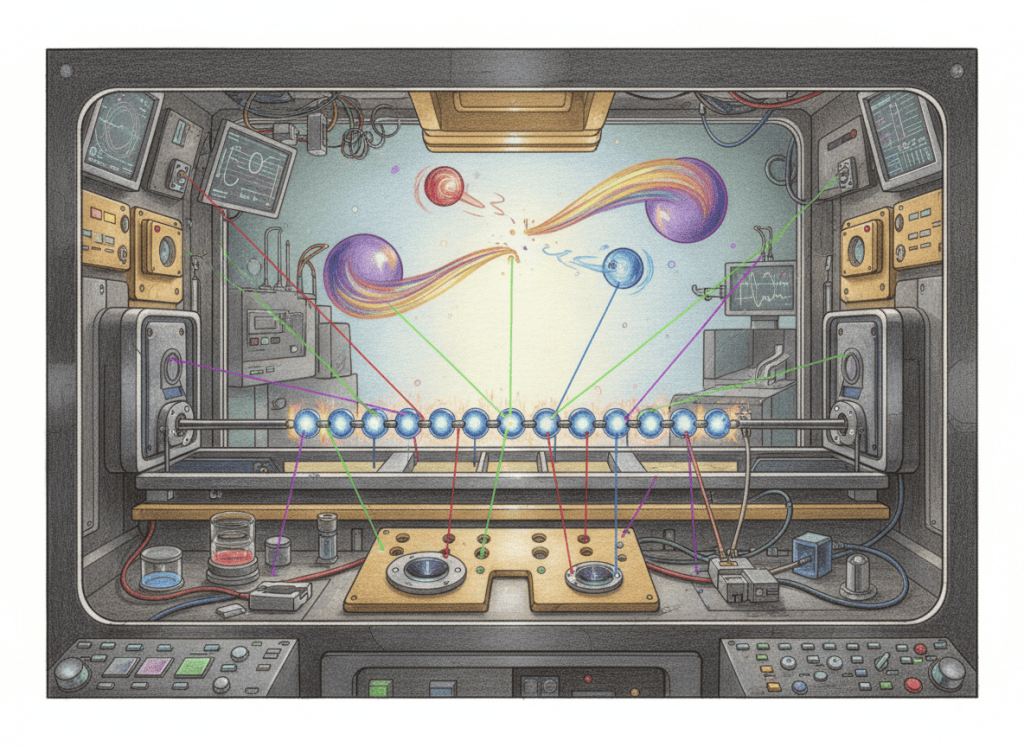
A recent YouTube explainer highlights one of the stranger things quantum computers can do: not merely calculate numbers faster, but imitate the rules of a different physical system closely enough to watch particle-like excitations emerge from stored energy.
In a new trapped-ion experiment, researchers used just 13 ions to reproduce a process known as string breaking, a simplified version of the physics in which the energy binding two charges becomes large enough to create a new particle-antiparticle pair.
What “matter popping into existence” actually means
The headline sounds more dramatic than the physics. The machine did not create ordinary matter from nothing. Instead, researchers programmed a quantum simulator so that its ions obeyed the mathematics of a simplified lattice gauge theory.
Inside that simulated system, two charges are connected by a field that behaves like a stretched string. As the charges separate, energy builds in that field. Above a threshold, the energetically favorable outcome is for a new pair of excitations to appear, effectively snapping the original string into two shorter ones.
Duke Quantum Center’s primary account says the team used a chain of 13 trapped ions and precisely controlled laser interactions to emulate this string-breaking process and track the emergence of effective charges over time.
The experiment is about quantum field theory, not magic
String breaking is related to the way strongly interacting particles behave in quantum field theories. In the real strong force, quarks are confined: trying to pull them apart stores energy in the field between them rather than simply leaving isolated quarks behind.
The new experiment does not recreate full quantum chromodynamics. It uses a simpler one-dimensional lattice gauge theory that preserves enough of the underlying structure to study how confinement and pair creation unfold dynamically.
The peer-reviewed Nature Physics paper describes the experiment as a programmable trapped-ion simulation of string-breaking dynamics in a one-dimensional lattice gauge theory. The point is not that the ions become quarks, but that their interactions can be engineered to follow analogous equations.
Phys.org summarized the result with the right scale
A story-specific Phys.org X post captures the key result: a 13-ion quantum simulator recreated string breaking connected to particle formation and tracked the effective charges as the simulated connection gave way.
Why quantum computers are useful for this kind of physics
Classical computers can model small quantum systems very accurately, but the required computational resources can explode as researchers add more interacting quantum degrees of freedom. That is one reason quantum field dynamics are considered a natural long-term use case for quantum processors.
A quantum simulator does not have to calculate every possible state explicitly in the same way a classical machine does. Researchers instead engineer a controllable quantum system whose own evolution represents the problem they want to study.
BitcoinVersus recently covered D-Wave opening an error-aware gate-model simulator to developers, another example of quantum hardware being turned into an experimental computing platform rather than treated only as a future replacement for classical machines.
Quantum hardware still has no single winning architecture
The trapped-ion approach used here is only one branch of the industry. Superconducting qubits, neutral atoms, photonics, annealers, and topological approaches all pursue different tradeoffs in fidelity, connectivity, speed, and scaling.
That is why BitcoinVersus has argued that quantum computing still has no universally dominant architecture. A useful scientific simulator may not look like the eventual machine used for cryptography, chemistry, or optimization.
The ecosystem is also becoming more hybrid. IonQ’s connection of its Superion 256 system to NVIDIA AI infrastructure shows how quantum processors are increasingly being designed to work alongside classical accelerators rather than operate in isolation.
The Big Bang connection is indirect but real
Researchers are interested in string breaking because related out-of-equilibrium field dynamics appeared in extreme environments throughout the early universe and still appear in high-energy particle physics. A programmable quantum simulator gives physicists a controllable laboratory for simplified versions of those equations.
That does not mean 13 ions can reproduce the Big Bang. It means the same mathematical structures that are hard to follow in high-energy theories can sometimes be encoded into a much smaller engineered quantum system and watched evolve step by step.
The real milestone is controllable quantum dynamics
The most important result is not the phrase “particles from nothing.” It is that researchers controlled a quantum device precisely enough to reproduce a nontrivial real-time field-theory process and compare it with classical calculations.
If this style of simulation scales to larger systems, more dimensions, and more realistic field theories, quantum processors could become experimental tools for questions that today exist mostly in equations and supercomputer approximations.
BitcoinVersus.Tech
Advertisement
Editor’s Note
We volunteer daily to ensure the credibility of the information on this platform is Verifiably True.
If you would like to support to help further secure the integrity of our research initiatives, please donate here: 3C9o19EH5HSiwEPyCTmEKzxhNCbo2X6TTb
BitcoinVersus.tech is not a financial advisor. This media platform reports on financial subjects purely for informational purposes.


Leave a Reply