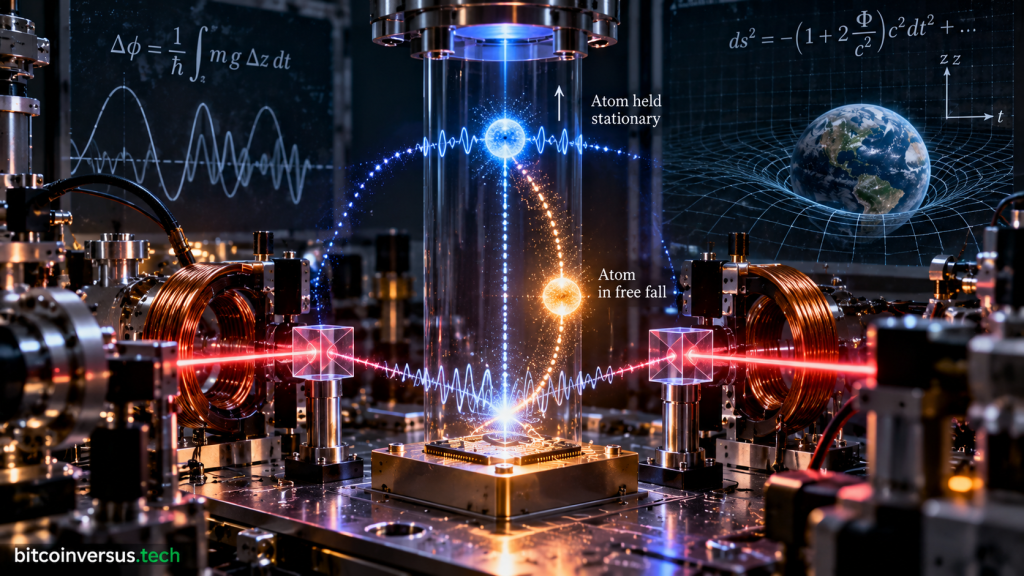
A new atom-interferometer experiment has pushed Einstein’s equivalence principle into territory where quantum mechanics cannot be ignored. Researchers split ultracold rubidium atoms into two quantum paths at once: one wave packet remained effectively stationary in the laboratory while the other entered free fall. When the two paths were recombined, the measured phase shift matched the prediction expected when Einstein’s gravity and quantum wave behavior remain consistent in the tested regime.
The Ben-Gurion University research record describes the result as a direct test of the interface between quantum theory and gravity. The study, published in Science Advances, was led by researchers including Ron Folman and involved collaborators from Germany and the United Kingdom, including Nobel laureate Roger Penrose.
Ars Technica highlighted the experiment in its September X discussion, focusing on the central question: what happens when quantum mechanics and relativity are forced into the same laboratory test?
One Atom, Two Paths, Two Descriptions of Gravity
The experiment used a cold-atom interferometer to create a superposition in which the same atom followed two alternatives. One wave packet was allowed to fall freely. The other was held in place by a magnetic force tuned to counteract the atom’s weight. From the laboratory frame, one path fell while the other hovered.
Quantum mechanics predicts that each path accumulates phase differently. General relativity, through the equivalence principle, says that a freely falling object locally behaves as though gravity has disappeared. The experiment therefore turns a foundational statement about gravity into something that can be read through quantum interference.
The Interference Pattern Matched the Prediction
Ars Technica’s technical report explains that the freely falling and stationary paths were separated by only micrometers and evolved for milliseconds before being recombined. As the free-fall time increased, the measured quantum phase changed in the direction and amount expected from theory.
The result does not provide a finished theory of quantum gravity. It does something narrower and more useful: it shows that, at low energies and on the scale of this experiment, the quantum phase associated with free fall remains consistent with the equivalence principle.
Why the Equivalence Principle Matters
Einstein’s equivalence principle says that, locally, free fall and weightlessness are physically equivalent. It is one of the conceptual foundations of general relativity. Testing it with ordinary objects is straightforward compared with testing it when matter is deliberately placed into a quantum superposition.
BitcoinVersus.Tech recently covered a complementary route to the same boundary in a new muonium beam designed for future gravity tests. Muonium offers a different kind of probe because it is a purely leptonic bound state rather than an ordinary atom with a nucleus.
This Is a Test of Compatibility, Not a Quantum-Gravity Victory Lap
The distinction matters. Quantum mechanics and general relativity are each extraordinarily successful in their own domains, but they are not yet unified into a complete quantum theory of gravity. Experiments like this one test whether specific pieces of the two frameworks remain compatible when they overlap.
That is similar to the caution required when interpreting anomalous data elsewhere in fundamental physics. BitcoinVersus.Tech’s coverage of LUX-ZEPLIN’s 2.6-sigma dark-matter outlier emphasized the difference between an intriguing result and a confirmed discovery.
The New Interferometer May Matter More Than This One Result
The experimental platform is important because it can create a controlled contrast between a freely falling quantum wave packet and one held static in Earth’s frame. That gives researchers a new way to search for tiny deviations from established theory rather than merely confirming the first predicted phase.
The broader lesson also applies to high-profile theoretical claims. BitcoinVersus.Tech recently examined the debate around whether AI had truly solved the Navier-Stokes Millennium Problem. In both cases, the meaningful question is not whether a headline sounds revolutionary, but whether the mathematics, experiment and independent scrutiny survive contact with one another.
A Tiny Falling Atom Becomes a Test of Two Giant Theories
The experiment is striking because its physical scale is so small while the conceptual target is so large. A rubidium atom travels only micrometers and evolves for milliseconds, yet its interference phase probes one of the oldest unresolved boundaries in modern physics.
For now, Einstein’s equivalence principle survives this quantum test. The more important development may be that physicists finally have an interferometer capable of asking the question directly—and of looking for where the agreement might eventually fail.
BitcoinVersus.Tech
Advertisement
Editor’s Note
We volunteer daily to ensure the credibility of the information on this platform is Verifiably True. If you would like to support to help further secure the integrity of our research initiatives, please donate here: 3C9o19EH5HSiwEPyCTmEKzxhNCbo2X6TTb
BitcoinVersus.tech is not a financial advisor. This media platform reports on financial subjects purely for informational purposes.


Leave a Reply