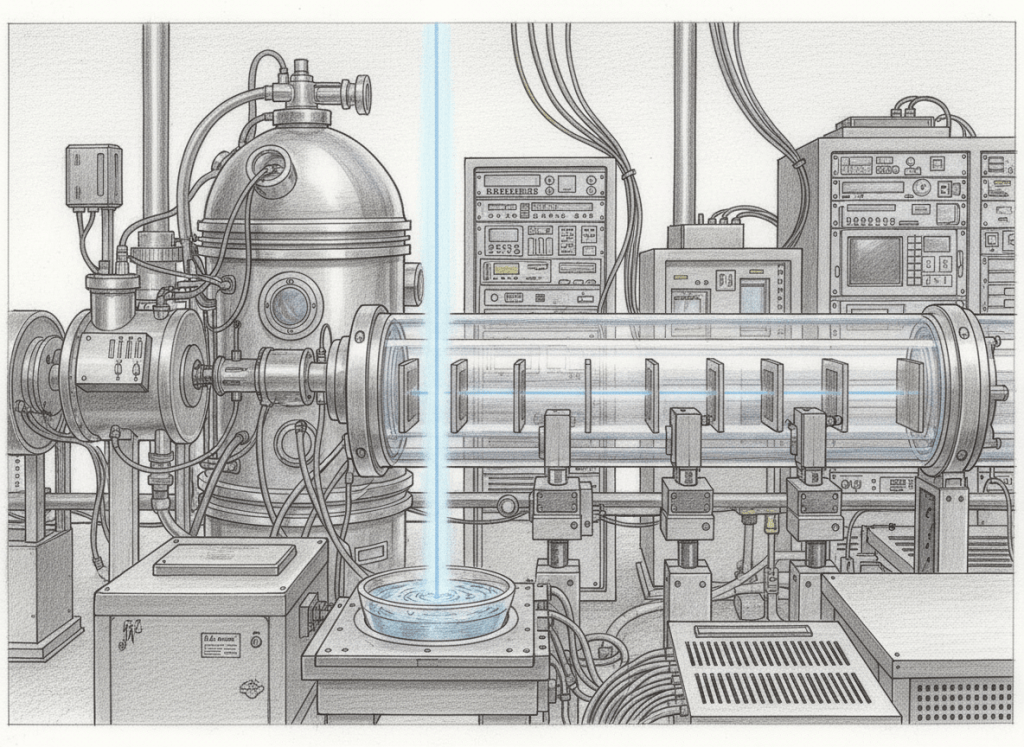
Einstein’s equivalence principle has survived increasingly precise tests, but nearly all direct free-fall measurements have involved ordinary matter, first-generation particles or first-generation antimatter. Researchers at ETH Zürich and the Paul Scherrer Institute have now built a beam that could extend that question into a different part of the Standard Model: does a second-generation lepton fall exactly the way ordinary matter does?
The new result is not a measurement showing that Einstein was wrong. It is the enabling technology for a future measurement. In a September 15 ETH Zürich research report, the team describes an intense, cold beam of muonium atoms designed to make a direct gravity experiment feasible.
Muonium is almost the cleanest possible second-generation gravity probe
Muonium is an exotic neutral atom made from a positively charged muon and an electron. The positive muon is the antimatter partner of the muon and belongs to the second generation of leptons; the electron belongs to the first. Because the system contains no proton or neutron, its mass is not dominated by the strong-interaction energy that makes up most of the mass of ordinary atomic nuclei.
That is what gives the experiment its theoretical value. If muonium falls with the same gravitational acceleration expected for ordinary matter, the equivalence principle survives another qualitatively different test. If it does not, physicists would have to explain why gravity appears to couple differently to matter containing a heavier lepton generation.
BitcoinVersus.Tech recently covered a quantum free-fall test that again supported Einstein’s equivalence principle. The muonium proposal asks a related question from a different direction: not simply whether quantum objects fall universally, but whether that universality extends directly to a second-generation Standard Model particle.
The problem is that the muon barely exists long enough to fall
A free muon has a lifetime of only about 2.2 microseconds. That makes gravity extraordinarily difficult to measure because the gravitational displacement accumulated over such a short time is tiny. Charged muons are also poor direct gravity probes because electromagnetic fields overwhelm gravity by enormous margins.
Muonium solves the charge problem because the positive muon and electron form a neutral atom. The lifetime problem remains. To extract a measurable gravitational signal, the atoms must emerge with tightly controlled speed and direction so an interferometer can detect a tiny gravity-induced shift in their matter-wave interference pattern.
Superfluid helium becomes an atomic cannon
The team’s key advance is a new way to create that beam. Positive muons are sent into a thin layer of superfluid helium cooled close to absolute zero. After a muon captures an electron and forms muonium, the exotic atom can move through the quantum fluid and is expelled from the helium surface with a relatively uniform velocity.
The researchers describe the effect as using the chemical potential of muonium in superfluid helium like an “atomic cannon.” Instead of producing a diffuse cloud traveling in many directions, the source produces atoms moving at similar speeds and nearly parallel trajectories.
The peer-reviewed Nature Physics paper published September 14 reports that the high-brightness, superthermal beam should enable muonium interferometry and a percent-level measurement of its gravitational acceleration. The same beam could also support much more precise laser spectroscopy of muonium.
The experiment is really a search for universality
The weak equivalence principle says that, in the same gravitational field, freely falling test bodies accelerate independently of their composition. It is one of the conceptual foundations from which general relativity is built.
Ordinary-matter experiments have verified that principle to astonishing precision. Antihydrogen experiments have also shown that neutral antimatter falls toward Earth consistently with ordinary gravity. Muonium would open a different sector because its mass is overwhelmingly associated with an elementary second-generation lepton instead of a proton or neutron.
That makes this a good example of why physics keeps testing ideas that already work. BitcoinVersus.Tech’s recent Gran Sasso coverage showed an experiment ruling out one gravity-driven quantum-decoherence model. Null results matter because every well-designed failure to find new physics removes territory from the map of possible theories.
What would a deviation mean?
A statistically credible difference between muonium’s gravitational acceleration and the expected value would be extraordinary. It could indicate that gravity is not completely universal across particle generations or point toward an additional interaction sometimes described generically as a fifth force.
But there is no such deviation yet. The beam is the breakthrough; the decisive gravity measurement is still ahead. ETH Zürich says the team hopes to test the interferometer method with the beam first, with the full gravity experiment following later if the apparatus performs as expected.
That careful distinction is similar to the one required around anomalous signals elsewhere in physics. BitcoinVersus.Tech recently examined LZ’s 2.6-sigma dark-matter outlier: an unexplained result can be scientifically interesting without yet qualifying as a discovery.
The muonium experiment therefore has two valuable outcomes. If it agrees with Einstein, physicists will have extended direct equivalence-principle testing into a new particle generation. If it does not, the discrepancy would become one of the most important clues in modern fundamental physics. Either way, the new beam turns a question that was previously close to experimentally inaccessible into something that can actually be measured.
BitcoinVersus.Tech
Advertisement
Editor’s Note
This report distinguishes the demonstrated muonium-beam breakthrough from the future gravity measurement it is intended to enable. No violation of Einstein’s equivalence principle has been observed. The featured cover is an original editorial illustration and is not duplicated in the article body.
We volunteer daily to ensure the credibility of the information on this platform is Verifiably True. If you would like to support our research initiatives, please donate here: 3C9o19EH5HSiwEPyCTmEKzxhNCbo2X6TTb
BitcoinVersus.tech is not a financial advisor. This media platform reports on financial subjects purely for informational purposes.


Leave a Reply