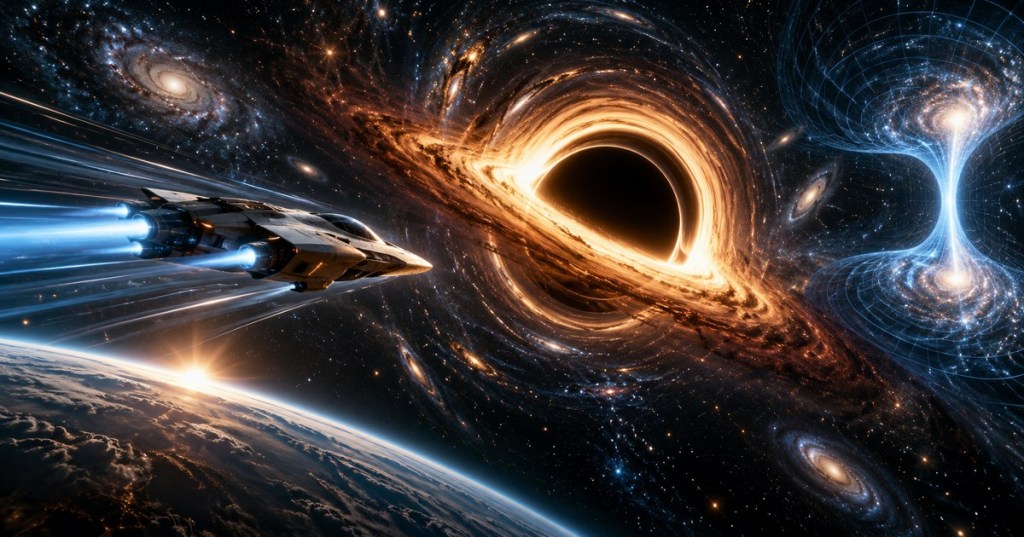
Could you leave Earth, travel through space, and return to a future where generations have passed—while your body has aged only a few years? Einstein’s equations say yes in principle. The remarkable part is that two of the mechanisms involved are not science fiction: velocity and gravity really do alter the amount of time recorded by different clocks. A third possibility, the wormhole, remains a mathematical and engineering conjecture.
- Near-light-speed travel: a traveler moving at 99.9% of light speed would experience about 4.47 years while 100 years pass on Earth, in an idealized journey.
- Black-hole gravity: clocks deeper in a gravitational field generally run more slowly relative to distant clocks; the exact difference depends on orbit and black-hole properties.
- Wormholes: equations permit hypothetical spacetime shortcuts, but no traversable wormhole has been observed or engineered.
- Scientific reality: time dilation is measured with atomic clocks and incorporated into GPS technology.
1. Flying Near the Speed of Light
Imagine identical 25-year-old twins. One remains on Earth; the other boards a spaceship that spends almost its entire journey moving at 99.9% of the speed of light. When they reunite after 100 Earth years, the traveler would have aged only about 4.47 years—ending around biological age 29.47, compared with age 125 for the person who remained on Earth. This is the famous twin paradox, not a medical anti-aging effect.
The calculation uses the Lorentz factor γ = 1 / √(1 − v²/c²). The traveler’s elapsed time is τ = T / γ = T × √(1 − v²/c²), where v is speed, c is light speed, and T is Earth-frame elapsed time. At 0.999c, γ ≈ 22.37.
How much would you personally age? The following values assume an idealized trip with a nearly constant cruising speed, negligible acceleration and turnaround time, and an Earth observer used as the reference clock.
| Spaceship speed | 10 Earth years | 25 Earth years | 100 Earth years |
|---|---|---|---|
| 90% c | 4.36 years | 10.90 years | 43.59 years |
| 99% c | 1.41 years | 3.53 years | 14.11 years |
| 99.90% c | 163.3 days | 1.12 years | 4.47 years |
| 99.99% c | 51.7 days | 129.1 days | 1.41 years |
Even though a clock aboard the ship appears slow to the Earth observer, the astronaut does not feel life running in slow motion. Their heartbeat, thoughts, metabolism and watch all proceed normally in their own frame. The difference emerges when the elapsed times along the two journeys are compared. The traveling twin changes reference frames to return home; the two paths through spacetime accumulate different amounts of proper time.
A light-year measures distance, not time. At 0.999c, a spaceship covers about 99.9 light-years of total path length in 100 Earth years of cruising. In an ideal out-and-back trip, its farthest point would be about 49.95 light-years from Earth. For the passenger, length contraction helps explain why the long journey need not consume 100 biological years. No human-carrying spacecraft can currently reach anything close to these speeds, and a massive object cannot travel at light speed.
The real phenomenon is measurable, even at ordinary speeds. In 2010, the U.S. National Institute of Standards and Technology demonstrated minute clock-rate differences both from motion and from a height difference of just 33 centimeters.
2. Orbiting Near a Black Hole
Einstein’s general relativity adds a second route: gravity changes clock rates. A clock near a sufficiently massive object can record less time than a distant clock. A black hole produces an extreme gravitational environment, but orbiting one is not the same as entering its event horizon. Once you cross that boundary, ordinary escape is no longer possible.
For a simplified nonrotating Schwarzschild black hole, a stationary clock held at radius r runs at the factor √(1 − rs/r) compared with a clock far away, where rs is the event-horizon radius. At r = 1.01 rs, 100 years far away would correspond to about 9.95 years on the hovering clock. But hovering that close would require tremendous continuous acceleration and is not a stable, free-fall orbit.
For an astronaut on the innermost stable circular orbit of a nonrotating black hole, at r = 3 rs, the combined gravitational and orbital-velocity effects yield approximately 70.71 years of astronaut time for 100 years measured far away. These illustrative comparisons assume ideal clocks and ignore travel to and from the black hole. Larger differences are possible in specialized scenarios involving rapidly rotating black holes, but the exact numbers cannot be transferred from one black hole to another.
A popular misconception is that falling toward the horizon lets you watch the entire future of the universe flash by. That does not follow for an ordinary falling observer. The apparent freezing seen from afar is tied to the propagation and redshifting of emitted light; the falling astronaut continues to experience their own finite proper time. NASA’s black-hole FAQ explains this distinction.
Real obstacles remain formidable: fuel and propulsion, lethal radiation around some accretion disks, tidal forces, orbital stability, and a practical route back to Earth. For more on experimental tests of gravity, see our earlier reporting on quantum free-fall tests of Einstein’s equivalence principle.
3. Folding Spacetime With a Wormhole
The third idea is different. A wormhole is a proposed tunnel through spacetime linking otherwise distant regions. The familiar illustration involves folding a sheet of paper until two far-apart points touch, then connecting them with a shorter route. That picture is only an analogy: general relativity describes four-dimensional spacetime, not literal paper being folded in an external room.
A traversable wormhole could, if it physically exists and could be stabilized, let a traveler cross a shorter spacetime path without locally exceeding light speed. A 100-light-year separation in ordinary space would not automatically require 100 years of travel through the shortcut. But that possibility is not equivalent to a demonstrated way to build the tunnel or keep its throat open.
In 1988, physicists Michael Morris, Kip Thorne and Ulvi Yurtsever examined whether a hypothetical traversable wormhole could be turned into a time machine by altering the relative timing of its two mouths. Their peer-reviewed paper in Physical Review Letters discusses severe unanswered constraints involving energy conditions, causality and quantum physics. A theoretical solution is not proof that a usable wormhole exists.
A stable traversable wormhole in standard general relativity is generally associated with highly problematic matter or energy requirements, including violations of classical energy conditions. Whether quantum effects can supply the necessary conditions without rendering the configuration unstable remains an open research problem. No observational evidence shows that traversable wormholes exist. Also, ordinary astrophysical black holes should not be treated as proven wormhole portals.
What Has Actually Been Verified?
| Concept | Evidence | Would it send a human into the future? |
|---|---|---|
| Motion-based time dilation | Measured with clocks and particle physics | In principle yes; propulsion is the barrier. |
| Gravitational time dilation | Measured with clocks; essential to satellite timing | In principle yes; a survivable mission is the barrier. |
| Traversable wormholes | Mathematical models only; no observed example | Unknown; existence and stability are unresolved. |
GPS satellites provide an everyday example. Their onboard clocks are affected by both speed and Earth’s gravity, so engineers must account for relativity to keep navigation accurate. This is a real application of the same physics, though the effects are tiny compared with our imagined spacecraft. NASA explains the GPS corrections; more precision-clock results are documented by NIST.
Conclusion
The most credible kind of future time travel is not a portal or a machine that makes your local clock reverse. It is taking a journey through spacetime on which less time passes for you than for someone who stays behind. Einstein predicted it, laboratories have measured it, and satellite navigation already accounts for it. For an ideal traveler at 99.9% of light speed, 100 Earth years really can correspond to roughly 4.47 years of personal aging. Strong gravity offers another mathematically valid route, while wormholes remain an intriguing and unproven possibility. The gap between a verified equation and a viable human mission is enormous—but the underlying differences in elapsed time are real.
BitcoinVersus.Tech Editor’s Note:
We volunteer daily to ensure the credibility of the information on this platform is Verifiably True. If you would like to support to help further secure the integrity of our research initiatives, please donate using the QR code provided

For best QR-code scanning results, please scan this donation code from a desktop or larger screen. Mobile screens may prevent camera recognition.


Leave a Reply