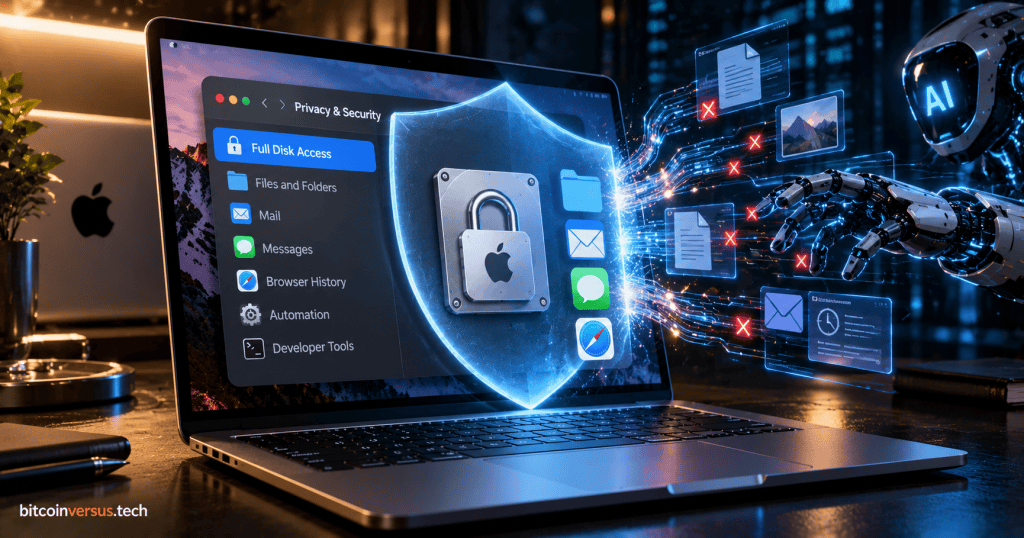
Apple is tightening macOS Full Disk Access after warning that increasingly capable AI agents make broad access to files, mail, messages, and browsing history substantially more dangerous.
In the company’s October 2 developer notice, Apple said Full Disk Access was created to let software such as backup tools work across a Mac, but that some developers are using the permission in ways that can expose far more private data than users realize. Apple says future controls will require people who truly want to grant that level of access to take “very explicit” action.
This is a platform-level acknowledgement that AI agents change the risk model for desktop permissions: the more autonomous the software becomes, the more dangerous an all-access permission can be.
Full Disk Access sits above normal app permissions
Most macOS privacy controls are designed around specific capabilities: an app may request access to contacts, a microphone, a camera, selected folders, automation features, or other narrowly defined resources. Full Disk Access is different because it can sidestep many of those boundaries and expose data across the system.
That can include files that were never intentionally handed to an AI assistant. Apple specifically called out files, mail, messages, and browsing history as categories that can become exposed when a developer receives broad disk access without the user fully understanding the scope.
BitcoinVersus.tech has followed Apple’s broader security architecture before, including Apple’s Private Cloud Compute security-testing program. The new Full Disk Access warning shifts the focus from cloud infrastructure back to permissions on the local Mac.
Ars Technica’s report shared on Twitter framed the change as an attempt to curb abuse by AI agents after questions about how much desktop assistants can see.
AI agents make old permissions more powerful
A conventional desktop app usually waits for a user to open it, click something, and request a specific operation. An agent can behave differently: it may observe context, remember state, call tools, search local information, and take actions across multiple applications with much less direct supervision.
That does not automatically make an AI agent malicious. It does mean that a permission originally designed for a deterministic utility can become much more consequential when granted to software that can interpret goals and act across a system.
The same design problem appears in hardware. BitcoinVersus.tech recently covered NVIDIA’s hardware watchdog for autonomous AI agents, which uses an independent layer to monitor and contain agent behavior rather than trusting the agent to police itself.
Apple is moving toward a stronger consent boundary
Apple has not yet published the complete interface or rollout schedule for the new Full Disk Access controls. What it has said is that granting the permission will require clearer, more deliberate user action so people understand how exceptional the access really is.
That distinction matters. A permission dialog is only useful if the user understands both what is being requested and what software can do after approval. AI agents make that second question harder because the future sequence of actions may not be known at the moment permission is granted.
The trigger was not theoretical
Independent reporting on the change connects Apple’s announcement to a recent controversy involving Meta’s Muse assistant and whether users understood that broad disk access could expose Apple Messages history to an AI agent.
Apple’s response is broader than one product. Its developer notice does not name one assistant as the problem; instead, it warns that the risks associated with Full Disk Access will grow as AI agents become more capable and autonomous.
That is relevant to the wider desktop-agent race. BitcoinVersus.tech recently reported on OpenAI’s always-on Dots agents working across applications. As products like these become more useful, operating systems increasingly have to decide not just whether an app is trusted, but how much autonomy that trusted app should receive.
The operating system is becoming the AI security boundary
Desktop AI makes operating-system permissions more important because the OS can enforce rules even when an agent, plugin, model, or connected service makes a bad decision. That moves security closer to the data itself.
For users, the practical lesson is simple: Full Disk Access should be treated as an exceptional permission rather than a routine setup step. Any application receiving it may gain visibility into information far beyond the document or task currently on screen.
Apple’s change shows where desktop AI security is heading: smarter agents will need stronger operating-system boundaries, clearer consent, and fewer permissions that silently unlock everything at once.
BitcoinVersus.Tech
Advertisement
BitcoinVersus.Tech Editor’s Note:
We volunteer daily to ensure the credibility of the information on this platform is Verifiably True. If you would like to support to help further secure the integrity of our research initiatives, please donate here: 3C9o19EH5HSiwEPyCTmEKzxhNCbo2X6TTb
BitcoinVersus.tech is not a financial advisor. This media platform reports on financial subjects purely for informational purposes.


Leave a Reply