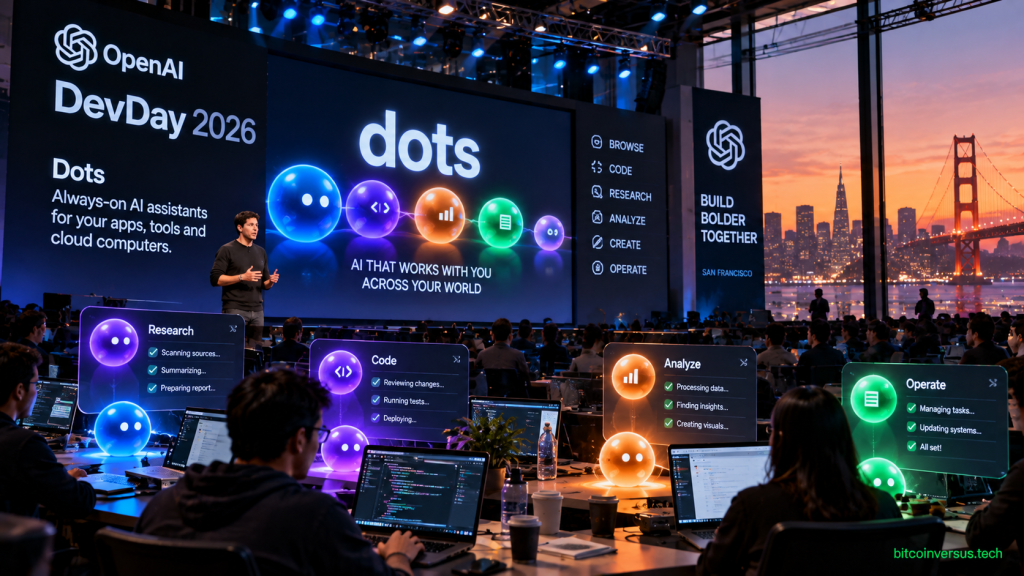
OpenAI used DevDay 2026 to launch dots, a new class of always-on AI agents designed to keep working across apps, projects and cloud computers instead of waiting for a user to start each task manually.
During the company’s annual developer event in San Francisco, OpenAI presented dots as persistent assistants that can pursue goals, carry context across work, and hand specialized jobs to tools such as Codex and ChatGPT Work. A same-day social post from Digital Trends highlighted the shift from chatbots toward agents that can investigate, build and act across thousands of connected applications.
Dots are designed to keep projects moving
Unlike a conventional chat session, a dot is intended to remain available over time. Users can give it a goal, set boundaries for what it may do independently, and let it continue working until it needs review, approval or more information.
Independent reporting from the launch says dots are powered by GPT-6 Astra and can work across services including Slack and Microsoft Teams while using OpenAI tools such as Codex and ChatGPT Work. The system is positioned first toward professional and enterprise users rather than as a mass-market consumer assistant.
That puts dots into direct competition with systems such as Meta’s Muse AI agent and a growing class of assistants built to operate continuously rather than answer one prompt at a time.
OpenAI’s own keynote shows the agent model in action
OpenAI’s official DevDay keynote demonstrates dots alongside more than 20 product announcements. The video is in English and is published by OpenAI’s official YouTube channel.
The agent race is moving from tools to operating environments
Persistent agents change the software model because they need permissions, memory, application access and a place to execute tasks. BitcoinVersus.Tech recently covered Microsoft turning Copilot into an AI operating layer for work, another sign that agent platforms are becoming environments rather than isolated assistants.
The more autonomy these systems receive, the more important control mechanisms become. BitcoinVersus.Tech also recently examined NVIDIA’s hardware-watchdog approach to autonomous-agent safety, which tackles the same broader problem from the infrastructure side.
OpenAI says users can define permission rules and approval boundaries for dots. That design reflects a basic tradeoff in autonomous software: the assistant becomes more useful as it gains access to more systems, but every additional permission also increases the importance of monitoring, review and secure isolation.
Why dots matter
Chatbots made AI conversational. Dots represent the next step toward AI systems that remain present while work continues around them. Instead of treating every request as a fresh interaction, the agent can maintain project context, continue tasks in the background and return when a decision is needed.
That does not make the system fully autonomous. Human approvals, application permissions and operating limits remain central to the product. But the launch shows where major AI platforms are heading: from answering questions toward managing ongoing work.
BitcoinVersus.Tech
Advertisement: See the BitcoinVersus.Tech X post below for the current Bitaxe mining-hardware promotion.
BitcoinVersus.Tech Editor’s Note:
We volunteer daily to ensure the credibility of the information on this platform is Verifiably True. If you would like to support to help further secure the integrity of our research initiatives, please donate here: 3C9o19EH5HSiwEPyCTmEKzxhNCbo2X6TTb
BitcoinVersus.tech is not a financial advisor. This media platform reports on financial subjects purely for informational purposes.


Leave a Reply