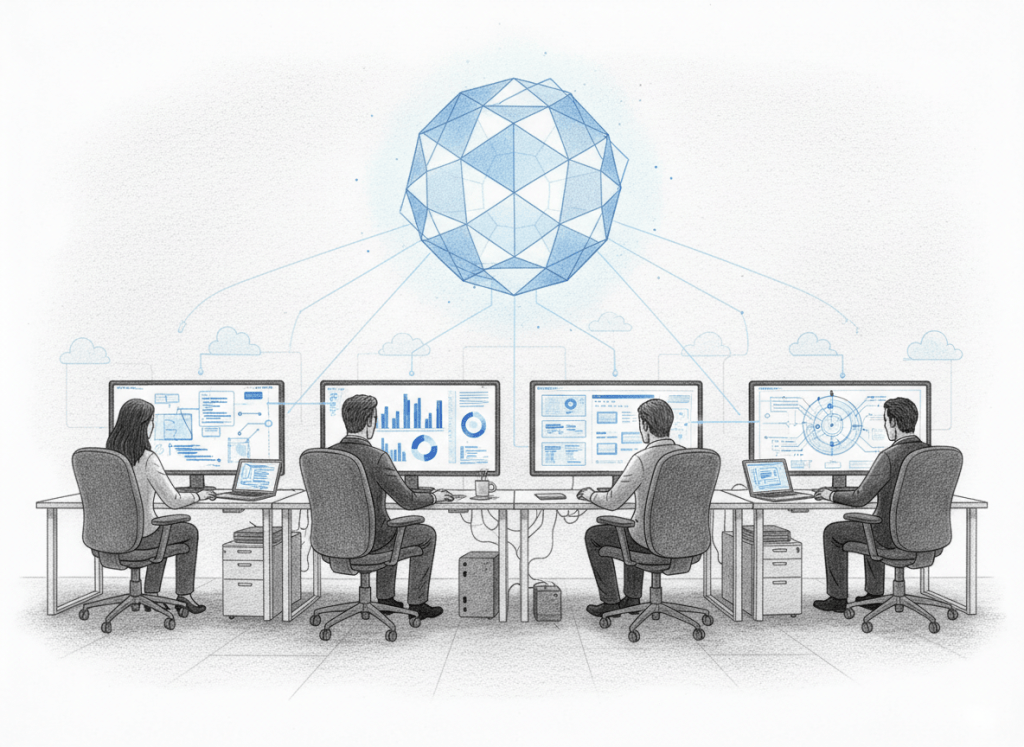
SpaceXAI has pushed Grok Bot from a personal agent toward a shared piece of company infrastructure. Its new Team Bots feature lets a group publish one Grok Bot around a common role, give it the files, tools and operating knowledge that role needs, and let multiple coworkers use that same bot without rebuilding the setup from scratch.
In the official Team Bots launch, SpaceXAI says each shared bot combines four building blocks: context, plugins, credentials and memory. The company is positioning the product less like a chatbot tab and more like a persistent coworker that already knows the team’s workflow before a new request arrives.
Grok Bot announced the launch on X as shared AI teammates that learn as a team works with them. The September 28 Team Bots announcement says teams can equip a bot with skills, plugins and credentials, then work with it through Slack or Grok Bot.
One bot, many coworkers, separate conversations
The most important architectural change is persistence at the team level. A Team Bot can be built around sales, product management, marketing, engineering or analytics, then published so coworkers start from the same role definition and shared resources rather than creating isolated personal agents.
SpaceXAI says individual conversations with a Team Bot remain private, while the shared bot can still draw on the files, instructions, skills and approved integrations configured for its role. That creates a useful separation: one organizational agent can know how a team works without requiring every conversation to become a public group chat.
This is the workplace version of a broader move toward agents that persist across sessions. BitcoinVersus.Tech recently covered OpenAI’s Dots as always-on agents that work across apps. Team Bots takes a different route by making the persistent context explicitly shareable across a work group.
The integrations are what make the bot operational
Team Bots are not useful only because they remember instructions. The launch material describes plugins for systems such as Salesforce, Notion and GitHub, plus credentials for APIs that do not have a packaged plugin. A Team Bot can also receive its own Slack handle so coworkers can call it into a channel and work with it where the team is already communicating.
That makes agent orchestration the real product surface. BitcoinVersus.Tech’s recent map of the agentic AI production stack focused on the same underlying problem: models become much more useful when memory, tools, permissions, observability and task routing are treated as first-class infrastructure instead of afterthoughts.
SpaceXAI is using the same pattern internally
SpaceXAI says its own Team Bots are already embedded in sales, engineering, marketing and analytics workflows. Its engineering example connects a Team Bot to Notion, Linear, Hex, Datadog and Cursor, where the bot follows product decisions, triages bugs, creates tickets and launches cloud agents for well-defined fixes.
The company says a five-person team used that setup while building Team Bots and shipped more than 100 pull requests per day. Its Data Bot example is similarly ambitious: SpaceXAI says the bot can query approved Databricks tables with read-only credentials and use a skill library built over two years for navigating more than 45,000 tables.
AI Insiders’ independent coverage highlights the same core shift: the product is trying to turn company context into a reusable team asset instead of making each employee repeatedly explain the same account, project or process to a fresh AI session.
A Grok Bot walkthrough shows the base layer underneath Team Bots
The shared-team feature sits on top of the broader Grok Bot architecture: persistent cloud computers, app connections, plugins and agents that can continue work outside a single chat. The walkthrough below shows that underlying system in practice, including Grok Bot’s tool connections, sub-agents and multi-step automation.
Shared agents also magnify bad permissions
The upside of a shared agent is that useful context compounds. The downside is that mistakes can compound too. A stale instruction, overly broad credential or incorrect workflow that affects one personal agent becomes more consequential when a whole group relies on the same bot.
That is why permissions, logging and independent safety controls matter more as agents become operational infrastructure. BitcoinVersus.Tech recently examined NVIDIA’s push to put an external circuit breaker around autonomous AI agents. Team Bots approaches the same future from the productivity side: more persistent context, more tool access and more delegated work all increase the value of strong boundaries.
The larger shift is straightforward. Enterprise AI is moving from “everyone gets a chatbot” toward “the team gets an agent that already knows the job.” If that model works, the durable asset may not be the model alone. It may be the accumulated skills, integrations, permissions and operating knowledge wrapped around it.
BitcoinVersus.Tech
Advertisement
Editor’s Note
This report distinguishes SpaceXAI’s product claims from independently observed capabilities. The featured cover is an original editorial illustration and is not duplicated in the article body.
We volunteer daily to ensure the credibility of the information on this platform is Verifiably True. If you would like to support our research initiatives, please donate here: 3C9o19EH5HSiwEPyCTmEKzxhNCbo2X6TTb
BitcoinVersus.tech is not a financial advisor. This media platform reports on financial subjects purely for informational purposes.


Leave a Reply