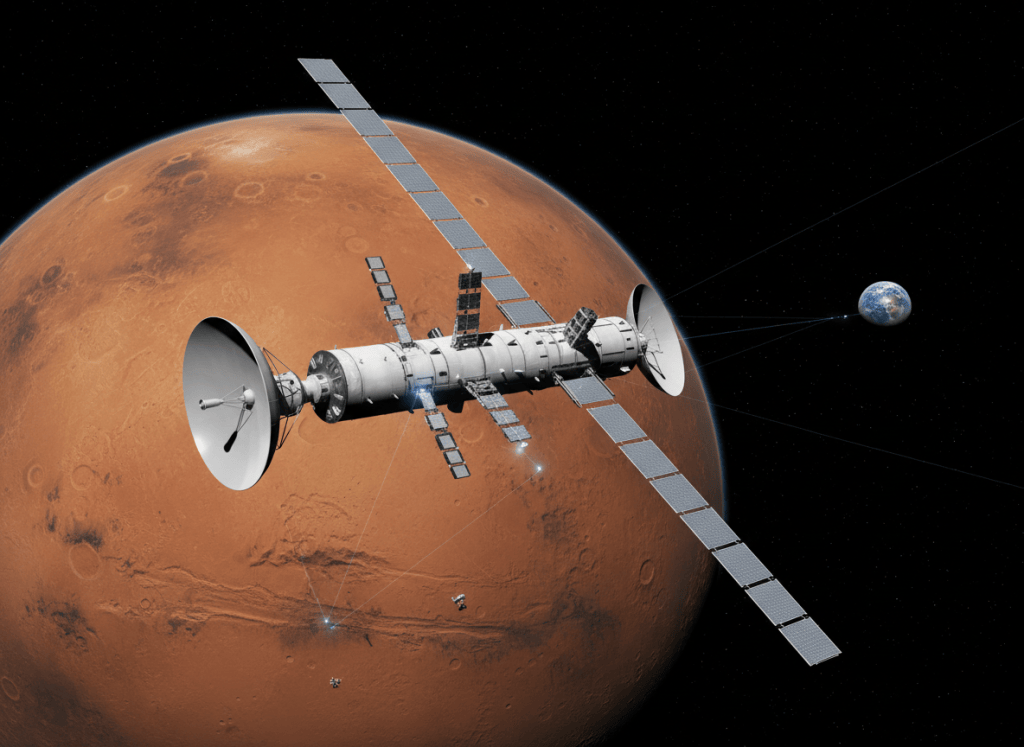
NASA has selected Blue Origin to build a new communications and navigation network around Mars, giving future spacecraft and surface missions a dedicated relay instead of depending as heavily on direct links back to Earth.
According to NASA’s September 1 award announcement, Blue Origin will design, develop, integrate, launch, and operate the Mars Telecommunications Network. The company is required to deliver a high-performance telecommunications orbiter to NASA no later than December 31, 2028.
Mars needs a network, not just another spacecraft
As Mars missions generate more imagery, science data, navigation traffic, and operational commands, communications becomes infrastructure. A dedicated relay can receive data from spacecraft or assets on the surface, then move that information across the much longer Mars-to-Earth link.
That matters if human exploration eventually follows robotic missions. BitcoinVersus recently compared Elon Musk’s and Jim Gates’ competing timelines for putting humans on Mars. Before astronauts can work there safely, high-bandwidth communications and dependable navigation will have to become routine rather than exceptional.
Blue Origin described the assignment in a directly relevant X post, saying its Mars Telecommunications Orbiter will be built on the company’s Blue Ring platform and will also carry multiple payloads to Mars orbit.
The orbiter is designed to relay data and navigation
NASA says the network is intended to support reliable, high-bandwidth communications and navigation services for current and future Mars missions. That means the spacecraft is not simply a science probe. Its job is to become shared infrastructure for other missions operating around or on Mars.
Space.com’s independent coverage reports that the network is expected to be operating at Mars by 2030. The schedule gives Blue Origin only a few years to move from development through integration, launch, cruise, and deployment around another planet.
Mars communications fits a broader shift in space infrastructure
Space systems are increasingly being designed as networks instead of one-off spacecraft. BitcoinVersus has also covered Google’s move to send AI chips into orbit, where computing happens closer to the data source instead of waiting for every raw dataset to travel back to Earth.
Launch providers are changing at the same time. Astra Space is targeting a 2027 return to orbital launches, one example of the growing number of companies trying to supply transportation for the expanding satellite and deep-space economy.
The hard part begins after launch
A Mars relay has to survive launch, interplanetary cruise, orbital insertion, radiation, thermal cycling, and long communication delays while remaining dependable enough for other missions to treat it as infrastructure. It also has to maintain useful links with moving spacecraft, surface systems, and Earth over distances that change dramatically throughout the Mars orbit cycle.
If Blue Origin delivers that capability on schedule, NASA will gain something more important than another vehicle at Mars. It will gain a communications layer that future missions can build on, which is exactly the kind of infrastructure required before exploration can scale from isolated missions into a sustained presence.
BitcoinVersus.Tech
Advertisement
Editor’s Note
We volunteer daily to ensure the credibility of the information on this platform is Verifiably True.
If you would like to support to help further secure the integrity of our research initiatives, please donate here: 3C9o19EH5HSiwEPyCTmEKzxhNCbo2X6TTb
BitcoinVersus.tech is not a financial advisor. This media platform reports on financial subjects purely for informational purposes.


Leave a Reply