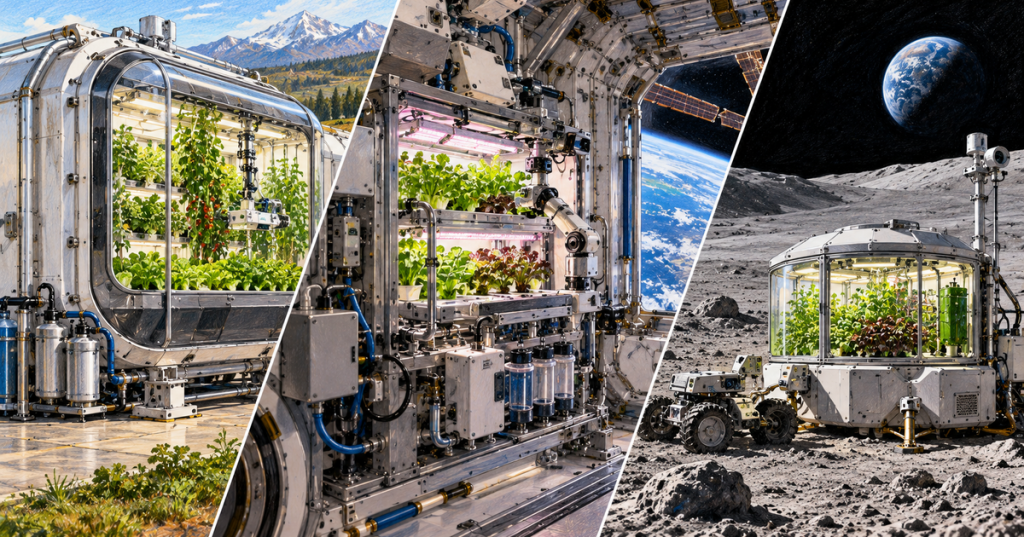
In January 2024, BitcoinVersus.Tech reported on Interstellar Lab’s BioPods, modular controlled-environment plant systems designed to recreate climates while recycling resources and reducing the amount of human labor needed to grow plants. At the time, the most eye-catching part of the plan was Mars. Nearly three years later, the stronger story is what happened in between: the technology has split into a family of Earth, orbital and lunar systems, won a NASA food-system competition, and picked up concrete flight partners.
The original Reuters post showed the terrestrial BioPod concept. The important follow-up is that Interstellar Lab has moved beyond presenting a single greenhouse shell. Its space work now includes NuCLEUS, Eden and Bloom, each aimed at a different step in the path from Earth-based cultivation to long-duration human missions.
NASA turned the idea into a real benchmark
In 2024, Interstellar Lab won the $750,000 U.S. grand prize in NASA’s Deep Space Food Challenge with NuCLEUS, its Nutritional Closed-Loop Eco-Unit System. NASA later described NuCLEUS as an autonomous system that can grow microgreens, vegetables and mushrooms while also sustaining insects as part of a broader astronaut food supply. The system is designed around low human intervention, controlled irrigation and multiple food outputs rather than a single crop. NASA’s follow-up on the challenge says that work directly shaped Interstellar Lab’s next orbital platform, Eden 1.0.
The next stop is orbit
Eden is the smaller research-focused descendant of that work. Interstellar Lab says Eden is scheduled to fly with Vast in low Earth orbit in 2027, where the automated plant-growth chamber is intended to study how plants respond to microgravity. That matters because a future Mars greenhouse cannot simply be a terrestrial farm sealed inside a pressure vessel. Engineers need real data on growth, water behavior, nutrient delivery, lighting, disease control and automation when gravity and crew time are constrained.
Then comes the Moon
The company’s lunar system is called Bloom. Interstellar Lab says it is working with Astrolab to place the automated greenhouse on the lunar surface, with a mission target in 2028. Its broader Mission Little Prince program plans to grow a rose in orbit, on the Moon and eventually on Mars. In other words, the company is using a symbolic plant experiment to validate increasingly demanding pieces of autonomous space horticulture.
That progression also fits the infrastructure problem we discussed in Sports on Mars Will Come Much Later: before an off-world settlement has large-scale leisure, it needs reliable food, water, power, communications and life-support systems. Plant-growth hardware is part of that survival stack, not just an agricultural side project.
The business is becoming more concrete too
Interstellar Lab’s September 2026 update says it works on Earth with L’Oréal, Robertet and dsm-firmenich on high-value plant production. The company also says it closed a $15 million Series Seed round in June 2026, bringing total capital raised to $17 million. A new partnership with space-procurement company Nebex identified $37 million in near-term opportunities and more than $400 million over five years for plant cultivation and regenerative life-support systems. Those figures are opportunity estimates, not booked backlog or guaranteed revenue, which the companies explicitly acknowledge. Interstellar Lab’s September release provides the current commercial and mission roadmap.
What changed from our 2024 report
The 2024 story treated the BioPod mainly as one modular greenhouse concept with a future Mars version. The 2026 picture is more mature. BioPod is now the broader technology base. NuCLEUS is the closed-loop food-production system. Eden is the orbital research unit. Bloom is the lunar greenhouse. Mars remains the long-term destination rather than the nearest deployment.
Our 2024 report also cited a $350,000 target price for a MarsPod. We are not carrying that number forward as current pricing because the company’s 2026 disclosures used for this update do not provide a current MarsPod sales price. The more verifiable milestones today are the NASA win, the Vast orbital mission, the Astrolab lunar mission and commercial deployments on Earth.
The technology still has a long way to go before it becomes a self-sustaining farm on Mars. But compared with where the story stood in early 2024, Interstellar Lab has moved from an ambitious greenhouse concept toward a staged development path with Earth customers, NASA validation and flight hardware planned for orbit and the Moon. That is a much stronger basis for judging whether autonomous plant pods can eventually become part of a real Mars settlement.
For the broader transportation and infrastructure side of that problem, see our report on NASA’s planned Mars communications network.
BitcoinVersus.Tech Editor’s Note:
We volunteer daily to ensure the credibility of the information on this platform is Verifiably True. If you would like to support to help further secure the integrity of our research initiatives, please donate using the QR code provided

For best QR-code scanning results, please scan this donation code from a desktop or larger screen. Mobile screens may prevent camera recognition.


Leave a Reply