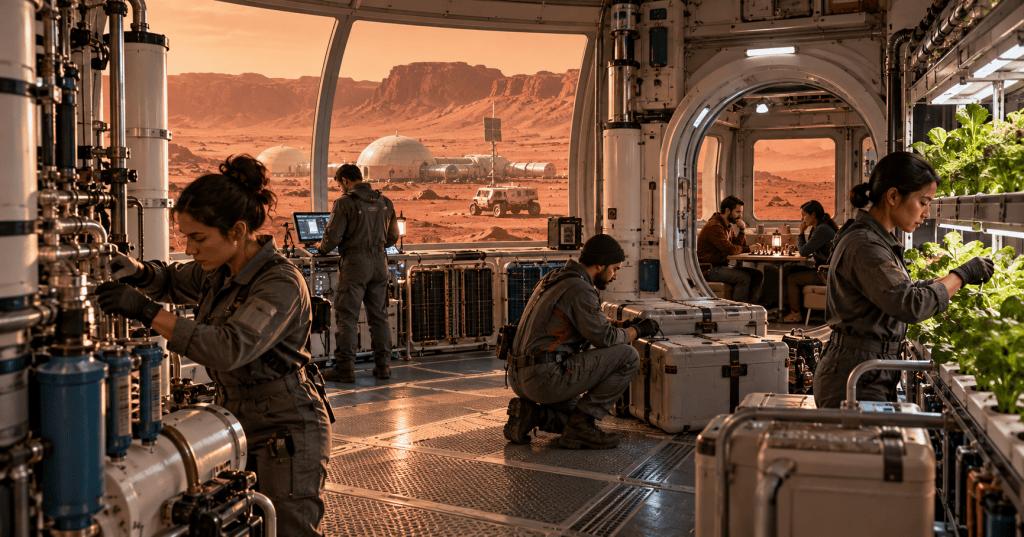
Opinion: I do not think the first generations of humans living on another planet will carry Earth’s sports culture with them in any recognizable form. For roughly the first 40 to 100 years of a real settlement, survival will matter more than stadiums, leagues, courts or fields.
The early priorities will be brutally practical: oxygen, water, food, shelter, power, radiation protection, medical care, communications, maintenance and replacement parts. BitcoinVersus.Tech has already looked at how long a human Mars timeline could really take, how controlled agriculture might work on Mars, and the communications infrastructure future Mars missions will need. Those systems come before recreation infrastructure.
Exercise would still be mandatory
That does not mean people would stop moving. It means physical activity would first be treated as health maintenance rather than entertainment. NASA says astronauts aboard the International Space Station average about two hours of exercise per day because microgravity weakens bone and muscle. NASA’s astronaut-exercise research shows how seriously space crews already treat physical conditioning.
NASA Johnson demonstrates the kind of exercise equipment astronauts use as a health countermeasure rather than as organized sport.
Mars changes the rules before a game even starts
Mars has only about 38% of Earth’s surface gravity, and its atmosphere is thin, cold and dominated by carbon dioxide. NASA’s Mars facts make the basic problem obvious: an outdoor football game, baseball game or basketball court is not just a matter of bringing a ball. Players would need pressure protection, temperature control, dependable medical response and a safe playing surface inside a controlled environment.
NASA’s radiation-sensor update is a useful reminder that even routine human activity beyond Earth is wrapped in engineering and health constraints. A sprained ankle on Earth is an inconvenience. A serious injury on an early settlement could consume scarce medical capacity, labor and equipment.
The first leisure will probably be small
The more believable first-generation leisure looks compact: cards, chess, tabletop games, books, music, movies, puzzles, video games and virtual-reality experiences. Those activities require little space, create limited injury risk and can happen inside a pressurized habitat without consuming land, structural material or large amounts of power.
There may still be small physical games indoors. Settlers could invent low-gravity versions of handball, climbing, resistance competitions or other activities that fit inside a protected habitat. But that is different from importing the NFL, NBA, MLB or international soccer exactly as they exist on Earth.
Sports arrive when a settlement becomes a society
Sports probably become realistic after a settlement has redundancy: multiple habitats, dependable food production, mature medicine, spare labor, excess power, large pressurized spaces and enough population to support activities that are not directly tied to keeping everyone alive. That could take decades. My estimate of 40 to 100 years is not a scientific forecast; it is a way of expressing how far down the priority list organized sports may sit.
And once sports finally arrive, they may not look like ours. Lower gravity could change jumping, throwing, running, collision forces and field dimensions. The first truly Martian sport may be something humans on Earth have never played.
The first settlers will bring culture with them, but survival will decide which parts of culture fit inside the first habitats. Chess can fit on a table. A football stadium cannot.
BitcoinVersus.Tech Editor’s Note:
We volunteer daily to ensure the credibility of the information on this platform is Verifiably True. If you would like to support to help further secure the integrity of our research initiatives, please donate using the QR code provided

For best QR-code scanning results, please scan this donation code from a desktop or larger screen. Mobile screens may prevent camera recognition.


Leave a Reply