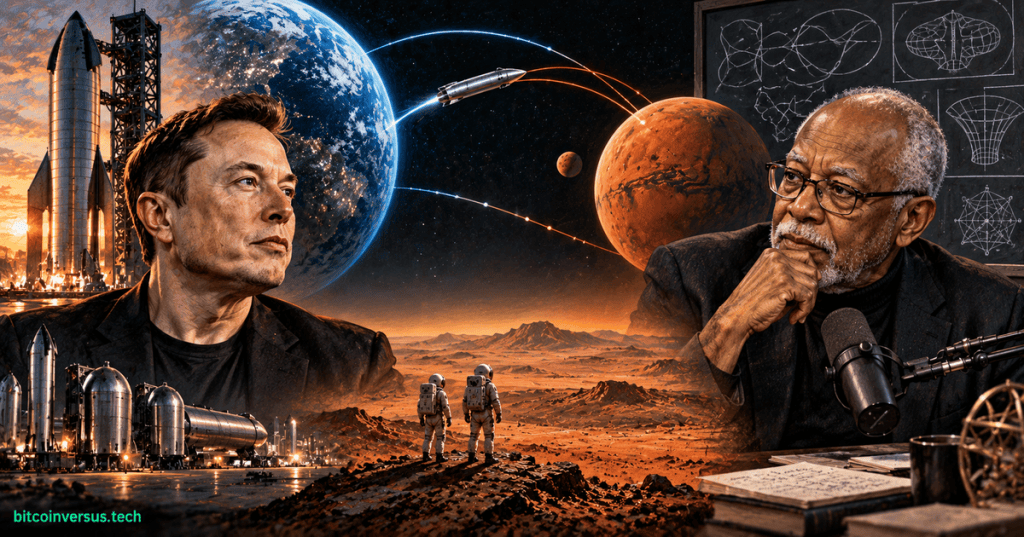
For nearly a decade, two radically different Mars forecasts have been sitting on opposite sides of the same question.
Elon Musk repeatedly argued that humans could reach Mars surprisingly soon. Theoretical physicist S. James Gates Jr. argued that the engineering, money and biology were so difficult that the first human might not arrive until near the end of this century.
As of October 2026, neither extreme looks quite right. Musk’s earliest dates have already failed. Gates’ warning that humans would not reach Mars by 2030 increasingly fits the actual development schedule. But his 2090–2120 estimate now looks much more pessimistic than the hardware trajectory requires.
Musk’s Mars clock started extremely fast
In 2017, Musk presented a SpaceX architecture that called for uncrewed cargo missions in 2022 and crewed Mars missions in 2024. Neither happened.
On the Lex Fridman Podcast in December 2021, Musk gave a broader range: roughly five years in the best case and ten years in the worst case. That translated to approximately 2026–2031.
Then in September 2024, Musk tightened the schedule again. In his Mars timeline post on X, he said the first uncrewed Starships would leave for Mars in 2026 and that, if those landings worked, crewed flights would follow in 2028.
The 2026 Mars mission did not happen. SpaceX’s public roadmap has since moved the first cargo flights to Mars to no earlier than 2028.
Jim Gates went almost completely the other direction
Gates made his forecast much earlier, during a December 2019 conversation with Lex Fridman. The Mars section begins around 5:16 in Lex Fridman Podcast #60 with S. James Gates Jr.
Gates said he was extraordinarily convinced that humans would not reach Mars by 2030. He then went much further, suggesting approximately 2090, 2100 or even 2120 as possible dates for the first human arrival.
His reasoning centered on two constraints: cost and biology. Gates argued that Mars was being discussed as though it were mainly a rocket problem, while radiation exposure, long-duration human survival and the scale of spending required could prove equally difficult.
On the calendar, Gates is currently closer
The simplest comparison is unforgiving. Musk’s 2024 human-landing target is already gone. His 2026 best-case estimate from the 2021 Lex conversation is also gone. His 2028 crew target is now extremely difficult to reconcile with SpaceX’s own current roadmap because the company does not plan its first cargo Mars flights before 2028.
Gates’ narrower prediction—no humans on Mars by 2030—therefore looks much stronger today than it did in 2019.
But that does not automatically make the 2090–2120 prediction strong. There is a huge difference between saying “not by 2030” and saying “not for another 60 to 90 years.” Nothing demonstrated so far proves humanity needs the rest of the century to solve Mars transportation.
The cost curve has moved faster than the schedule
Using an October 3 Bitcoin reference of approximately ₿1 ($84,672), SpaceX’s current Mars economics are already radically different from older government-only concepts.
SpaceX’s current Mars page advertises cargo flights to the Martian surface starting no earlier than 2028 at approximately ₿1,181 ($100 million) per metric ton.
That is still enormous. A hypothetical 100 metric tons delivered at the posted rate corresponds to roughly ₿118,103 ($10 billion) of transportation value before adding crew systems, habitats, power, food, surface vehicles, redundancy and return infrastructure.
Musk’s own 2024 cost argument was even more revealing. He estimated the existing effective cost of useful payload delivered to Mars at roughly ₿11,810 ($1 billion) per metric ton and argued that a self-sustaining city ultimately requires something near ₿1.18 ($100,000) per ton.
So Musk’s calendar has been too aggressive, but his underlying economic argument has aged better: getting to Mars is increasingly a cost-per-ton and launch-frequency problem rather than simply a question of inventing one giant rocket.
Starship has finally crossed a major threshold — but Mars needs much more
Starship Flight 14 reached orbit on September 28, 2026 and deployed 26 Starlink V3 satellites. That is a major step beyond the earlier test campaign.
But humans standing on Mars require several additional capabilities that have not yet been demonstrated together: rapid Starship reuse, repeated tanker launches, large-scale cryogenic propellant transfer in orbit, long-duration deep-space operations, high-mass Mars atmospheric entry, precision landing, surface power, reliable multi-year life support, radiation protection and a credible return architecture.
NASA’s Office of Inspector General reported in March 2026 that SpaceX’s lunar Starship development had already slipped at least two years from its original contract schedule and identified vehicle-to-vehicle cryogenic propellant transfer as one of the most significant remaining technical challenges. A crewed Mars mission needs that capability at an even larger operational scale.
What the next Mars windows tell us
Earth and Mars reach favorable transfer geometry roughly every 26 months. That creates natural checkpoints rather than a smooth yearly schedule.
If SpaceX launches cargo in the 2028–2029 window and demonstrates that a full-scale Starship can survive Mars entry, descend and land intact, the following window around 2031 becomes the earliest remotely credible opportunity for people.
That would still require nearly everything else to go right. A more defensible band is approximately 2033–2035, with the late 2030s remaining plausible if orbital refueling, lunar Starship development, Mars landing tests or surface systems take longer than expected.
Musk may be early. Gates may be late.
The historical record now allows a more precise judgment.
Musk consistently underestimated how long the development sequence would take. His 2022 cargo, 2024 crew, 2026 cargo and 2028 crew milestones have either failed or moved beyond the current official roadmap.
Gates appears increasingly accurate on the narrower claim that humans would not stand on Mars by 2030. But his end-of-century estimate assumes that the remaining engineering and biological problems require many additional decades. Current Starship development, lunar infrastructure work and Mars cargo planning do not yet justify that level of pessimism.
The evidence in 2026 therefore points toward a middle ground: not Musk’s original mid-2020s future, but probably not Gates’ 2100 future either.
Mars is no longer theoretical
BitcoinVersus.Tech’s latest Perseverance exploration update shows how much planetary reconnaissance is already happening on the ground before humans arrive.
We have also examined advanced propulsion concepts intended to shorten Mars travel, one possible route to reducing radiation exposure and transit time.
And our earlier report on Musk’s two-year Mars mission forecast now provides a useful timestamp for seeing how quickly ambitious schedules collide with real aerospace development.
The remaining question is no longer whether humanity can build machines that reach Mars. We already do that. The question is when transportation, cost, refueling, life support and surface infrastructure all become reliable enough to put a human boot on the planet and bring that person home.
BitcoinVersus.Tech
Advertisement
Editor’s Note
We volunteer daily to ensure the credibility of the information on this platform is Verifiably True. If you would like to support to help further secure the integrity of our research initiatives, please donate here: 3C9o19EH5HSiwEPyCTmEKzxhNCbo2X6TTb
BitcoinVersus.tech is not a financial advisor. This media platform reports on financial subjects purely for informational purposes.


Leave a Reply